Simulation Predicts Average Travel Speed May Drop to 16.6 km/h
Traffic Big Data to Guide 20 Measures Across 14 Construction Sections
First Nationwide Introduction of HOV Lanes and Traffic Forecasting System
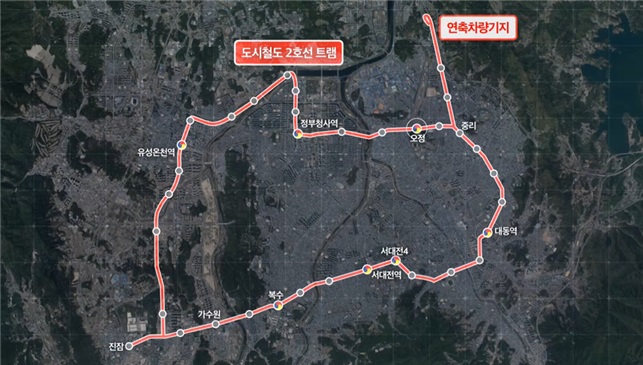
Daejeon City announced that, starting in March, it will implement phased traffic measures to minimize inconvenience to citizens as the construction of Urban Railway Line 2 (Tram) enters full swing.
The first sections where tram construction will begin are ▲from Jungri Intersection toward Sintanjin (Sections 1 and 2), and ▲from in front of Chungnam National University toward Doan-dong (Section 7). The city plans to complete the bidding process and selection of construction companies for the remaining sections within the first half of this year.
The city expects that the construction of Urban Railway Line 2 will reduce the number of lanes by one or two across all road sections, with up to four lanes reduced in some areas. Simulation results indicate that the average travel speed could decrease to as low as 16.6 km/h, making proactive, phased responses essential.
Accordingly, the city will not enforce full traffic control across the 14 construction sections but will implement 20 measures in phases.
First, highways will be used as urban arterial roads, and high-occupancy vehicle (HOV) lanes will be piloted depending on traffic congestion levels. The city will also utilize big data to monitor weekly traffic congestion and respond in phases based on average travel speed.
From late March, when construction fully begins, Phase 1 measures will be applied. If the average speed drops below 20 km/h, Phase 2 will be implemented; if it falls below 15 km/h and congestion becomes severe, Phase 3 will be enacted.
Phase 1 measures include promoting staggered work hours, expanding incentives for participation in the car-free day program, and increasing the frequency of city buses and subways during rush hours.
Additionally, to disperse some of the traffic, 66 detour routes will be intensively managed, and the Daejeoncheon riverside road will be actively utilized. The city will also temporarily suspend 24-hour enforcement of the bus-only lane on the riverside expressway.
To predict and respond quickly to traffic congestion during tram construction, the city will introduce a traffic forecasting system and actively operate the 120 Call Center to handle real-time traffic complaints.
Phase 2 measures will focus on utilizing the outer ring highway network to disperse vehicle flow and will continue weekly monitoring based on big data. If traffic flow worsens to below 20 km/h, the city plans to pilot HOV lanes for the first time in the country.
The section from Jinjam Intersection to Seodaejeon Intersection (Gaebaek-ro), where the likelihood of speeds dropping below 20 km/h is high, will be selected for the HOV lane pilot to make efficient use of limited road capacity. The city will consider expanding the system after analyzing its effectiveness.
The city also plans to provide an additional 20% toll discount for the Seo-Daejeon IC to Anyoung, Namdaejeon, and Panam IC sections, in addition to the 20% discount already provided by Korea Expressway Corporation during rush hours.
If traffic speed drops below 15 km/h and congestion becomes extremely severe, Phase 3 measures will be activated, introducing even stronger traffic policies.
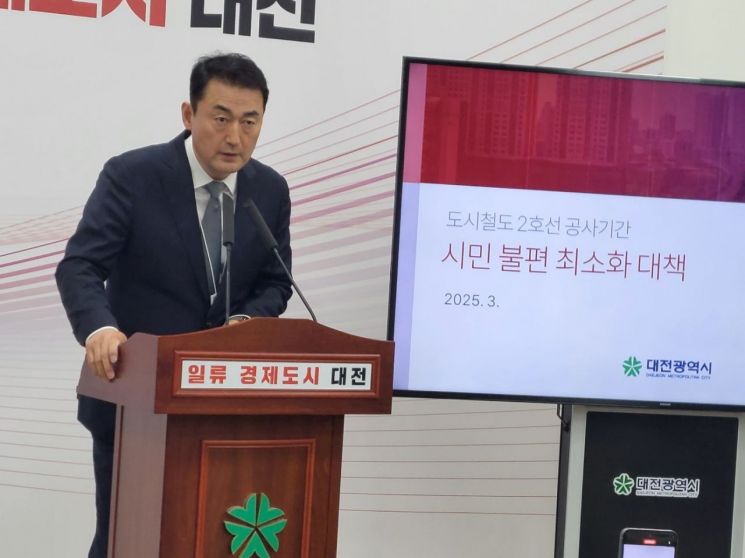 Nam Sideok, Director of the Transportation Bureau of Daejeon City, is briefing on measures to minimize citizen inconvenience related to tram construction on the 10th. / Daejeon Photo by Park Jongmyung
The city will expand the sections eligible for highway toll support to eight toll booths within the city and provide additional subsidies to the current K-Pass. Furthermore, public institutions will implement alternate-day driving restrictions for private vehicles, parking lots will be converted to paid parking with increased fees, and universities and private companies will be encouraged to participate to reduce private vehicle use.
To ensure the effectiveness of these traffic measures, the city will also actively utilize advanced traffic information systems. Like weather forecasts, the city will provide timely and accurate information about lane changes, construction sections, and detour routes in advance through broadcasts, SNS, and electronic displays by fully utilizing the "traffic situation forecasting system."
Additionally, the city plans to provide real-time updates on tram construction progress and optimal routes through navigation applications and continuously monitor construction sections to optimize traffic signal systems.
Nam Sideok, Director of Daejeon City’s Transportation Bureau, said, “The moment has finally arrived for Urban Railway Line 2, which Daejeon citizens have long awaited, to become a reality. We will focus all administrative resources to minimize inconvenience and maintain smooth traffic flow.”
© The Asia Business Daily(www.asiae.co.kr). All rights reserved.
![Clutching a Stolen Dior Bag, Saying "I Hate Being Poor but Real"... The Grotesque Con of a "Human Knockoff" [Slate]](https://cwcontent.asiae.co.kr/asiaresize/183/2026021902243444107_1771435474.jpg)
















