Shim: "Instructed the investigation team to contest the detention period calculation method in the main trial"
Prosecution decides to abandon all appeals, including 'immediate appeal,' after 27 hours... "Considering risk of unconstitutionality"
Directly contradicts prosecution's stance maintained for 10 years regarding 'detention cancellation'... Potential for controversy
Avoids direct answer on HOCI responsibility... On impeachment push: "Not grounds for impeachment"
The prosecution, which accepted the court's decision to cancel the detention of President Yoon Seok-yeol, has decided not to file an immediate appeal or a regular appeal to have the court's judgment reviewed again after his release, escalating the controversy. This came after Prosecutor General Shim Woo-jung instructed the Emergency Martial Law Special Investigation Headquarters, led by Seoul High Prosecutor Park Se-hyun, to "actively present opinions to the main trial court and respond accordingly." The prosecution's special investigation team, which had shown differences with the Supreme Prosecutors' Office, failed to enforce the 'immediate appeal' stance and instead began preparing to maintain the indictment by responding to procedural and substantive issues that President Yoon's side is expected to continuously raise.
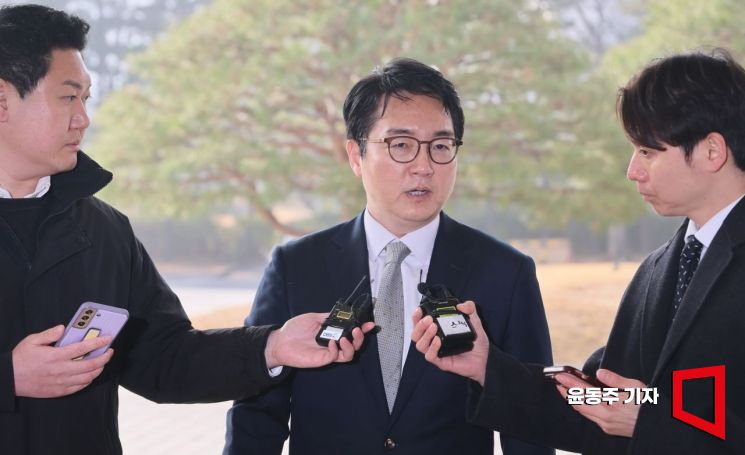 Prosecutor General Shim Woo-jung is responding to reporters' questions on the morning of the 10th at the Supreme Prosecutors' Office in Seocho-gu, Seoul. 2025.03.10 Photo by Yoon Dong-joo
On the morning of the 10th, as Shim Woo-jung arrived at the Supreme Prosecutors' Office building in Seocho-gu, Seoul, he told reporters, "After synthesizing various opinions from the investigation team and the Supreme Prosecutors' Office chiefs' meeting, I made a conscientious decision based on the principle of due process." He added, "However, the method of calculating the detention period is a long-established practical practice between the courts and the prosecution. Since it does not align with existing practical practices, I find it difficult to agree, and I have instructed the investigation team to contest this part in the main trial."
The prosecution deliberated for about 27 hours between filing an 'immediate appeal' and issuing a 'release order.' Intense debates occurred within the prosecution over these two options. Immediately after the Seoul Central District Court's (Presiding Judge Ji Gui-yeon) decision at 1:50 p.m. on the 7th, Prosecutor General Shim held a meeting with Deputy Prosecutor General Lee Jin-dong and six chiefs of the Supreme Prosecutors' Office. They concluded that "considering past Constitutional Court decisions, accepting the court's ruling would be advantageous for maintaining the indictment going forward." However, the prosecution's special investigation team maintained that it was difficult to accept the court's decision to calculate the detention period in 'hours,' and the disagreement persisted until early morning on the 8th.
Ultimately, Prosecutor General Shim intervened, re-discussed the matter on the morning of the 8th, and decided to directly issue a release order. Until the last moment, the special investigation team opposed this, arguing that if President Yoon, accused of 'leading a rebellion,' were released, other defendants imprisoned as important operatives might be unsettled, and their testimonies could be shaken. However, Shim did not accept this and made the final decision to issue the 'release order.' Although there were disagreements, Shim took full responsibility.
Prosecution abandons immediate appeal, considering unconstitutionality
The background for the prosecution's decision to forgo all procedures to ask the court for reconsideration lies in past Constitutional Court rulings. In 1993, the Constitutional Court ruled unconstitutional the prosecution's immediate appeal provision against the court's bail approval decision. Later, in 2012, it also ruled unconstitutional the prosecution's immediate appeal to maintain the detention status of suspects or defendants against the court's decision to suspend detention execution.
The Supreme Prosecutors' Office leadership judged that although the cancellation of detention applied to President Yoon this time is subject to immediate appeal, considering the Constitutional Court's past rulings, filing an immediate appeal carries a risk of unconstitutionality. They viewed it as a procedure likely to be deemed unconstitutional at any time, although no case has yet questioned its constitutionality before the Constitutional Court. When finalizing the 'release order,' the Supreme Prosecutors' Office explained to the press, "Considering comprehensively the Constitutional Court's rulings and the warrant principle established in the Constitution, we decided not to file an immediate appeal."
This decision by the Supreme Prosecutors' Office directly contradicts the prosecution's stance maintained for the past decade. In 2015, when the National Assembly sought to amend the Criminal Procedure Act to remove the prosecution's immediate appeal right upon detention cancellation, then Deputy Minister of Justice Kim Joo-hyun (currently Senior Secretary for Civil Affairs at the Presidential Office) clearly opposed it, stating, "The Constitutional Court's decision cannot be directly applied to 'detention cancellation.'" The reason was that, unlike suspension of detention execution, the grounds are not temporary, and conditions ensuring the defendant's appearance cannot be imposed.
Meanwhile, regarding the responsibility of the High-ranking Officials' Crime Investigation Office (HOCI), Prosecutor General Shim avoided a direct answer but strongly warned about the five opposition parties' threat to consider all countermeasures, including impeachment, stating, "I do not think there are grounds for impeachment. Since impeachment is the National Assembly's authority, if it proceeds, I will comply with the procedure."
© The Asia Business Daily(www.asiae.co.kr). All rights reserved.
![Clutching a Stolen Dior Bag, Saying "I Hate Being Poor but Real"... The Grotesque Con of a "Human Knockoff" [Slate]](https://cwcontent.asiae.co.kr/asiaresize/183/2026021902243444107_1771435474.jpg)

















