Liberal Party Leadership Race: 85.9% Support Rate
Prime Minister Acceptance Speech: "Are You Ready to Fight Together?"
Signals Continued Anti-Trump Stance
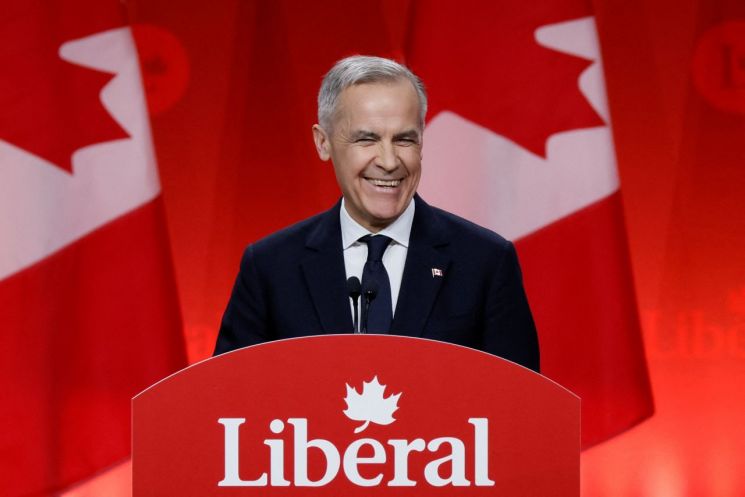 Mark Carney, former Governor of the Bank of Canada and a traditional economist (59 years old), took the podium on the 9th (local time) after winning the leadership race of the Liberal Party, the ruling party of Canada. Photo by Reuters and Yonhap News
Mark Carney, former Governor of the Bank of Canada and a traditional economist (age 59), was appointed as the next Prime Minister on the 9th (local time) after winning the leadership race of the ruling Liberal Party in Canada. He overcame the limitation of being a 'political newcomer' with no political experience and made a strong impression on voters as the right person to respond to the trade policies of the second Trump administration.
Newly appointed Prime Minister Carney took first place, surpassing prominent candidates such as former Deputy Prime Minister and Finance Minister Chrystia Freeland. In this leadership race, which involved about 150,000 Liberal Party members, he won with an overwhelming support rate of 85.9%.
Following the announcement of resignation by current Prime Minister Justin Trudeau in January amid a no-confidence vote by the opposition coalition threatening his position, the Liberal Party began the election to select a new party leader. In Canada, the leader of the majority party becomes the Prime Minister.
Prime Minister Carney is noted for his strong economic expertise and anti-Trump stance. Carney, who previously worked at the American investment bank Goldman Sachs, was appointed Governor of the Bank of Canada in February 2008 and is credited with relatively successfully defending the Canadian economy during the global financial crisis. In 2013, he also served as Governor of the Bank of England (BOE), the first non-British person to hold the position. Although his lack of activity on the central political stage meant he was somewhat less known to the Canadian public, he overcame this weakness.
U.S. news agency Reuters evaluated that Prime Minister Carney "emphasized that he is the right person to revive the Liberal Party and successfully lead trade negotiations with the Trump administration, securing victory." The British Guardian also noted his "strong economic expertise," adding that "Trump's trade pressure and the conservative party leader's check-and-balance sentiment also led to a rise in Liberal Party support."
The immediate challenge is to establish an independent economic strategy for Canada to confront trade negotiations with the United States led by President Donald Trump. Canada has maintained a tough stance, announcing retaliatory tariffs in response to the U.S. imposing a 25% tariff.
In his acceptance speech for the prime ministership, Carney shouted, "Are you ready to fight together for Canada?" and strongly criticized Conservative Party leader Pierre Poilievre as a "politician who kneels to Trump." He also emphasized, "He is attacking Canadian households, workers, and businesses," and "We will not let him succeed."
He continued, "The Canadian government has taken rightful retaliatory measures, and our tariffs are designed to maximize the impact on the U.S. while minimizing the impact on Canada," adding, "My government will maintain our tariffs until the U.S. shows us respect." Regarding the threat by U.S. President Donald Trump, who openly declared merging Canada as the 51st state of the U.S., Carney asserted, "The United States is not Canada," and "Canada will never, under any circumstances, in any form or shape, become part of the United States."
Meanwhile, former Prime Minister Trudeau, who resigned, served as Prime Minister for nine years from November 4, 2015. He faced criticism for failing to respond effectively to trade negotiations before and after the launch of the second Trump administration, leading to a sharp decline in support among voters.
In his farewell speech, former Prime Minister Trudeau referred to President Trump's mockery of Canada as the "51st state of the United States" and emphasized the "elbows up" spirit of ice hockey legend Gordie Howe. The "elbows up" move in ice hockey is used to push away opponents and is interpreted as signaling a strong response from Canada.
© The Asia Business Daily(www.asiae.co.kr). All rights reserved.
![Clutching a Stolen Dior Bag, Saying "I Hate Being Poor but Real"... The Grotesque Con of a "Human Knockoff" [Slate]](https://cwcontent.asiae.co.kr/asiaresize/183/2026021902243444107_1771435474.jpg)















