EU Commission: "It Would Be Detrimental if European Rearmament Funds Go Overseas"
Possibility of Cooperation with Non-Member Countries Left Open
Hints at Easing Regulations for Defense Industry Investments
The European Union (EU) announced on the 9th (local time) that it will actively promote the 'Buy European' strategy, which prioritizes the purchase of European-made products, as it pushes for 'rearmament.'
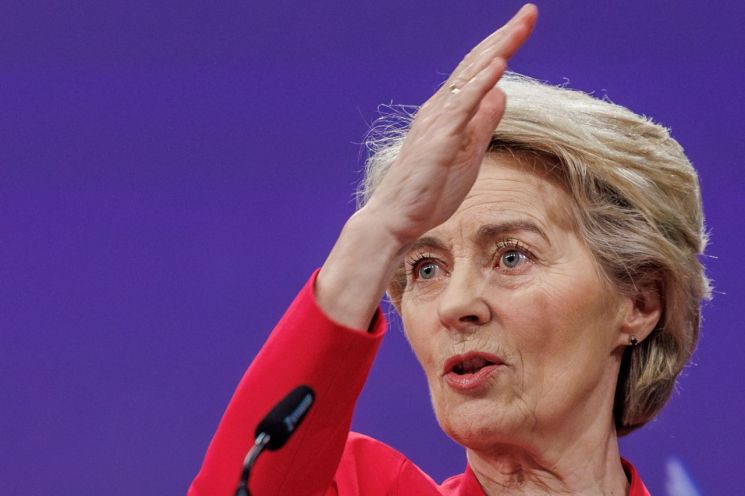
Ursula von der Leyen, President of the European Commission, said at a press conference held in Brussels, Belgium, that the European rearmament plan, which aims to mobilize a total of 800 billion euros (approximately 1,258 trillion won), would be detrimental to Europe if 80% of these funds went overseas.
She stated, "The reason we currently buy 80% of (military equipment) from outside the region is due to urgency and the lack of necessary capabilities within the region," and urged, "Therefore, we need to rethink how to operate Europe's defense industrial base." In particular, regarding the 150 billion euros (approximately 236 trillion won) in joint weapon funding loans directly utilized from the EU budget out of the 800 billion euros, she made clear the policy to limit purchases to European-made products.
When asked whether member states could jointly purchase American-made F-35 fighter jets with this loan, von der Leyen responded firmly, "It is entirely up to each country to decide what is necessary for their military readiness," but added, "The joint weapon procurement loans will be different."
However, she noted, "We need to consider the scope of what constitutes European-made," leaving open the possibility of cooperation with European countries that are not EU members. She added, "It is very important that cooperation with non-EU countries provides research and development and good jobs within the EU."
The Financial Times (FT) pointed out that the question of whether to include non-EU countries in the EU's rearmament policy and Buy European strategy has become a new point of contention between France and Germany. Germany argues that the European rearmament plan should be shared with closely cooperating countries such as the UK, Norway, Switzerland, and Turkey, which are not EU members, while France insists that "expenditures should be limited to European-made products."
The European rearmament plan was prepared after U.S. President Donald Trump threatened that the United States would no longer be responsible for European security. The plan involves suspending fiscal rules to increase defense spending, supporting 150 billion euros in joint weapon procurement loans secured by the EU budget, and thereby raising about 800 billion euros. It received unanimous support from all 27 countries at the EU special summit on the 6th, and specific legislative proposals are expected within two weeks.
The European Commission also decided to ease regulations for defense industry investments. President von der Leyen said, "We plan to announce an additional 'omnibus package' this month to simplify industrial regulations, including those in the defense sector."
© The Asia Business Daily(www.asiae.co.kr). All rights reserved.
![Clutching a Stolen Dior Bag, Saying "I Hate Being Poor but Real"... The Grotesque Con of a "Human Knockoff" [Slate]](https://cwcontent.asiae.co.kr/asiaresize/183/2026021902243444107_1771435474.jpg)















