Last Year, Purchases of HBM from Samsung and Others Before U.S. Export Controls
AI Gap Between U.S. and China Could Close in Less Than 1-2 Years
China's largest telecommunications equipment company Huawei has circumvented U.S. sanctions through a paper company and secured more than 2 million AI semiconductors from Taiwan's TSMC, according to the U.S. think tank Center for Strategic and International Studies (CSIS).
In a report released on the 7th (local time), CSIS cited Taiwanese officials, stating, "TSMC manufactured more than 2 million Ascend 910B logic dies, all of which are now with Huawei," adding, "If true, this is enough to produce 1 million Ascend 910C units (which combine two Ascend 910B dies and high-bandwidth memory)."
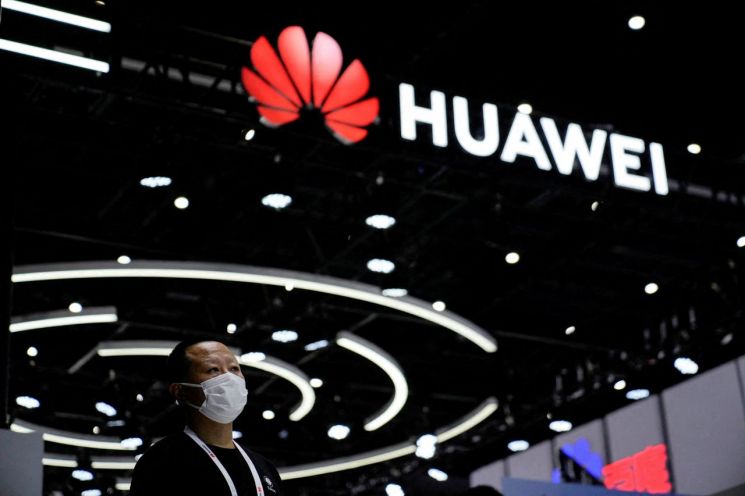
The report pointed out that although the U.S. blocked Huawei's access to TSMC's advanced node manufacturing capabilities in 2020 and appeared to apply the same export controls to all Chinese advanced node AI semiconductor designers in October 2022 and October 2023, "a large number of Huawei Ascend 910B chips manufactured by TSMC were transported to China in violation of U.S. export controls through Huawei's paper company."
The report described the 2 million AI semiconductors secured by Huawei as a "strategically significant stockpile," noting that after Huawei learned of the U.S. plan to control advanced HBM inflows to China in August last year, most purchases were made from Samsung Electronics until the actual measures were implemented in December of the same year. Industry insiders mentioned that potentially, at least one year's worth of HBM was imported through paper companies.
Meanwhile, the report commented on the Chinese AI model DeepSeek, which has recently attracted global attention, stating that DeepSeek's success was due to flaws in the U.S. semiconductor export controls from 2022 to 2023.
The report said, "Although there is no publicly available evidence, industry sources indicated that large-scale smuggling of Nvidia semiconductors occurred before October 2023, and significant smuggling of H100 chips continued until early 2024."
It further noted that DeepSeek's success in extracting U.S. AI models and replicating closed-source algorithm innovations raises questions about the nature of AI competition without strong intellectual property protections, stating, "The worst-case scenario is that AI becomes structurally similar to pharmaceuticals, where original technology development is costly but technology replication by other countries is possible."
The report analyzed, "U.S. companies still lead China in the competition for human-level Artificial General Intelligence (AGI) and superhuman Artificial Superintelligence (ASI), but the gap has significantly narrowed, and it is unrealistic to expect to maintain a lead of more than 1 to 2 years even with extremely aggressive export controls." It added, "China's success is the result of a combination of government investment, semiconductor smuggling, exploiting loopholes in U.S. export controls, domestic transfer of equipment, hiring talent with experience from leading international companies, overseas technology reverse engineering, state-supported economic espionage, and domestic innovation."
It concluded, "Now is the time for the U.S. to win the artificial general intelligence race and solidify a stronger strategic advantage through that victory. There is no room to tolerate careless enforcement of export controls or large-scale semiconductor smuggling." It added, "The effectiveness of export controls depends on the prohibition, implementation, and enforcement of semiconductor smuggling. If the Trump administration reduces government resources and personnel or causes non-cooperation among allies, it will raise serious concerns."
© The Asia Business Daily(www.asiae.co.kr). All rights reserved.
![Clutching a Stolen Dior Bag, Saying "I Hate Being Poor but Real"... The Grotesque Con of a "Human Knockoff" [Slate]](https://cwcontent.asiae.co.kr/asiaresize/183/2026021902243444107_1771435474.jpg)















