Atmosphere of Employers Accepting Union Wage Demands
Japan's Potential Labor Force Population Hits Record Low at End of Last Year
Labor unions under the Japanese Trade Union Confederation (Rengo), Japan's largest labor union, are demanding a wage increase in the 6% range in this year's wage negotiations. This is the highest level in 32 years.
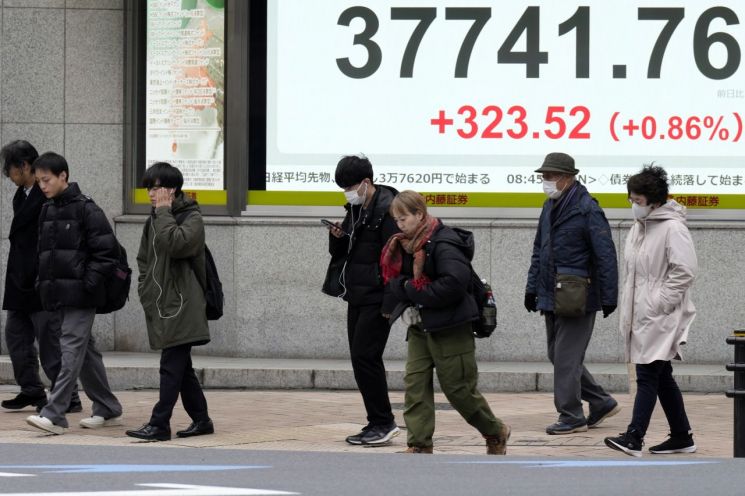 Tokyo citizens are walking in front of an electronic stock board displaying the Japan Nikkei index. Photo by AP Yonhap News
On the 8th, local media including the Yomiuri Shimbun reported that Rengo compiled the wage increase rates demanded by its affiliated unions in this spring's wage negotiations, known as Chuntu (春鬪), and as of the 3rd, the average was 6.09%. This is 0.24 percentage points higher than the previous year, with the average wage increase amount rising by 1,638 yen to 19,244 yen compared to last year. The demand for a wage increase in the 6% range is the first in 32 years since 1993. Last year, the average wage increase rate of Rengo-affiliated unions, mainly composed of large company unions, was 5.10% during Chuntu.
Recently in Japan, there have been a series of decisions by employers to accept the unions' wage increase demands as they are. The main cause is cited as labor shortages. The biggest reason companies want to raise wages was "securing labor," accounting for 75% of responses.
The Nihon Keizai Shimbun (Nikkei) recently reported, citing a survey by Japan's Ministry of Internal Affairs and Communications, that the potential labor force population in Japan recorded 310,000 in the second half of last year. This is the lowest since the ministry began compiling statistics in 2018. The potential labor force population refers to workers who are willing and able to work and be employed. In Korea, this is equivalent to the economically active population. Japan's potential labor force population surged to 520,000 during the COVID-19 pandemic in 2020 but decreased again due to economic recovery and revitalization of the employment market.
According to a survey by Tokyo Shoko Research, among companies that closed last year, 289 cases of bankruptcy were due to "labor shortages," the highest number. Japan's labor shortage is interpreted as stemming from rapid aging, declining birth rates, and labor market avoidance by women and young people.
The Dai-ichi Life Research Institute analyzed, "Companies have no choice but to raise wages to secure labor," and suggested that "the wage increase rate may exceed last year's level."
Since June 12 is the so-called "concentrated response day," when major Japanese companies such as automobile manufacturers respond to unions' wage increase demands, the industry is focusing attention on the actual wage increase rate.
© The Asia Business Daily(www.asiae.co.kr). All rights reserved.
![Clutching a Stolen Dior Bag, Saying "I Hate Being Poor but Real"... The Grotesque Con of a "Human Knockoff" [Slate]](https://cwcontent.asiae.co.kr/asiaresize/183/2026021902243444107_1771435474.jpg)















