170,000 Laid Off... "Largest Since COVID-19 Pandemic"
Low-Income Groups Hit Hard... Sharp Rise in Delinquency Rates Among Low-Credit Borrowers
Last month, the number of people laid off in the United States reached the highest level since the COVID-19 pandemic. Among them, more than one-third were federal government employees who were dismissed.
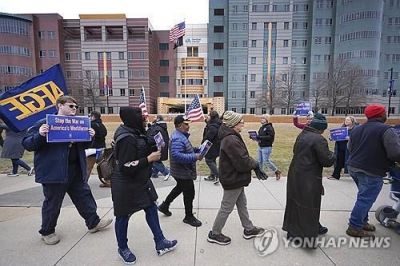 The American Federation of Government Employees is holding protests against federal government layoffs. Yonhap News
The job search firm Challenger, Gray & Christmas (CGC) announced on the 6th (local time) that the number of layoffs in the U.S. last month was 172,017.
This represents a 103% increase compared to the same month last year and is the highest since July 2020. It is a large-scale layoff level similar to the mid-2020 period when mass unemployment occurred due to COVID-19.
In particular, since the inauguration of Donald Trump's second administration, a large number of government employees became unemployed due to the federal government reform efforts led by Elon Musk, CEO of Tesla, through the Department of Government Efficiency (DOGE). Among last month’s layoffs, 62,242, accounting for one-third, were federal government employees who were dismissed.
CGC explained, “The increase in layoffs last month was significantly influenced by the Department of Government Efficiency, government contract cancellations, trade war concerns, and corporate bankruptcies.”
The economic slowdown and weakened consumer sentiment also fueled the wave of layoffs. Retailers such as Macy’s and Forever 21 conducted restructuring, resulting in 38,956 layoffs in the retail sector, about six times higher compared to February last year.
Earlier, the department store chain Macy’s announced in January that it would close 66 stores to improve productivity. It explained that all 66 stores targeted for closure would be shut down within the first quarter.
Additionally, low-income groups were significantly affected, with the delinquency rate on auto loan payments reaching the highest level in 30 years.
On the same day, credit rating agency Fitch reported that in January, the rate of U.S. auto buyers who were more than 60 days overdue on monthly installment payments reached 6.56%. This is the highest figure since the related statistics began in 1994.
Mike Girard, Senior Director at Fitch, forecasted, “This situation is expected to continue throughout this year,” adding, “The effects of high inflation and high interest rates will also persist.” Fitch reported, “Delinquency rates among low-credit borrowers have risen significantly, and delinquency rates among high-credit borrowers have also increased slightly.”
© The Asia Business Daily(www.asiae.co.kr). All rights reserved.
![Clutching a Stolen Dior Bag, Saying "I Hate Being Poor but Real"... The Grotesque Con of a "Human Knockoff" [Slate]](https://cwcontent.asiae.co.kr/asiaresize/183/2026021902243444107_1771435474.jpg)
















