Preferred Work Arrangement: 4-Day Workweek Ranks First
Majority Would Stick to 5 Days If Salary Decreases
"Work-Life Balance Matters... Salary Is Another Issue"
 Young job seekers are looking at the recruitment board at the Youth Employment Fair. Stock photo unrelated to the article. Photo by Kim Hyun-min
More than half of Generation Z job seekers (born in the mid-1990s to early 2000s) prefer a '4-day workweek,' but a survey found that more would choose a 5-day workweek if their annual salary were to decrease.
On the 7th, the recruitment platform JinHakSa Catch released the results of a survey conducted on 1,778 Generation Z job seekers. According to the results, 41% of respondents selected '4-day workweek' as their most preferred work arrangement. Following that, 28% chose 'flexible working hours,' and 11% opted for 'selective working hours.' Those who selected staggered commuting hours and flexible work schedules accounted for 10% and 5%, respectively.
However, when annual salary was determined based on the number of working days, 54% responded that they would choose a '5-day workweek.' Thirty-two percent did not change their choice of a 4-day workweek, and 14% expressed willingness to work 6 days a week. Among those who chose to maintain or extend their working days, 61% cited 'financial stability' as the reason. Among the remaining respondents, 21% selected 'career growth,' 12% 'long-term future plans,' and 5% 'job immersion.'
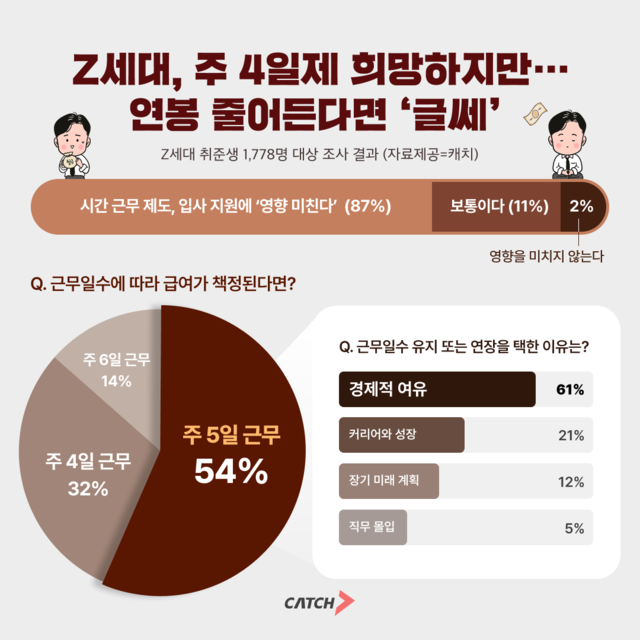 The recruitment platform JinHakSa Catch announced the results of a survey conducted on 1,778 Gen Z job seekers. JinHakSa Catch
The top reason for maintaining the choice of a 4-day workweek was 'work-life balance (WLB),' accounting for 59%. This was followed by 'health maintenance' (16%), 'self-development such as hobbies and exercise' (15%), and 'securing time with family and friends' (9%).
Jung-Hyun Kim, head of the JinHakSa Catch division, said, "Work-life balance is an important factor for Generation Z, but a reduction in salary is another issue. Since Generation Z also values flexibility in working hours, when considering the introduction of working hour welfare, trying practical alternatives such as flexible working hours could be a viable option."
© The Asia Business Daily(www.asiae.co.kr). All rights reserved.
![Clutching a Stolen Dior Bag, Saying "I Hate Being Poor but Real"... The Grotesque Con of a "Human Knockoff" [Slate]](https://cwcontent.asiae.co.kr/asiaresize/183/2026021902243444107_1771435474.jpg)
















