Return to 3,058 Medical School Admissions Next Year Amid Disrupted Education
A Stopgap Measure to Address Doctor Shortage,
But Trust Between Government and Medical Community Remains Broken
The government’s decision to revert the medical school admission quota for the 2026 academic year to the pre-increase level has led to interpretations that it has effectively abandoned the medical school expansion policy pursued over the past year. As medical students and residents who left schools and hospitals have not returned for two years, and the government ultimately surrendered to their 'endurance strategy,' criticism has arisen, along with concerns that future discussions on expansion will not proceed smoothly.
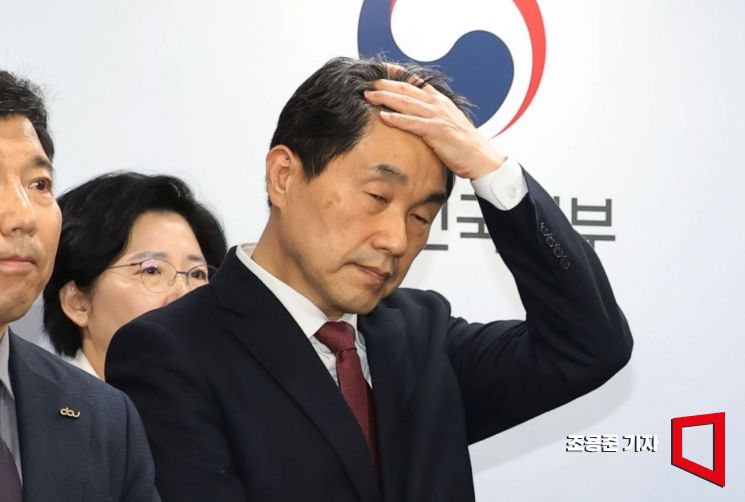 Deputy Prime Minister and Minister of Education Lee Ju-ho is deep in thought while attending a briefing on student return and normalization of medical education at the Government Seoul Office in Jongno-gu, Seoul on March 7, 2025. Photo by Jo Yong-jun
On the 7th, Lee Ju-ho, Deputy Prime Minister and Minister of Education, held a briefing at the Government Seoul Office and announced that the government would accept the proposal to adjust next year’s medical school admission quota to 3,058 students, the number before the increase, following recommendations from medical school presidents and deans. However, he emphasized that this was conditional on all medical students returning by the end of this month, and if the students do not return, the original increased quota of 5,058 students will be maintained.
The government’s decision to roll back the 2,000 additional seats it had increased despite enduring a year-long conflict between the medical community and the government, as well as medical service gaps, is interpreted as stemming from the fact that even after the new year, students show no signs of returning, and the students’ academic losses have reached a critical level.
Since the announcement of the medical school expansion in February last year, only about 2% of residents who left hospitals have returned by the first half of this year. With medical students continuing collective leaves of absence, it is reported that over 96% of the 2024 and 2025 medical school cohorts nationwide expressed their intention to take a leave of absence for the first semester of this year. Most notably, a significant number of the 2025 cohort admitted under the increased quota have not attended classes, raising concerns that next year, more than 10,000 medical students might simultaneously attend first-year classes.
As medical education and resident training have not been properly conducted, the number of newly licensed doctors and specialists passing this year’s exams amounted to only 9% and 19%, respectively, compared to the previous year. With no clear solution in sight, medical school deans officially requested a compromise of a 3,058-student quota for next year, which the government promptly accepted.
However, it remains uncertain whether medical students will respond positively to the government’s policy and return to classes. A university official said, "There is concern that medical students might oppose the zero-increase policy, which is based on the premise of all students returning," adding, "If students do not all return, the government will need to present a stronger negotiation card, but there seems to be no alternative."
A 2024 cohort student currently on leave from a metropolitan medical school said, "What we are demanding now is not just a freeze on the quota but improvements in the medical training environment and the withdrawal of the 'Essential Medical Package' policy," adding, "Since trust in the government has already been broken, it is difficult to fully accept the policy to reset the expansion based on students returning to classes."
The Korean Medical Association criticized the government for the lack of clarity on how it will support medical students’ education. Kim Seong-geun, spokesperson for the KMA, pointed out, "The important question is whether an environment is in place to provide proper education to the approximately 7,500 students from the 2024 and 2025 cohorts combined."
An Ki-jong, president of the Korea Patient Group Federation, expressed deep dismay, saying, "It is seriously disconcerting that the doctor expansion policy has been reset," and warned, "Since the government has once again retreated from its medical workforce policy, the medical community will now demand the complete cancellation of medical reform."
The government had planned to discuss the medical school quota for the 2027 academic year onward through the 'Medical Workforce Supply and Demand Estimation Committee,' but significant difficulties are expected in forming and launching the committee. Previously, the government intended to place the committee under the Health and Medical Policy Deliberation Committee (HMPDC), chaired by the Minister of Health and Welfare, but the KMA opposed this, arguing that the committee’s independence could not be guaranteed.
A Health and Welfare Ministry official said, "Realistically, it is physically difficult to set the 2026 medical school quota through the estimation committee, so this year (2026 academic year) the government has allowed university presidents some leeway to adjust the quota," adding, "There is no change in the principle that future medical school quotas will be decided based on scientific evidence through consultation with the medical community at the estimation committee."
© The Asia Business Daily(www.asiae.co.kr). All rights reserved.

















