Ministry of Education Announces Plan to Normalize Medical Education
If Medical Students Do Not Return, Increased Quota Will Remain
No Flexibility in Academic Operations This Year, Government Firm on Policy
The government has finally reached a conditional agreement to 'restore' the medical school admission quota to its original state by 2026. On the condition that all medical students return to their studies by March, the admission quota for the 2026 academic year can be adjusted to 3,058 students, the same as the 2024 academic year. For the education of the 24th cohort, who did not attend classes last year, and the 25th cohort, who enrolled this year, four models were proposed depending on each university's situation.
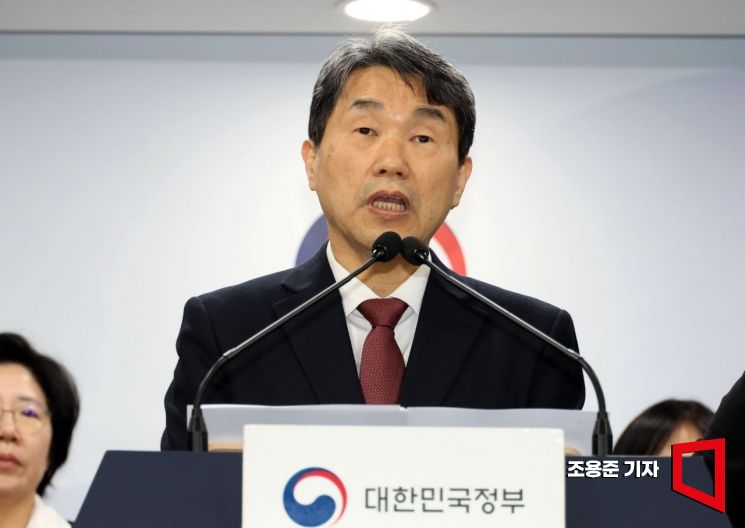 Deputy Prime Minister and Minister of Education Lee Ju-ho is holding a briefing on student return and normalization of medical school education on the 7th at the Government Seoul Office in Jongno-gu, Seoul, with Yang Oh-bong, president of Jeonbuk National University and chairman of the Council of University Presidents for Medical School Advancement, Lee Hae-woo, president of Dong-A University, and Lee Jong-tae, chairman of the Korea Association of Medical Colleges and Medical Schools. 2025.3.7 Photo by Jo Yong-jun
On the 7th, Lee Ju-ho, Deputy Prime Minister for Social Affairs and Minister of Education, announced the 'Plan for Student Return and Normalization of Medical Education' at the Government Seoul Office, together with Yang Oh-bong and Lee Hae-woo, chairpersons of the Council of Deans for the Advancement of Medical Schools (U-Med Council), and Lee Jong-tae, chairman of the Korean Association of Medical Colleges and Medical Schools (KAMC).
Deputy Prime Minister Lee stated, "Considering the start of the new semester in March and the admission schedule for the 2026 academic year, we have been discussing the medical education issue with a sense of urgency that it must be resolved. The government intends to respect the autonomous decisions of university presidents regarding the 2026 admission quota based on the U-Med Council's recommendations, assuming all students return by the end of March."
Previously, the KAMC submitted a petition signed by deans to the government stating that "if the 2026 admission quota is accepted as 3,058 students, medical students will definitely return." The U-Med Council also proposed to the government that, on the premise that all medical students return and classes proceed normally in the 2025 academic year, university presidents be allowed to adjust the 2026 admission quota to 3,058 students, the same as in 2024, for that year only.
"This measure will bring medical students back"
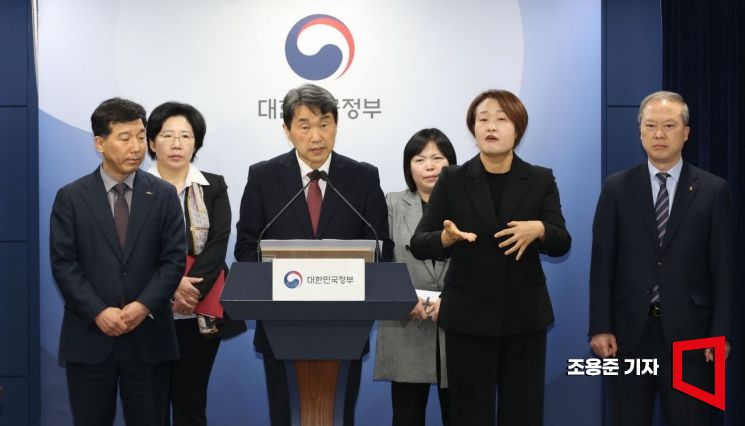 Deputy Prime Minister and Minister of Education Lee Ju-ho is holding a briefing on student return and normalization of medical school education on the 7th at the Government Seoul Office in Jongno-gu, Seoul, with Yang Oh-bong, former president of Jeonbuk National University and chairman of the Council of University Presidents for the Advancement of Medical Schools, Lee Hae-woo, president of Dong-A University, and Lee Jong-tae, chairman of the Korea Association of Medical Colleges and Medical Schools. 2025.3.7 Photo by Jo Yong-jun
The Ministry of Education accepted the proposal from medical school deans and presidents. The government decided to respect the autonomous decisions of university presidents regarding the 2026 admission quota, assuming all students return by the end of this month. The previously confirmed 2026 medical school quota of 5,058 students will remain unchanged, but universities recruiting students can adjust their 'admission quota' to 3,058 students.
However, if medical students do not return by the deadline at the end of this month, the adjustment plan will be withdrawn, and the admission quota will be maintained at 5,058 students. Academic operations will also strictly apply relevant university regulations this year. No special measures will be taken to facilitate student return; if students do not attend classes or engage in collective actions, they will be subject to academic warnings, failure, or expulsion according to the rules. No exceptional measures such as artificial academic schedule adjustments or blanket leave approvals will be applied. Students admitted in the 2025 academic year after the medical school expansion cannot refuse classes due to the expansion, and first-semester first-year leave of absence will not be allowed, with strict enforcement of related regulations emphasized.
The Ministry of Education and university presidents and deans urged students to return. Deputy Prime Minister Lee said, "We are communicating closely with students and exchanging opinions. Based on that communication, today's announcement was made, and we expect the students to come back."
Lee Hae-woo, president of Dong-A University and chairperson of the U-Med Council, also said, "I am confident that students will return. They must return. The education field considered this the deadline, and that is why we made a magnanimous decision to accept the proposal requested by the KAMC."
Chairman Lee addressed the medical students, saying, "If you do not return, the discussions on the admission quota, which the KAMC has painstakingly agreed upon through persuading the government and university presidents, will revert to square one. We urge you to make a wise decision and all return to school together."
Regarding the perception that there were disagreements with the Ministry of Health and Welfare about restoring the medical school admission quota to 3,058 students, the Ministry of Education reiterated, "An agreement has been reached." Deputy Prime Minister Lee explained, "There can be differences between ministries, but it is customary to reach an agreement before announcing a policy. This policy was also announced after coordinating differences and reaching an inter-ministerial agreement." He added, "Even if there were disagreements before the announcement, after the government announces the policy, the ministries cooperate to implement it."
Four Models Proposed for Medical Education
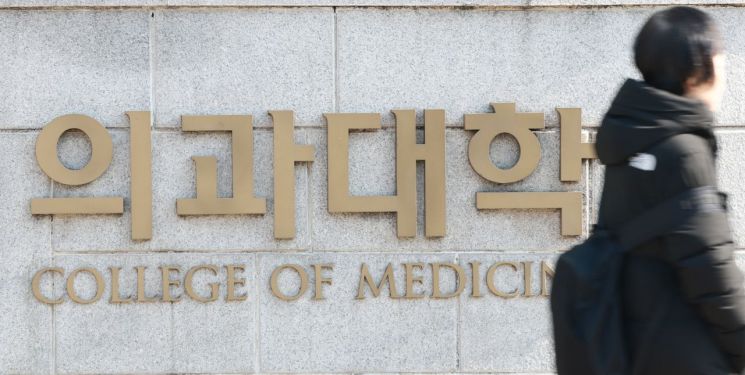
Measures were also introduced to educate the 24th cohort, who could not properly complete their first-year curriculum last year due to collective actions opposing the medical school expansion, and the 25th cohort, who enrolled this year. According to the Ministry of Education, the number of first-year medical students in the 24th and 25th cohorts increased from 3,058 last year to 7,623 this year, an average increase of 2.49 times.
Considering that education for new and returning students must be conducted over the next six years starting this year, the Ministry prepared measures based on various models proposed by the KAMC for educating the 24th and 25th cohorts. Each university will establish an operational plan based on these models after gathering student opinions and analyzing educational conditions.
The first model is to operate the existing curriculum as is, allowing the 24th and 25th cohorts to graduate simultaneously. Both cohorts will complete the six-year curriculum without special measures to graduate the 24th cohort early. Separate classes by cohort are possible during operation.
The second to fourth models compress the education period to allow the 24th cohort to graduate one semester earlier than the 25th cohort. The 24th cohort will graduate after completing the first semester of 2030, and the 25th cohort will graduate after the second semester of 2030. The second model operates the first and second years of the 24th cohort in a multi-semester system, enabling them to complete the second semester of the second year curriculum by the first semester of next year.
The third model applies to 24th cohort students who completed the first semester of their first year last year. They can return to school in the first semester this year to take the second semester of the first-year curriculum and sequentially complete the remaining semesters, graduating one semester earlier than the 25th cohort.
The fourth model redesigns the 24th cohort's fourth to sixth-year curriculum. Considering that the second semester of the sixth year is mainly self-study for the national medical licensing exam, the model allows completion of the six-semester curriculum over approximately five semesters starting from the first semester of the fourth year.
Chairman Lee of the KAMC, which proposed the four models, stated, "First, there must be no qualitative damage to medical education; second, medical workforce supply and demand must be considered; and third, these must be acceptable to each university." He added, "About 75% of universities said that if the government provides institutional and financial support, they can complete the curriculum within six months without compromising the quality of medical education." He further said, "We are preparing to provide the maximum education to students without compromising the quality of medical education."
If the graduation timing of the 24th cohort is operated differently through these curricula, an additional national medical licensing exam will be conducted for them. The allocation and selection of residents, training, and acquisition of specialist qualifications will also be planned to proceed smoothly considering the schedule.
© The Asia Business Daily(www.asiae.co.kr). All rights reserved.



















