People Choosing Side Jobs to Supplement Income
Construction Industry Sees 33.65% Increase, Up 7.79 Percentage Points
Accommodation and Food Service Up 16.8%
"Concerns Over Worsening Working Conditions"
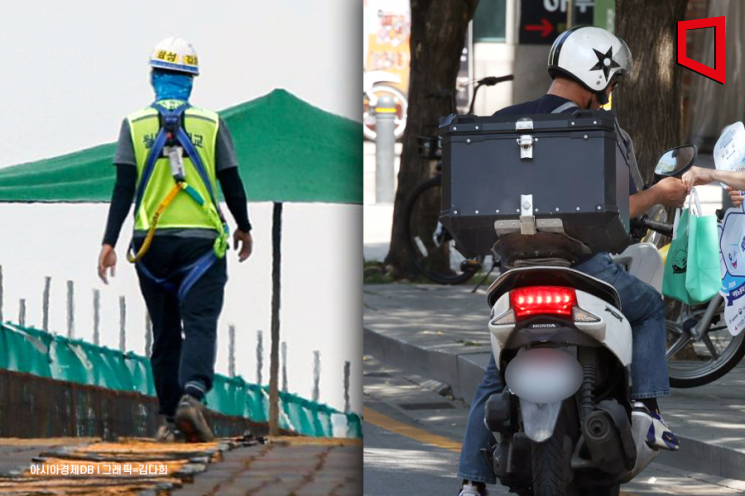
Yoon Jin-hyeok (32), who works at a landscaping facility installation company in South Korea, does delivery part-time work in the evenings. After finishing work, he eats at home and goes out between 6 and 7 p.m. to work for about three hours. In this case, he can earn about 50,000 won per day. If he does deliveries on weekdays for a month, he can earn over 1 million won as additional income. Yoon said, "It's hard to live on my salary alone, so I have no choice but to do a second job."
Yoon's monthly salary is about 3.5 million won, which is not the minimum wage. However, due to the nature of the industry, which is heavily affected by the construction market, when site work decreases as it does these days, the salary also shrinks. Yoon said, "I have many fixed expenses such as monthly rent and child-rearing costs, and with rising prices, various living expenses have increased," adding, "There are often situations where expenses exceed income." While saying this, Yoon forced a smile but could not hide his gloomy expression.
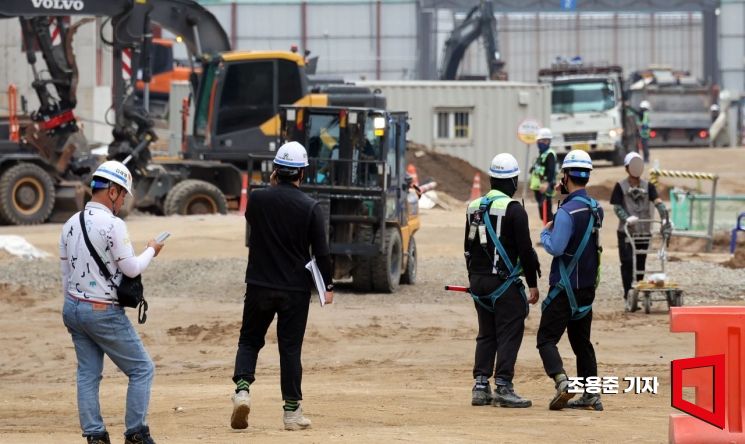
Construction and Accommodation & Food Service Workers Choosing Side Jobs for Income
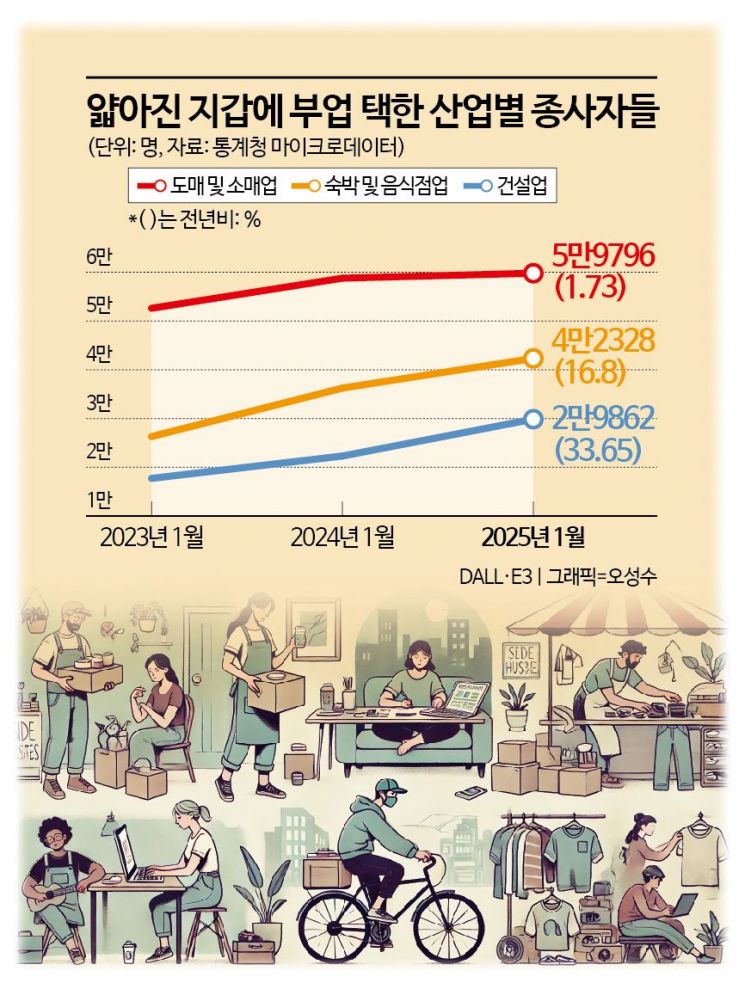
Cases of workers in industries affected by the economy supplementing their income with side jobs, like Yoon, are increasing. On the 10th, Asia Economy analyzed microdata from the Statistics Korea Economically Active Population Survey and found that as of January this year, among 21 industries, the number of workers with side job experience increased in ▲construction ▲accommodation and food service ▲wholesale and retail trade ▲agriculture, forestry, and fishing. This is based on the sum of those who answered "yes" to the "side job last week" item among workers by industry.
The number of construction workers with side job experience was 29,862, a 33.65% increase compared to the same month last year (22,308). Compared to the 25.86% increase in January last year by the same standard, it rose by 7.79 percentage points in one year. Due to the industry’s sensitivity to the economy, with the recent construction slump and domestic demand slowdown continuing, it appears that more people are trying to make up for reduced income.
The number of accommodation and food service workers also increased from 36,240 to 42,328 by the same standard, a 16.80% rise. Although the increase slowed compared to January last year (37.81%), it maintained a high double-digit growth rate. Agriculture, forestry, and fishing (2.48%) and wholesale and retail trade (1.73%) recorded single-digit growth rates, reducing the increase compared to the previous year's double-digit rise.
On an annual basis, last year, accommodation and food service (24.19%) and construction (23.38%) showed a notable increase of over 20% in workers with side jobs compared to the previous year. Also, healthcare and social welfare services (16.48%), wholesale and retail trade (13.75%), and transportation and warehousing (10.03%) saw increases in workers with side jobs across various industries.
Professor Kim Sang-bong of Hansung University’s Department of Economics said, "Even if South Korea’s per capita Gross National Income (GNI) was 50 million won last year, this includes the government and companies and is an average per person," adding, "It does not mean everyone earns that much." He explained, "Some people have insufficient income compared to rising prices, so they do other part-time jobs. That is why many people are doing delivery part-time jobs these days."
"Second Jobs with Worse Working Conditions... A Cause for Concern"
With the economic outlook bleak this year and next, cases of supplementing income with side jobs are expected to increase. The Bank of Korea recently forecast economic growth rates of 1.5% this year and 1.8% next year. The Korea Development Institute (KDI), a government research institute, diagnosed that growth will weaken this year due to delayed domestic demand recovery and adjustments in export growth. They also cited expanded domestic and international uncertainties due to U.S. trade policies as negative factors.
The phenomenon of flexibly choosing side jobs according to income situations or available time may also become more pronounced. According to a 2023 working environment survey by the Korea Occupational Safety and Health Agency, 65.9% of respondents (560 people) said they do side jobs irregularly, more than those who said they do them regularly (26.6%). Compared to the 2020 survey, where irregular (48.7%) and regular (45.7%) responses were similar, there is a clear preference for irregular side jobs.
However, the increase in platform-based irregular side jobs to work limited hours raises concerns about the deterioration of work quality. No Seri, Director of Planning and Coordination at the Korea Labor Institute, said, "Industries like construction do not have high-quality working conditions, and if workers want to do second jobs to supplement income, they have to find jobs under worse conditions," adding, "It is necessary to prepare for this phenomenon increasing faster than the establishment of social safety nets."
© The Asia Business Daily(www.asiae.co.kr). All rights reserved.



















