"U.S. Adds 'Swift Ceasefire' Condition to Mineral Agreement"
Zelensky Proposes "Ceasefire in Air and at Sea First"
Russia's Position Unclear... U.S. Plan Not Welcomed by Europe
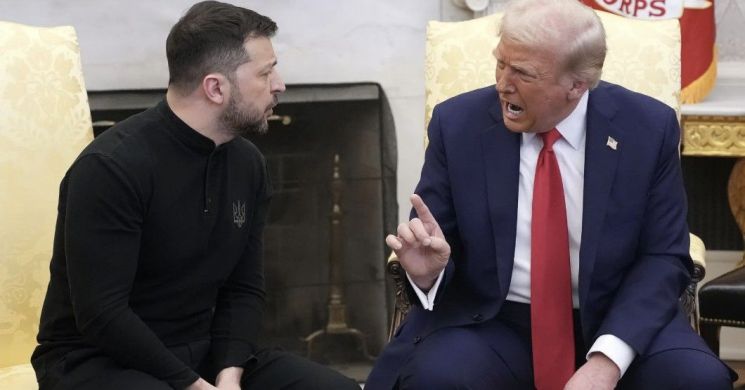 On the 28th of last month (local time), U.S. President Donald Trump (right) and Ukrainian President Volodymyr Zelensky (left) are having a summit meeting with tense expressions. The negotiations broke down that day as differences over the ceasefire talks and mineral agreements could not be resolved. / UPI·Yonhap News
The United States and Ukraine have announced plans to hold talks next week in Saudi Arabia, drawing attention to whether the two sides will be able to mend the rift caused by the previous summit breakdown. The key factors determining the success of the talks are the U.S. condition of a "swift ceasefire" and Ukraine's demand for "U.S. security guarantees." The crucial question is whether the working-level negotiators from both countries, who have begun detailed coordination to make up for the mistakes of last month's disastrous summit, can reach a broad agreement in time.
Zelensky: "Discussing Next Week's Meeting Schedule Between the Two Countries"
On the 6th (local time), Volodymyr Zelensky, President of Ukraine, stated, "We (the U.S. and Ukraine) hope to have a meaningful meeting next week," and revealed that the two countries are discussing a schedule for talks in Saudi Arabia next week. On the same day, Steve Witkoff, U.S. President Donald Trump's Middle East envoy, also confirmed the possibility of talks, saying, "We are currently coordinating to hold talks with Ukraine in Riyadh, Saudi Arabia."
The meeting is expected to be attended by U.S. Secretary of State Mark Rubio, White House National Security Advisor Mike Waltz, Envoy Witkoff, and Andriy Yermak, Chief of Staff to the Ukrainian President. There were differing reports regarding the specific date of the talks. The U.S. online media Axios cited sources saying that the date of the 12th was coordinated during a phone call between Mike Waltz, White House National Security Advisor, and Andriy Yermak, Chief of Staff to the Ukrainian President. On the other hand, Jackie Heinrich, Fox News White House correspondent, posted on social media that the meeting would be on Tuesday, the 11th.
This meeting will take place two weeks after the White House summit on the 28th of last month between U.S. President Trump and Ukrainian President Zelensky, which ended in a breakdown after a heated exchange. Unlike before, it is expected that detailed prior coordination on the framework of the mineral agreement (which allows the U.S. to participate in the development of rare earth and other minerals in Ukraine and share profits) and the basic framework of the Ukraine ceasefire agreement will precede the talks.
Talks Hinged on 'Swift Ceasefire'... Optimism Difficult
However, there are reports that President Trump attached the condition of a "swift ceasefire" to the key agenda item, the mineral agreement, making it difficult to be optimistic about the outcome of the talks. U.S. Bloomberg News, citing sources, reported that the mineral agreement includes a condition that President Zelensky must agree to a specific path toward a ceasefire and dialogue with Russia. Sources said that these "additional conditions" are the reason why the mineral agreement is progressing slowly.
President Zelensky introduced to European leaders a plan for "rapid progress toward peace" related to the ceasefire plan on the same day. He said, "The first step could be establishing and fully controlling a ceasefire in the air (stopping missile, long-range drone, and bomb attacks on energy and other civilian infrastructure) and at sea, which means halting all military operations in the Black Sea to ensure peaceful and safe navigation."
However, it remains uncertain whether such a proposal can satisfy President Trump's demand to "completely stop hostile acts." Ukraine is expected to once again request firm security guarantees from the U.S. during the mineral negotiation phase, but President Trump is unlikely to agree. The U.S. maintains the position that if it makes large-scale investments in Ukraine, it will serve as sufficient deterrence against a Russian re-invasion even without formal security guarantees.
The position of Russia, a party to the ceasefire, has not been confirmed. There are no public signs that Russian President Vladimir Putin is ready to agree to end the war, nor is there any indication that the U.S. is urging Moscow to compromise.
The U.S. plan differs significantly from Europe's wishes. European officials have expressed concerns, as reported by Bloomberg, that President Trump’s strong desire for a quick ceasefire without security guarantees risks forcing Ukraine into a bad deal, which could undermine the security of the European continent.
© The Asia Business Daily(www.asiae.co.kr). All rights reserved.
![Clutching a Stolen Dior Bag, Saying "I Hate Being Poor but Real"... The Grotesque Con of a "Human Knockoff" [Slate]](https://cwcontent.asiae.co.kr/asiaresize/183/2026021902243444107_1771435474.jpg)















