Emphasizing the Need for the "Gyeonggang Line Extension Railway Project"
in Relation to the 5th National Railway Network Construction Plan
Proposing Measures to Strengthen the Functionality of GTX-D
Gwangju City, Gyeonggi Province (Mayor Bang Se-hwan) announced on the 7th that Mayor Bang Se-hwan visited the Korea Transport Institute on the 6th to discuss solutions to the transportation issues of Gwangju City, which has surpassed a population of 400,000.
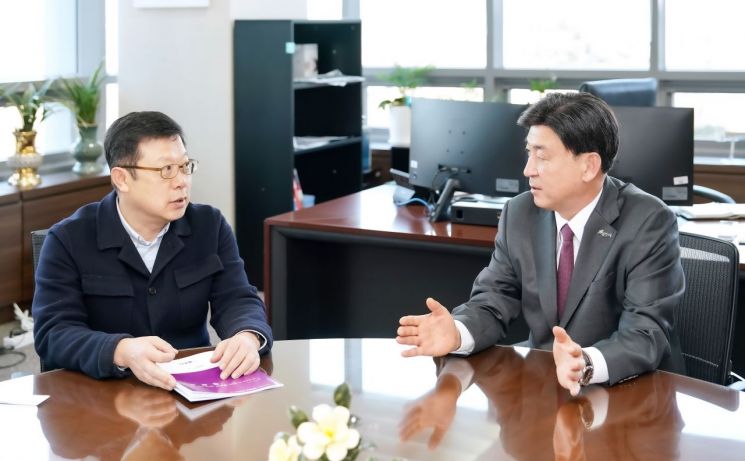 Gwangju Mayor Bang Se-hwan (right) met with Kim Young-chan, President of the Korea Transport Institute, on the 6th to discuss solutions for transportation issues in Gwangju City, which has surpassed a population of 400,000. Provided by Gyeonggi Gwangju City
On that day, Mayor Bang met with Kim Young-chan, President of the Korea Transport Institute, to explain the increasing road congestion caused by overlapping regulations and geographical characteristics of Gwangju City, emphasizing the urgent need to shift from a road-centered transportation system to a public transportation-centered one to overcome its limitations.
In particular, Mayor Bang highlighted the importance of establishing a railway network and systematic railway investment in line with the restructuring of the national spatial structure, stressing the urgency and necessity of the “Gyeonggang Line extension (Gwangju~Yongin) railway project” related to the 5th National Railway Network Construction Plan currently being conducted by the institute.
He also requested active cooperation from the institute to ensure that all Gwangju citizens are guaranteed minimum mobility rights through organic connections among major railway lines such as the Gyeonggang Line, Sugwang Line, and the Metropolitan Inland Line.
Mayor Bang also discussed the Metropolitan Area Express Railway (GTX-D) planned to pass through Gwangju City, pointing out that if the GTX-D line utilizes the Gyeonggang Line tracks, it would be difficult to secure transportation capacity comparable to the currently operating GTX-A. Accordingly, he proposed measures to strengthen the GTX-D’s functionality.
President Kim Young-chan responded, “Transportation must play an important role in connecting people and cities beyond simple interests between neighboring local governments,” adding, “We will actively review ways to overcome Gwangju City’s geographical limitations and enhance metropolitan travel convenience in the southeastern Gyeonggi region.”
Meanwhile, the city plans to continue consulting with the central government and related agencies to expand transportation infrastructure in the future.
© The Asia Business Daily(www.asiae.co.kr). All rights reserved.
![Clutching a Stolen Dior Bag, Saying "I Hate Being Poor but Real"... The Grotesque Con of a "Human Knockoff" [Slate]](https://cwcontent.asiae.co.kr/asiaresize/183/2026021902243444107_1771435474.jpg)















