People's Bank of China Governor: "Preventing Exchange Rate Fluctuations, Ensuring Yuan Stability"
Trump: "China's Currency Devaluation Is Disadvantageous to the US"
Potential for Intensified US-China Conflict If Exchange Rate Pressure Card Is Used
Amid escalating US-China trade tensions, the Chinese government has expressed its stance on maintaining the stability of the yuan exchange rate. This underscores China's determination to adhere to a currency depreciation policy despite warnings from President Donald Trump that China is devaluing the yuan. If China responds to the US's high tariff measures with further yuan devaluation, conflicts between the two countries are expected to intensify.
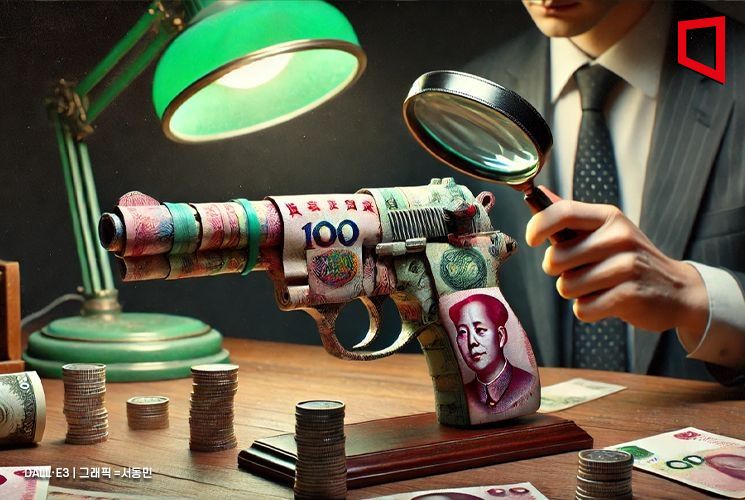
According to the Hong Kong daily South China Morning Post (SCMP), Pan Gongsheng, Governor of the People's Bank of China, stated at a press conference of the 14th National People's Congress (NPC) on the 6th, "We will prevent excessive fluctuations in the exchange rate and ensure that the yuan remains stable at a reasonable and balanced level."
This is the first official position released by the Chinese government following President Trump's criticism of China's currency devaluation. Earlier, on the 3rd (local time), President Trump expressed dissatisfaction, saying, "Whether it is the Chinese yuan or the Japanese yen, if they devalue their currencies, it will create a very unfair and disadvantageous situation for the United States."
Despite US accusations of weaponizing exchange rates, Governor Pan said, "Our stance on exchange rate policy remains unchanged," adding, "We respect the decisive role of the market while strengthening management." The People's Bank of China has consistently shown a strong commitment to yuan stability. As of the 6th, the bank announced the yuan's central parity rate against the dollar at 7.1692 yuan, the strongest level in the past four weeks.
On the same day, he referred to the "complex and severe external environment," diagnosing that inflation trends and uncertainties regarding monetary policies in major developed countries are increasing. This is interpreted as a remark targeting the Trump administration's tariff policies, which have contributed to global trade conflicts and increased economic uncertainty.
Governor Pan expressed concern that "this affects global market expectations and investor confidence, intensifies volatility in international financial markets, and has ripple effects on the stability of China's economy and finance." If China pursues foreign exchange policies that devalue the yuan under the guise of "yuan stability," the rift in US-China relations is expected to deepen further. If President Trump uses "exchange rates" as a pressure card alongside tariffs, China may counter with yuan devaluation. During Trump's first term, when the US imposed high tariffs on Chinese steel and aluminum, China immediately responded by devaluing the yuan to offset the tariff effects. The US viewed this as deliberate undervaluation of the yuan by China, and during Trump's first administration, the US designated China as a "currency manipulator."
However, Chinese officials mentioned that negotiations to resolve trade conflicts with the US are underway, leaving room for future compromise. Wang Wentao, Minister of Commerce, pointed out, "The essence of China-US economic and trade relations is mutual benefit," adding, "Building tariff barriers does not change market principles or hinder progress in cooperation." Minister Wang sent letters to new senior US economic officials last month and expressed willingness to hold talks at an "appropriate time."
Chinese authorities also indicated that there is room to implement accommodative monetary policies. Finance Minister Lan Fuan stated that the Chinese government has sufficient reserves to respond to external shocks and can take additional fiscal measures to support the economy if necessary. Governor Pan Gongsheng also noted, "The average reserve requirement ratio (RRR) of Chinese financial institutions is 6.6%, and there is still room for further reduction."
© The Asia Business Daily(www.asiae.co.kr). All rights reserved.
![Clutching a Stolen Dior Bag, Saying "I Hate Being Poor but Real"... The Grotesque Con of a "Human Knockoff" [Slate]](https://cwcontent.asiae.co.kr/asiaresize/183/2026021902243444107_1771435474.jpg)















