Turf Replacement Volume Secured at Three Times Last Year’s Level
Budget Increased from 1.1 Billion KRW to 3.3 Billion KRW
In preparation for the K League opening being moved up by two weeks, urgent turf restoration will begin at the World Cup Stadium located in Sangam, Seoul. The plan is to normalize the turf condition before FC Seoul's home game on the 29th.
The Seoul Metropolitan Government and Seoul Facilities Corporation announced on the 7th that they will carry out urgent turf restoration at the Seoul World Cup Stadium.
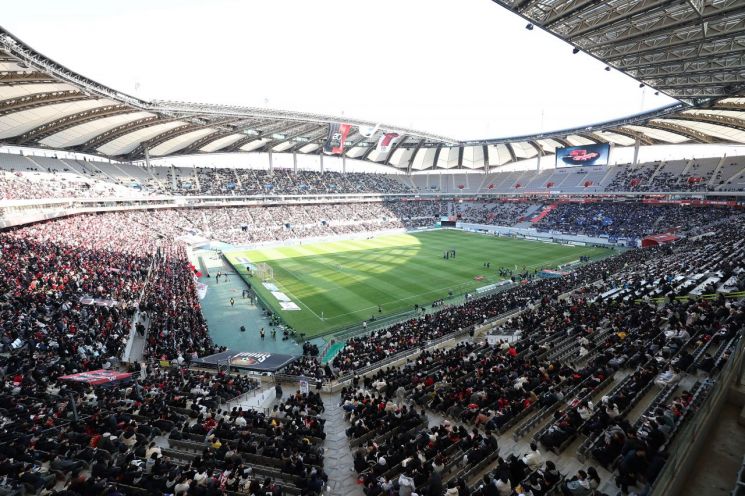
First, part of the turf will be replaced with hybrid turf, and soil layering and seeding work will be conducted to increase density. This year, 3.3 billion KRW, three times the 1.1 billion KRW spent last year, will be invested to secure sufficient turf replacement volume, and advanced machinery to aid turf growth will be introduced.
The city and the corporation explained that the K League opening was moved up by 16 days this year, causing difficulties in preparation. Additionally, the cold wave continued until early this month, freezing the ground and resulting in poor turf rooting and growth, causing lifting in various areas.
For urgent restoration, more than 2,500㎡ of turf inside the Seoul World Cup Stadium will be replaced with hybrid turf. To increase turf density, soil layering and turf seeding will be conducted over an area of 5,900㎡. Ground aeration, pest and disease prevention agents, and fertilizer components that help turf growth will be supplied to the soil, and ground compaction and watering work will also be carried out.
In addition to urgent repairs, based on the turf intensive improvement plan established last year, systematic year-round turf condition improvement and management will be promoted.
The amount of replaceable turf secured is about three times more than last year, totaling 12,500㎡. Turf will be replaced immediately if the ground turf condition is poor.
Advanced equipment used in famous overseas stadiums will also be newly introduced to thoroughly manage ground quality. Cooling fans necessary for turf growth in summer will be increased from the current eight fixed units to an additional five mobile units and foggers. Artificial lighting to solve sunlight issues and air aerators to improve poorly drained soil will also be newly acquired.
A provisional "National Football Stadium Council," composed of the Seoul World Cup Stadium and related organizations, will also begin operation from April. The council will discuss overall issues such as ground management, restoration measures, and infrastructure improvement.
The stadium rental system will also be improved. Considering the shortage of large-scale stadiums, cultural event rentals such as concerts will continue, but rental guidelines excluding ground seats will be maintained to protect the turf. However, after monitoring turf management status, exceptions may be considered during optimal growth periods.
Furthermore, taking into account the characteristics of the "Hanji-type turf" at the Seoul World Cup Stadium, active consultations will be held with related organizations such as the Korea Professional Football League regarding stadium usage schedules in winter and summer seasons.
Gu Jong-won, Director of the Seoul Tourism and Sports Bureau, said, "We deeply regret that the league schedule was moved up during the difficult winter turf management period, preventing us from providing a proper stadium environment. Moving forward, we will make every effort to manage the stadium so that players can compete under the best conditions through significantly expanding turf replacement volume, investing in advanced equipment, and coordinating league schedules."
© The Asia Business Daily(www.asiae.co.kr). All rights reserved.
![Clutching a Stolen Dior Bag, Saying "I Hate Being Poor but Real"... The Grotesque Con of a "Human Knockoff" [Slate]](https://cwcontent.asiae.co.kr/asiaresize/183/2026021902243444107_1771435474.jpg)















