Government and Universities Agree to Maintain Medical School Quota at 3,058 on Condition of Students' Return
Medical Students Also Demand Withdrawal of Essential Medical Package Policy
As the government and the ruling party have decided to revert the medical school quota for next year to the previous scale before the increase, attention is focused on whether the year-long ongoing conflict between the medical community and the government can find a resolution. By temporarily restoring the medical school quota, which was the root cause of the conflict, to its original point, a justification has been provided for residents and medical students to return, but it remains uncertain whether they will actually go back to hospitals and schools.
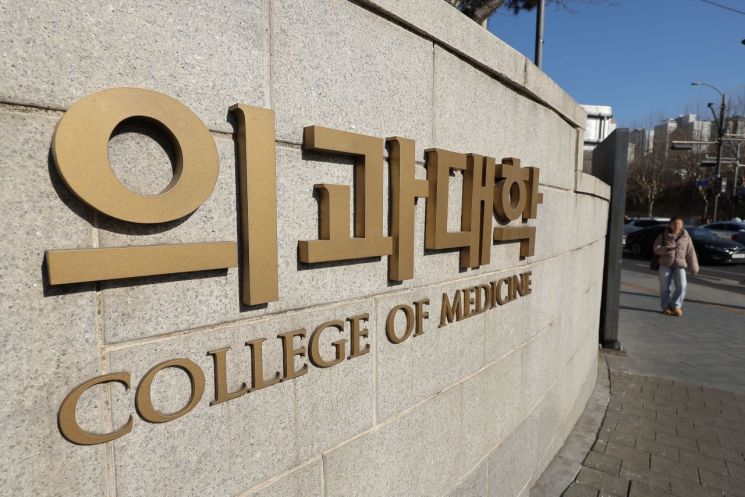
On the afternoon of the 7th, the Ministry of Education will announce measures for the return of medical students and the normalization of medical education at the Government Seoul Complex. Attending this event will be Lee Ju-ho, Deputy Prime Minister and Minister of Education, the chairpersons of the 'Council of Deans for the Advancement of Medical Schools (Uichonghyeop),' a gathering of presidents from 40 universities with medical schools, and Lee Jong-tae, chairman of the Korean Association of Medical Colleges (KAMC), a consultative body of medical school deans. They are expected to present concrete plans on how to operate the curriculum for the 7,500 medical students from the classes of 2024 and 2025.
The quota for medical schools next year gained momentum on the 5th when university presidents with medical schools accepted the deans' demand to maintain the quota at 3,058. Although the new semester started in March, students had not returned to classes, and even freshmen refused to register for courses, raising concerns about disruptions to classes for the second consecutive year, necessitating urgent measures to resolve the situation.
Earlier, KAMC officially proposed to the government to freeze the medical school quota at 3,058, the number before the increase, and on the 5th, the Uichonghyeop also agreed to this proposal during an online meeting. On the 6th, the People Power Party held consultations with the Ministry of Education and urged acceptance of the 3,058 quota. Subsequently, the Ministry of Health and Welfare, which had emphasized that the medical school quota could be reconsidered from scratch, also stepped back, expressing sympathy with the university presidents' desire to normalize medical education.
Ultimately, on the afternoon of the same day, the government held a confidential emergency meeting attended by Choi Sang-mok, Acting Prime Minister and Minister of Economy and Finance, Lee Ju-ho, Deputy Prime Minister and Minister of Education, Cho Kyu-hong, Minister of Health and Welfare, and Jang Sang-yoon, Senior Secretary for Social Affairs at the Presidential Office, and decided to effectively accept the plan to revert the medical school quota to the pre-increase level.
However, the plan to maintain the quota at 3,058 next year is conditional on the return of currently on-leave medical students and freshmen by the end of this month. If they return in March, each university will proceed with the process of changing the medical school admission quota for the 2026 academic year to a total of 3,058. It is also reported that the government and universities have agreed that if students do not return by March, the admission quota for next year will be finalized again at 5,058.
Despite this change in the government's stance, it is uncertain whether medical students will respond positively and return to classes. Kim Seong-geun, spokesperson for the Korean Medical Association, pointed out, "The important question is whether a proper medical school environment is prepared to provide adequate education to the approximately 7,500 students from the classes of 2024 and 2025 combined." A 24th class student on leave from a metropolitan medical school said, "What we are demanding now is not just freezing the quota but improving the medical training environment and withdrawing the 'Essential Medical Package' policy," adding, "Since trust in the government has already been broken, it is difficult to fully accept the policy to reset the quota on the premise of returning to classes."
© The Asia Business Daily(www.asiae.co.kr). All rights reserved.
![Clutching a Stolen Dior Bag, Saying "I Hate Being Poor but Real"... The Grotesque Con of a "Human Knockoff" [Slate]](https://cwcontent.asiae.co.kr/asiaresize/183/2026021902243444107_1771435474.jpg)















