Trump Temporarily Suspends Tariffs on Mexico and Canada
Tariff Exemption Extended Until April 2, White House Announces
"Psychodrama" of Tariff Policy Draws Global Attention
U.S. President Donald Trump decided to temporarily suspend the 25% tariff bomb he had imposed on Mexico and Canada just two days earlier, extending the suspension for about a month. However, the tariff exemption deadline was firmly set for April 2, the date when mutual tariffs were announced to each country. Reuters described President Trump's rollercoaster tariff policy as "a kind of psychodrama."
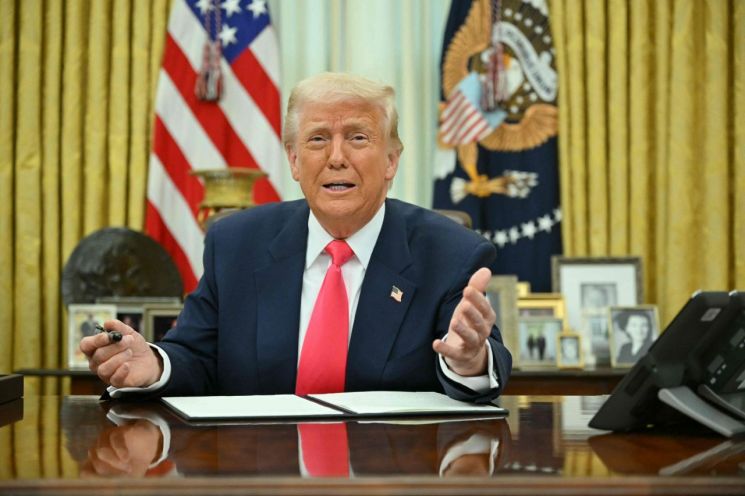
On the 6th (local time), President Trump signed an executive order exempting tariffs on all goods covered by the United States-Mexico-Canada Agreement (USMCA) imported from Mexico and Canada until April 2.
This temporary tariff suspension came just two days after the 25% tariffs, which had been postponed for a month for the two countries on the 4th, took effect. The White House announced the day before, just one day after the tariff strike, that automobile tariffs on Mexican and Canadian products would be exempted for a month, and within a day, the exemption was expanded to cover most items.
Earlier, President Trump stated on his social networking service (SNS) Truth Social, which he created, "After speaking with Claudia Sheinbaum, the President of Mexico, we agreed that Mexico would not have to pay tariffs on all goods covered by the USMCA," adding, "This agreement is valid until April 2." April 2 is the date President Trump set to impose reciprocal tariffs considering tariffs and non-tariff barriers of each country.
U.S. Secretary of Commerce Wilbur Ross also said, "We hope Mexico and Canada will do sufficiently good work on fentanyl," and added, "We hope that this part of the dialogue will be excluded from the (negotiation) table when new tariffs are applied."
The White House stated that 38% of Canadian imports and half of Mexican imports covered by the USMCA are subject to tariff suspension. Many Canadian energy products not covered by the USMCA are subject to a 10% tariff. However, CNN reported that the U.S. has practically not imposed tariffs on items not covered by the USMCA so far.
President Trump's temporary suspension of tariffs is interpreted as due to the highly integrated supply chains of the three North American countries under the USMCA free trade agreement (FTA), making it difficult for the U.S. to avoid economic damage. The U.S. Big Three automakers requested tariff suspension from President Trump the day before.
© The Asia Business Daily(www.asiae.co.kr). All rights reserved.
![Clutching a Stolen Dior Bag, Saying "I Hate Being Poor but Real"... The Grotesque Con of a "Human Knockoff" [Slate]](https://cwcontent.asiae.co.kr/asiaresize/183/2026021902243444107_1771435474.jpg)
















