Despite Tariff Exemption, Auto Stocks Weaken
GM Down 4.15%, Ford Drops 1.81%
Wall Street: Car Tariff Delay Is "A Bandage on a Gunshot Wound"
ECB Cuts Rate by 0.25% Point Amid U.S. Trade Policy Uncertainty
The three major indices of the U.S. New York Stock Exchange were in a downward trend in early trading on the 6th (local time). Market volatility is expanding as investors' caution deepens due to tariff uncertainties stemming from Trump.
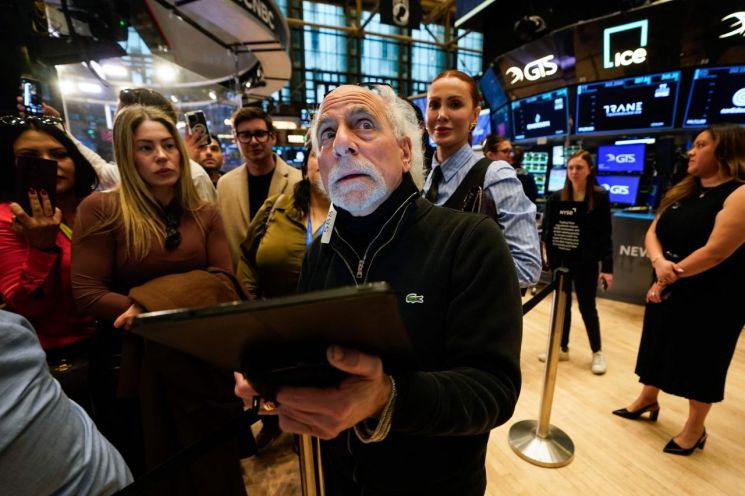
As of 9:43 a.m. in the New York stock market that day, the Dow Jones Industrial Average (Dow), centered on blue-chip stocks, was trading at 42,465.49, down 541.1 points (1.26%) from the previous trading day. The S&P 500, focused on large-cap stocks, was down 85.6 points (1.47%) at 5,757.03, and the Nasdaq, centered on tech stocks, was down 317.04 points (1.71%) at 18,235.69.
Among individual stocks, semiconductor companies were weak. Marvell Technology Group fell 19.8% after announcing disappointing first-quarter earnings forecasts. ON Semiconductor dropped 4.85%. Nvidia was down 3.51%. Despite the U.S. one-month tariff exemption on automobiles for Canada and Mexico announced the previous day, U.S. automakers General Motors (GM) and Ford were down 4.15% and 1.81%, respectively.
The White House announced the previous day that it would grant a one-month exemption from the 25% tariff imposed on the automotive sector for Canada and Mexico. President Trump made this decision after a phone call with representatives of the U.S. Big Three automakers: GM, Ford, and Stellantis. The U.S. automakers, with production bases in Mexico, Canada, and other locations, have expressed concerns that the North American supply chain is highly integrated, and this tariff measure is expected to cause a sharp rise in vehicle production costs and supply chain disruptions.
With the White House also hinting at the possibility of additional tariff exemptions, the stock market rebounded after three days the previous day amid expectations for follow-up compromise measures. However, concerns about the tariff war did not dissipate, and the market turned weak again after just one day. The White House also reaffirmed its intention to impose reciprocal tariffs as scheduled on April 2.
Adam Crisafulli, founder of Vital Knowledge, pointed out, "(The White House) granted only a one-month exemption from harsh tariffs on automakers," adding, "This is merely a stopgap measure, like putting a bandage on a gunshot wound amid the flood of trade and tariff announcements expected over the coming months."
Due to tariff uncertainties, corporate investment activities are also shrinking. The U.S. Federal Reserve (Fed) wrote in its Beige Book, a report on economic trends released the previous day, that "manufacturing contacts, from petrochemical products to office equipment, expressed concerns about the potential impact of changes in trade policy," and "most contacts in various regions expected prices to rise due to potential tariffs and reported preemptively raising prices." The Institute for Supply Management (ISM) stated in its February Manufacturing Purchasing Managers' Index (PMI) report that "customers (companies) are halting new orders due to tariff uncertainties," and "the administration has not provided clear guidance on tariff implementation measures, making it more difficult to predict the impact on business."
The European Central Bank (ECB) decided on the same day to lower the deposit rate by 0.25 percentage points from 2.75% to 2.5% annually due to weak eurozone exports and investment caused by trade policy uncertainties.
The employment data released that morning showed slight improvement. According to the U.S. Department of Labor, new unemployment claims for the week of February 23 to March 1 totaled 221,000, down 21,000 from the revised figure of 242,000 the previous week. This was also 13,000 below the expert forecast of 234,000.
U.S. Treasury yields were mixed but stable. The 10-year U.S. Treasury yield, a global bond yield benchmark, rose 1 basis point (1 bp = 0.01 percentage points) to 4.28% compared to the previous trading day, while the 2-year U.S. Treasury yield, sensitive to monetary policy, moved down 2 basis points to 3.96%.
© The Asia Business Daily(www.asiae.co.kr). All rights reserved.
![Clutching a Stolen Dior Bag, Saying "I Hate Being Poor but Real"... The Grotesque Con of a "Human Knockoff" [Slate]](https://cwcontent.asiae.co.kr/asiaresize/183/2026021902243444107_1771435474.jpg)















