[The Trap of Rapid Execution] ④
Effective in Reducing Unused Funds,
But Some Studies Suggest Negative Impact on Production
"Supplementary Budgets Needed to Revitalize the Economy"
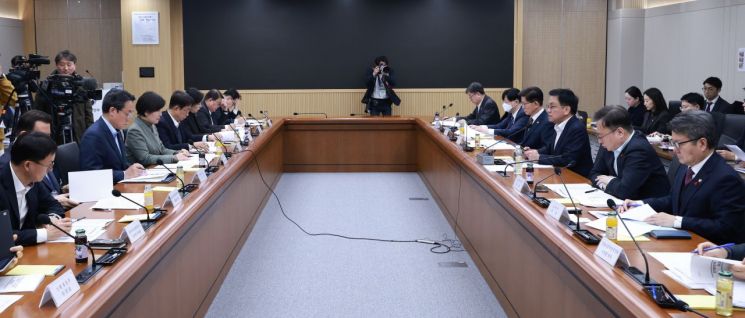 Acting President and Deputy Prime Minister Choi Sang-mok, who is also the Minister of Economy and Finance, is presiding over the 'Rapid Execution of Livelihood Policies Inspection Meeting' at the Government Sejong Complex on January 20. Photo by Yonhap News
The reason the government set this year's rapid execution target at an all-time high level is to supplement the economy. Given the unprecedented budget cuts passed by the National Assembly, the logic is that to prevent an economic downturn in the first half of the year, the budget for the second half must be used as much as possible. However, scholars who have studied rapid execution question whether it has an economic stimulus effect.
According to a synthesis of domestic rapid execution studies reviewed by Asia Economy on the 7th, most claims that rapid execution is effective focus on the reduction of unused funds. Unused funds refer to the budget left unspent. The logic is that by strongly encouraging budget execution from the first half of the year to spend as much money as possible, an economic stimulus effect will occur accordingly.
According to the 2017 report "Analysis of the Effectiveness of Rapid Execution in Local Finance" by Park Myung-ho of the Korea Institute of Public Finance, if rapid execution reduces unused funds, an additional 5.6?6.7% of the annual budget is executed. As a result, the average economic growth rate from 2011 to 2016 increased by up to 0.313 percentage points, and the real Gross Domestic Product (GDP) is analyzed to increase by 5.1 trillion won over the next three years.
Jang Hye-yoon, a visiting research fellow at the Gyeonggi Research Institute, also claimed in a 2019 report to the Korea Institute of Local Administration that rapid execution projects showed a low unused rate. Analyzing Gyeonggi Province's general account projects from 2014 to 2018, the unused rate for projects with rapid execution was only 3.30%. In contrast, projects conducted without rapid execution had an unused rate of 6.93%, more than twice as high.
However, the story changes when focusing on economic growth rates rather than unused funds. According to a 2014 study by Yeo Cha-min, head of the Seoul Metropolitan Council Policy Research Team, advancing the budget execution timing in basic local governments had no impact on the regional gross production. There were no significant effects on the number of companies or employment indicators either. The study concluded that only by increasing the input of finances can the economy be stimulated.
There is also research suggesting that rapid execution rather suppresses regional economic growth. Hong Jun-hyun, a professor at the Department of Public Human Resources at Chung-Ang University, published a paper in 2020 in the Journal of Korean Local Government Studies analyzing that rapid execution of local finance "weakened the positive relationship between local government expenditure and regional economic growth." The claim is that although production temporarily increases at the initial stage of rapid execution, if the total fiscal amount remains the same, the effect disappears in the latter half, potentially leading to an economic downturn.
Ultimately, contrary to the government's claims, the academic community has not verified the economic stimulus effect of rapid execution. Even studies that positively evaluated rapid execution made similar observations. Research fellow Jang explained in the report, "The operation of the rapid execution system needs to be considered as being promoted with the goal of strengthening fiscal execution efficiency rather than economic effects," adding, "Local finance is executed on a small scale depending on regional characteristics, making it difficult to achieve economic effects."
Voices supporting the view that to support the economy, reliance on rapid execution should be avoided and measures such as supplementary budgets should be considered are gaining strength. The National Assembly Budget Office released a report titled "Downside Risks and Policy Conditions of Our Economy in 2025" on January 26, advising, "There are limits to supporting economic recovery solely through rapid fiscal execution and effectively supporting vulnerable groups facing domestic demand recession and domestic demand-related service industries in a timely manner," and "It is necessary to prepare timely and effective supplementary budgets and other economic response measures."
© The Asia Business Daily(www.asiae.co.kr). All rights reserved.

















