Press Conference Marking First Anniversary in Office
Smart Farms Costing 11 to 15 Million Won per Greenhouse... NongHyup to Cover 70% of Installation Costs
Distribution Innovation Centered on 'NongHyup Mall' Utilizing Hanaro Mart and APC
Kang Ho-dong, Chairman of the National Agricultural Cooperative Federation (NongHyup), announced on the 6th that "we will cooperate with the government to distribute affordable smart farms to about 1,000 farms this year."
At a press conference marking his first anniversary in office held at the Government Complex Sejong on the same day, Chairman Kang said, "To create 'profitable agriculture,' we will reduce labor and ease the burden of farming costs."
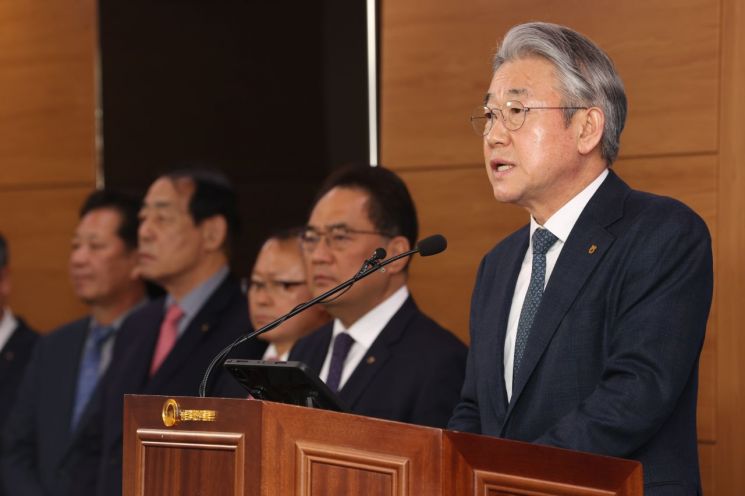 Kang Ho-dong, President of the National Agricultural Cooperative Federation, is announcing the achievements of his first year in office and future plans at the Government Sejong Complex on the 6th. (Photo by National Agricultural Cooperative Federation)
Chairman Kang explained, "Smart farms are necessary to address labor shortages and climate change, but installation costs ranging from several hundred million to even billions of won are difficult for farmers to bear. NongHyup plans to support 70% of the installation cost of affordable smart farms, which range from 11 million to 15 million won per greenhouse." NongHyup intends to continuously expand the distribution of smart farms.
NongHyup is also promoting the strengthening of distribution networks such as the online platform NongHyup Mall and nationwide Hanaro Marts. Through this, they plan to reduce logistics costs and increase farmers' income. Chairman Kang said, "Consumers recognize NongHyup as a supplier of 'safe and fresh food,' and based on this advantage and resources such as Hanaro Mart and Agricultural Product Distribution Centers (APC), we will supply agricultural products to consumers through the online agricultural food specialty platform, NongHyup Mall."
The plan is to utilize NongHyup resources at the regional level to supply locally produced agricultural products to local consumers, thereby reducing logistics costs and providing fresher agricultural products to consumers. Chairman Kang emphasized, "Companies like Coupang and Market Kurly are changing the agricultural product distribution structure, and by utilizing NongHyup's physical and human resources, we can gain competitiveness."
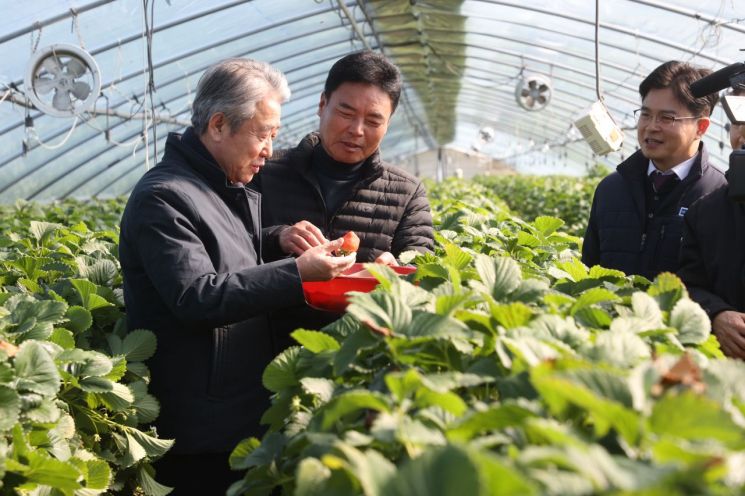 Kang Ho-dong, President of the National Agricultural Cooperative Federation (first from the left), is inspecting the growth condition of strawberries produced at the NH supply-type smart farm located in Goryeong-gun, Gyeongbuk, on the 13th of last month.
To revitalize the rice industry, which is struggling due to chronic oversupply, NongHyup will actively promote rice consumption and export expansion. Chairman Kang stated, "Following last year, we have allocated a budget of 100 billion won this year to improve rice-centered eating habits through breakfast campaigns, foster rice-processed foods, and aim for the consumption of more than 50,000 tons of rice through export expansion. We expect that if this rice consumption culture becomes part of daily life, it will have positive ripple effects on both agricultural income and public health."
Regarding the government's plan to reduce rice cultivation area by 80,000 hectares, he described it as a "difficult task" and a "last resort." He said, "Since per capita annual rice consumption has significantly decreased and rice is in surplus, I agree with reducing the rice cultivation area to some extent. However, with a mechanization rate of 99% in rice farming, elderly and female farmers find it difficult to give up rice farming. Support for alternative crop cultivation must be provided simultaneously."
NongHyup is working to resolve farmers' difficulties by supporting those affected by repeated natural disasters caused by abnormal weather. Over the past year, NongHyup has provided 725 billion won in interest-free disaster recovery funds to farmers suffering from natural disasters and supplied nutritional supplements and medicines worth 5.8 billion won. Additionally, to ease the burden on livestock farmers, feed prices were reduced twice, saving a total of 121.1 billion won, and 19 discount events promoted consumption worth 136.2 billion won.
In particular, to stabilize rice prices, the rice purchase fund was expanded to 3 trillion won, and the purchase price for 2024 rice was maintained at the same or higher level than the previous year. Furthermore, to promote rice consumption, the "Breakfast Eating Campaign" was actively pursued, and the "Our Rice, Our Alcohol K-Rice Festa" was held to increase consumption of rice-processed foods and traditional liquors.
Regarding agricultural policy, NongHyup secured 150 billion won in contributions to the Agricultural Credit Guarantee Fund in cooperation with the government and the National Assembly, and implemented various policies such as allowing the installation of material sales stores within agricultural promotion zones. As the chair country of the International Cooperative Agricultural Organization (ICAO), NongHyup is strengthening its position as a global agricultural cooperative by expanding trade and human exchanges among member countries.
To realize a "NongHyup together with Agricultural and Livestock Cooperatives," NongHyup aims to expand interest-free funds to 20 trillion won by 2027, planning to increase them to 16 trillion won this year. It will also reduce the deposit insurance premium burden of agricultural and livestock cooperatives by about 70 billion won by improving the operation method of the deposit protection fund, and support sustainable growth of agricultural and livestock cooperatives through customized management consulting and mid- to long-term development plans.
Social contribution activities will also be further strengthened. NongHyup plans to enhance rural welfare by expanding rural mobile clinic buses and the Love House Repair Project, and strengthen ethical management by reorganizing internal control systems. At the same time, NongHyup will strengthen emergency management systems in the financial sector and improve competitiveness through intensive innovation of deficit subsidiaries. Through these efforts, NongHyup aims to improve profitability and ensure that tangible benefits reach farmers.
Chairman Kang said, "We will continue change and innovation for the development of agriculture and rural areas, and do our best to create sustainable agriculture together with farmers."
© The Asia Business Daily(www.asiae.co.kr). All rights reserved.


















