K-Food Export Trends Over the Past 10 Years and Key Insights
Ramen, Ready Meals, Beverages, and Health Foods Lead the Way
Top Three Export Destinations: United States, China, and Japan
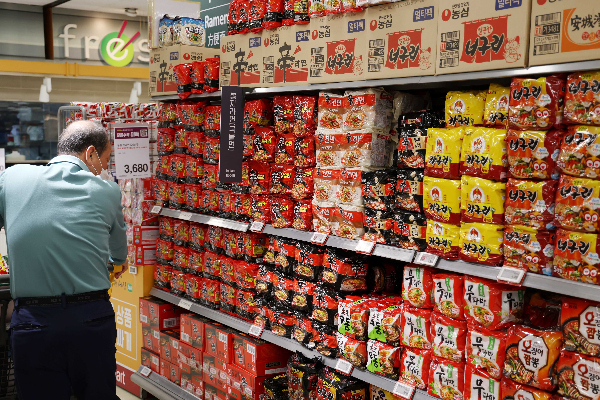 Citizens are shopping at a large supermarket in downtown Seoul. Photo unrelated to the article. Photo by Asia Economy DB
As Korean 'K-Food' such as ramen and seasoned seaweed gain global popularity, the United States has been identified as the country with the highest exports.
On the 6th, the Korea Chamber of Commerce and Industry released a report titled "10 Years of K-Food Export Trends and Implications," analyzed upon request from the Korea Trade Statistics Promotion Institute. According to the report, K-Food export value doubled from $3.51 billion in 2015 to $7.02 billion in 2024. By product category, ramen ranked first with $1.36 billion (approximately 2 trillion KRW), followed by ready meals ($980 million), beverages ($940 million), health foods ($820 million), and seasonings ($650 million).
Looking at the average annual growth rate, K-Food exports increased by 8% over the past decade. In particular, the growth rate was 5.9% from 2015 to 2019 and surged to 9% from 2020 to 2024. Over the 10 years, ramen showed the highest export growth rate at 20.1%, followed by health foods (11.9%) and seasoned seaweed (11.3%). Especially, ramen led both export value and growth rate rankings, driven by the spread of K-Culture and e-commerce, as well as the preference for convenient meals during the COVID-19 pandemic, setting new records every year.
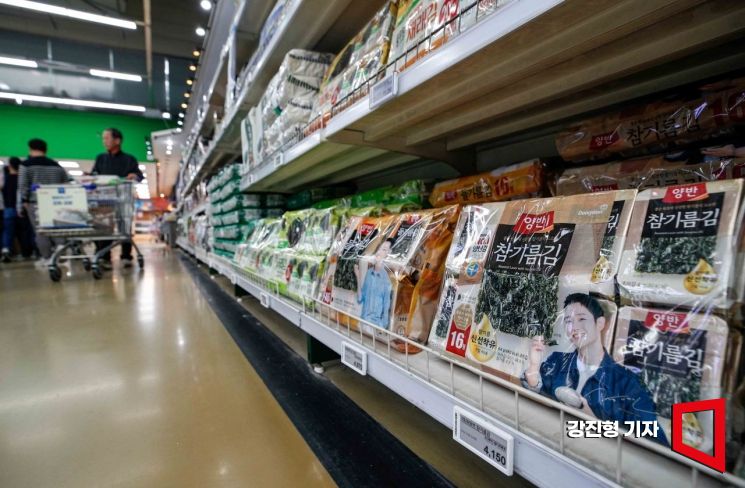 Seaweed displayed at Hanaro Mart Yangjae Branch in Seocho-gu, Seoul. Photo unrelated to the article. Photo by Kang Jin-hyung
Additionally, last year, the top three K-Food export countries were the United States, China, and Japan, respectively. Compared to 10 years ago, the top export destination shifted from China to the United States. Exports to Southeast Asian countries also increased, with Vietnam rising from 6th to 4th place and the Philippines from 7th to 5th.
Professor Moon Jeong-hoon of Seoul National University explained, "The influence of Hallyu and the trend toward health food preferences in the U.S. and Southeast Asian markets have increased interest in Korean food, boosting exports. In the U.S., Korean food has expanded its distribution network by entering large retail stores like Costco, and the increase in franchise stores and strengthened local marketing also appear to have been effective."
Kim Min-seok, head of the Distribution and Logistics Policy Team at the Korea Chamber of Commerce and Industry, said, "Although uncertainties remain in the domestic and international trade environment this year, we should continue to expand exports by leveraging opportunities such as the popularity of Hallyu and K-Food, diversifying export regions and product categories."
© The Asia Business Daily(www.asiae.co.kr). All rights reserved.
![Clutching a Stolen Dior Bag, Saying "I Hate Being Poor but Real"... The Grotesque Con of a "Human Knockoff" [Slate]](https://cwcontent.asiae.co.kr/asiaresize/183/2026021902243444107_1771435474.jpg)

















