Worry Scores 4.1, Depression 3.5... Both Up from Last Year
"Moderate" Most Common Political Orientation
Employment Identified as the Area with the Most Severe Discrimination
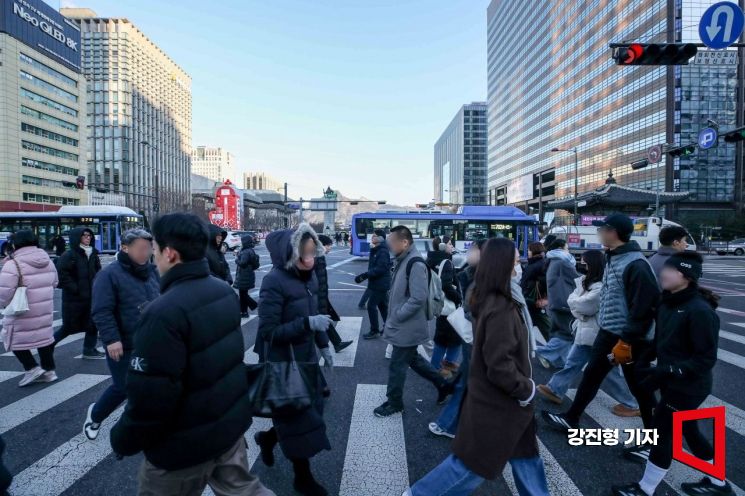
Negative emotions such as worry and depression experienced by the people of our country have significantly increased compared to the previous year. In particular, there was a meaningful difference in the sense of happiness felt according to income. Regarding political orientation, 5 out of 10 people considered themselves moderate, 3 conservative, and 2 progressive.
On the 6th, the Korea Institute of Public Administration announced the results of the "2024 Social Integration Survey" conducted from August to September last year on 8,251 adults aged 19 and older nationwide. The institute is known to conduct this survey annually to examine public perceptions and attitudes toward the level of social integration in Korea.
According to the content, the average happiness score of our people last year was 8.6 out of 10, a 0.1-point increase from the previous year (6.7 points). On the other hand, negative emotions such as worry rose significantly from 3.4 points to 4.1 points, and depression increased from 2.8 points to 3.5 points. By age group, happiness scores were 7.0 points for those aged 19-29 and in their 30s, 6.8 points for those in their 40s and 50s, and 6.6 points for those aged 60 and above, showing a tendency to decrease with age.
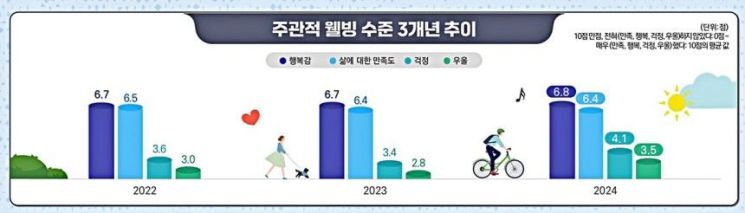 Three-Year Trend of Subjective Well-Being Levels. Provided by Korea Institute of Public Administration
The happiness score of the lowest income group with a monthly income of less than 1 million won was 6.0 points, lower than the previous year (6.1 points), while the highest income group with a monthly income of 6 million won or more saw their happiness score rise from 6.8 points last year to 7.0 points. The perception of social status also showed a widening gap between income groups. For households with a monthly income of less than 1 million won, the perception score of social status slightly increased from 4.8 points to 4.9 points, whereas the 6 million won or more group rose from 5.7 points to 6.1 points, a 0.4-point increase. As a result, the gap between the two groups widened further from 0.9 points last year to 1.2 points. Additionally, pride in being a citizen of Korea was the highest in the past five years, with an average score of 3.1 out of 4 points.
Satisfaction with political and economic situations also increased by 0.7 points each compared to the previous year, reaching 5.1 points and 5.3 points, respectively. The proportion of respondents who identified their ideology as moderate was 45.2%, a 1.5 percentage point decrease from the previous year, but it remained the highest among ideological orientations. Furthermore, 30.2% identified as conservative, and 24.6% as progressive. Among moderate respondents, the proportion of women and men was 47.2% and 43.2%, respectively. Notably, the older the age and the lower the household income, the higher the proportion of conservative respondents.
Meanwhile, the area perceived as having the most severe discrimination in Korean society was employment. The perception of discrimination based on employment type scored the highest at 2.8 out of 4 points, followed by discrimination due to disability, academic background, and economic status (2.7 points), age, country of origin/race (2.6 points), and religion (2.3 points). The most serious type of social conflict was identified as "ideological conflict between conservatives and progressives" (3.1 points). Next were "class conflict between the poor and the middle class" (2.9 points) and "labor-management conflict between workers and employers" (2.8 points).
© The Asia Business Daily(www.asiae.co.kr). All rights reserved.
![Clutching a Stolen Dior Bag, Saying "I Hate Being Poor but Real"... The Grotesque Con of a "Human Knockoff" [Slate]](https://cwcontent.asiae.co.kr/asiaresize/183/2026021902243444107_1771435474.jpg)

















