Tariff Impact to Become Visible by Year-End... Consumer Goods to Be Affected First
Inflationary Pressure from Global Supply Chain Collapse and Reorganization
Deepening Concerns in Europe... "Need to Remove Trade Barriers Within Europe"
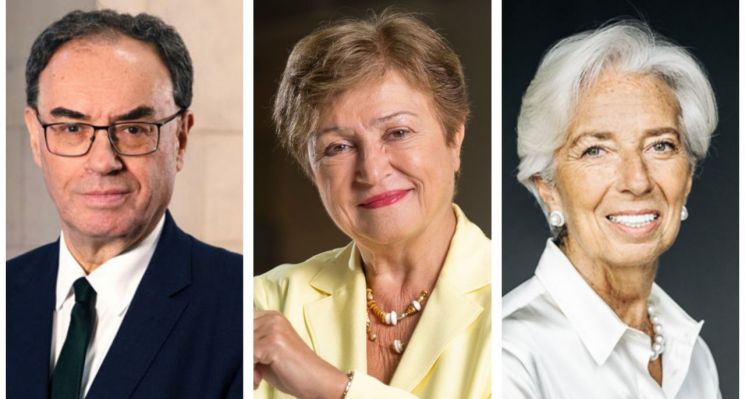 Andrew Bailey, Governor of the Bank of England (BOE), Kristalina Georgieva, Managing Director of the International Monetary Fund (IMF), Christine Lagarde, President of the European Central Bank (ECB). Photo by BOE, IMF, ECB
On the 4th (local time), U.S. President Donald Trump imposed a blanket 25% tariff on Mexico and Canada. In response, central bank governors worldwide unanimously warned that Trump's tariff policy could trigger trade frictions and inflation globally. It is also anticipated that by the end of this year, the impact of tariffs will become visible, affecting consumer goods such as food, clothing, electronics, and furniture.
According to reports from the UK’s BBC and The Guardian on the 5th (local time), Andrew Bailey, Governor of the Bank of England (BOE), stated during a Q&A session with UK Members of Parliament that Trump's tariff policy poses "considerable risks not only to the UK economy but also to the global economy."
Alan Taylor, a member of the BOE’s Monetary Policy Committee (MPC) who was present, also expressed concern, saying, "If you throw sand into the gears of trade, we will inevitably suffer losses in some way." Governor Bailey fully agreed with Taylor’s remarks, emphasizing that "trade supports growth, and openness promotes innovation and the spread of ideas."
The central bank governors concur that President Trump's tariffs not only directly affect exports from targeted countries but could also simultaneously cause economic slowdown and inflation if global supply chains collapse or are reorganized.
Kristalina Georgieva, Managing Director of the International Monetary Fund (IMF), also remotely attended an IMF event held in Tokyo, Japan, the previous day, stating, "We know that trade is no longer the driving force behind global economic growth as it once was," and added, "The new U.S. administration is rapidly changing policies on trade, taxation, public spending, deregulation, and digital assets, prompting other governments to readjust their policies accordingly."
John Williams, President of the Federal Reserve Bank of New York, said at a Bloomberg event held in New York the previous day, "We see the possibility that tariffs could affect inflation and prices," and predicted, "Some effects are expected to appear around the end of this year." Particularly, it is expected that the impact on consumption will be reflected quickly. Regarding the Fed’s decisions, he suggested a cautious approach, stating, "It is important to consider not only trade policy but also changes in fiscal and regulatory policies together."
In Europe, concerns are even greater as President Trump has indicated a focused attack. After taking office, Trump said, "The EU has done very, very bad things to us," and "Therefore, they will not be able to avoid tariffs." He also directly cited the value-added tax (VAT) held by most countries worldwide, including Europe, as a tariff barrier. According to the EU VAT directive, the EU imposes a minimum standard VAT rate of 15%, with some countries charging up to 27%.
Christine Lagarde, President of the European Central Bank (ECB), expressed in an interview with U.S. CNBC that Trump’s decision not to choose comprehensive tariffs was "wise." She noted, "Comprehensive tariffs may not necessarily bring the expected results," and pointed out that "the Trump administration’s tariff policy is more likely to be selective and focused on specific targets." In preparation for U.S. tariff policies, she advocated for the removal of trade barriers within Europe, stating, "Europe aims to build a single market, but obstacles still exist that hinder the smooth movement of goods and services."
The remarks from these governors came amid the global economy preparing for shocks due to the expansion of President Trump’s tariff policies and retaliatory measures by various countries. Trump has raised tariffs on China up to 20% and imposed the planned 25% tariffs on Mexico and Canada. The U.S. plans to enforce 25% tariffs on steel and aluminum starting on the 12th and will implement reciprocal tariff policies against the entire world beginning on the 2nd of next month.
Meanwhile, Governor Bailey also warned about the risks if the U.S. were to withdraw from international financial institutions such as the IMF and the World Bank. He expressed strong concern, saying, "The U.S. leaving these institutions would cause very serious damage to the global economy." However, he added that it is "very welcome" that U.S. Treasury Secretary Scott Bessent supports multilateralism.
© The Asia Business Daily(www.asiae.co.kr). All rights reserved.

















