The Korea Customs Service is launching a comprehensive inspection of origin labeling violations as part of its response to the United States' trade policies.
On the 6th, the Korea Customs Service announced that it has established a "Task Force for Origin Labeling Violation Response" to conduct a comprehensive inspection combining crackdowns, inspections, and guidance activities on origin labeling violations.
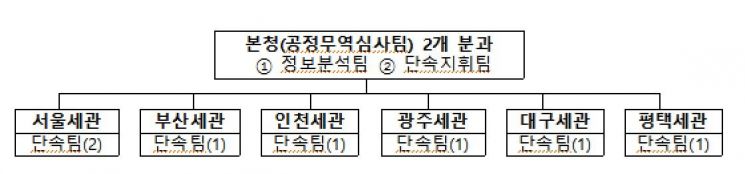 Organizational chart of the 'Dedicated Response Team for Origin Labeling Violations.' Provided by the Korea Customs Service
The comprehensive inspection will continue from the 6th of this month until the end of next month in response to the expected occurrence of origin labeling violations aimed at avoiding customs duties imposed under U.S. trade policies such as high tariffs.
Typical cases of customs duty avoidance include importing goods from third countries into Korea and then falsely labeling them as domestic products before re-exporting them to evade U.S. high tariffs, as well as importing third-country goods into Korea to enter alternative markets outside the U.S. and other existing markets, then disguising them as domestic products for distribution.
During the inspection period, the Korea Customs Service plans to analyze export-import transactions and tax records, focusing on items subject to U.S. anti-dumping and high tariff measures such as steel and automobile parts, to select companies with potential illegal activities for intensive crackdowns. In addition, the manufacturing process and actual products will be checked during the enforcement process to determine illegality.
The agency will also crack down on acts of intentionally damaging, altering, or falsely labeling the origin, and will respond strictly by imposing fines and requesting criminal investigations on detected cases.
However, for companies with insufficient origin labeling due to lack of awareness or simple mistakes, corrective actions will be taken upon the first detection, and penalties such as fines will be progressively increased from the second detection onward.
Under the current Foreign Trade Act, goods subject to origin labeling (imported goods and domestically produced goods using imported raw materials, etc.) must have their origin indicated in a prescribed manner (in a location easily readable by the final purchaser of the actual product).
For example, to label "Korea" as the origin on domestically produced goods using imported raw materials, the origin criteria under the Foreign Trade Act must be met. According to the Foreign Trade Management Regulations, for goods whose HS 6-digit classification changes during domestic production, the domestic cost ratio must be 51% or higher; for goods whose HS 6-digit classification does not change, the domestic cost ratio must be 85% or higher.
It is especially important to note that goods subjected only to simple processing activities such as packaging or simple cutting cannot be labeled as domestic products, as this would be illegal.
Violations such as failing to label the origin or providing misleading or false labeling may result in corrective orders, fines (up to 300 million KRW), and criminal penalties (up to 5 years imprisonment or fines up to 100 million KRW).
Yoon Ji-hye, head of the Fair Trade Review Team at the Korea Customs Service, stated, "Through this comprehensive inspection, we aim to preemptively block illegal origin labeling activities by exporters, importers, and distributors and encourage proper origin labeling. Since disguising low-priced foreign goods as domestic products directly affects public safety, the Korea Customs Service will continue to enforce crackdowns on origin labeling violations."
Meanwhile, the Korea Customs Service recorded origin labeling violation enforcement results of 253 cases (226.9 billion KRW) in 2020, 237 cases (193.3 billion KRW) in 2021, 258 cases (461.3 billion KRW) in 2022, 259 cases (526.5 billion KRW) in 2023, and 217 cases (156.7 billion KRW) in 2024.
© The Asia Business Daily(www.asiae.co.kr). All rights reserved.

















