Agricultural and Livestock Product Prices Up 0.6% Year-on-Year
Processed Foods Up 2.9%, Dining Out Up 3.0%
"Government to Focus on Supplying Stockpiled Quantities and Expanding Discount Support to Stabilize Vegetable Prices"
The government evaluated that consumer prices for agricultural and livestock products have maintained stability for seven consecutive months. However, prices for open-field vegetables such as cabbage and radish continue to rise due to supply shortages, prompting the government to focus on supplying stockpiled quantities and continue discount support measures.
The Ministry of Agriculture, Food and Rural Affairs announced on the 6th that consumer prices for agricultural and livestock products in February rose by 0.6% compared to the same period last year. Processed foods and dining out increased by 2.9% and 3.0%, respectively, compared to the previous year.
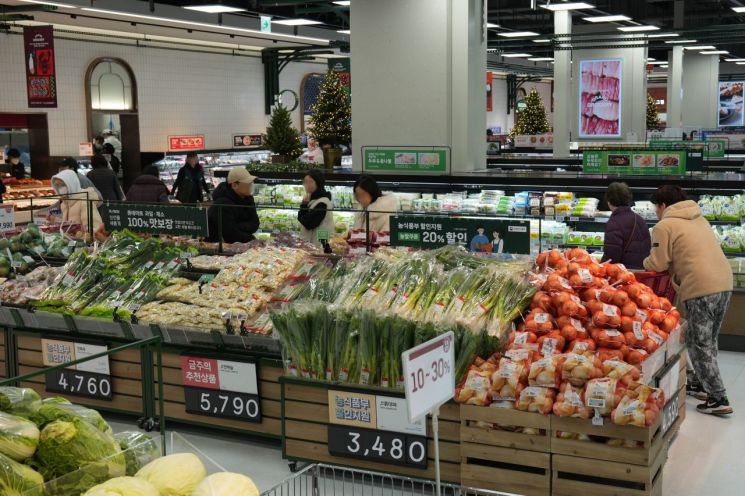
An official from the Ministry of Agriculture, Food and Rural Affairs stated, "The consumer price inflation rate for agricultural and livestock products, which rose 2.4% in December last year, recorded 1.8% in January and 0.6% in February this year, indicating continued stability in consumer prices for agricultural products, food, and dining out. In February, prices for fruits and facility-grown vegetables declined, resulting in a 1.2% decrease compared to the previous year."
However, prices for open-field vegetables such as cabbage, radish, and carrots continue to rise due to supply shortages. The ministry plans to focus on supplying government stockpiled quantities in preparation for increased demand for major vegetables following the reopening of schools in March and to continue discount support to alleviate consumer burdens.
In particular, for items with an absolute shortage in supply such as cabbage and radish, import volumes will be increased through measures such as tariff quotas, supplying mainly to actual users like kimchi manufacturers and food material companies. Additionally, alternative items such as spring cabbage, young radish, and young napa cabbage will receive both discount support and promotional efforts. To prevent continued supply shortages, the ministry will also promote the expansion of cultivation areas for spring cabbage and spring radish. To prepare for potential poor crop conditions due to unexpected weather changes, support for farmers will be expanded, including growth condition monitoring and nutrient supply.
Livestock products saw a 1.4% decrease from the previous month due to smooth supply across all livestock categories, but prices were 3.8% higher than the previous year when prices were low. The ministry plans to strengthen quarantine management to prevent livestock infectious diseases such as highly pathogenic avian influenza (AI) and African swine fever (ASF), and minimize supply and demand impacts through early detection and rapid response to outbreaks. Furthermore, in preparation for potential additional pork price increases due to rising spring demand, the ministry will review supply management and price stabilization measures through the Livestock Supply and Demand Adjustment Council.
Processed foods rose 0.3% from the previous month and 2.9% from the previous year. The ministry explained that price increases for processed products using raw materials such as cocoa and coffee are inevitable due to recent abnormal weather, reduced cultivation areas, and exchange rate impacts causing higher import raw material prices. Accordingly, tariff quotas on food raw materials, various tax and financial supports will be implemented, and continuous communication with the food industry will be maintained to stabilize food prices.
Dining out prices increased by 0.4% from the previous month and 3.0% from the previous year due to complex factors including food material costs, labor costs, rent, and delivery app commissions. The ministry plans to ease the management burden on the dining industry by expanding foreign workers and establishing and activating a public delivery app portal (scheduled for April).
Baemin-sik, head of the Agricultural and Food Supply Stability Support Group at the Ministry of Agriculture, Food and Rural Affairs, said, "To sustain the stability of agricultural and livestock product prices, we will strengthen crop management from the preparation stage of cultivation to harvest to create stable supply conditions, and expand stockpiling of major agricultural products to prepare for temporary supply-demand imbalances caused by sudden weather changes."
© The Asia Business Daily(www.asiae.co.kr). All rights reserved.
![Clutching a Stolen Dior Bag, Saying "I Hate Being Poor but Real"... The Grotesque Con of a "Human Knockoff" [Slate]](https://cwcontent.asiae.co.kr/asiaresize/183/2026021902243444107_1771435474.jpg)















