Trump Cites 'WTO Bound Tariff Rates' to Justify Claims
Unrelated to 13 Years of Korea-U.S. Trade Under FTA
Han Areum: "It Is Important to Highlight Korea's Efforts to Lower Trade Barriers"
U.S. President Donald Trump pressured South Korea by citing that Korea's average tariff rate is four times higher than that of the United States, invoking the principle of reciprocity. This ignores the reality that most tariffs on U.S.-bound goods have already been eliminated under the Korea-U.S. Free Trade Agreement (FTA) and refers to figures that do not actually apply to Korea-U.S. trade. Analysts interpret this as a 'Trump-style pressure' aimed at abolishing semiconductor subsidies and renegotiating defense cost-sharing.
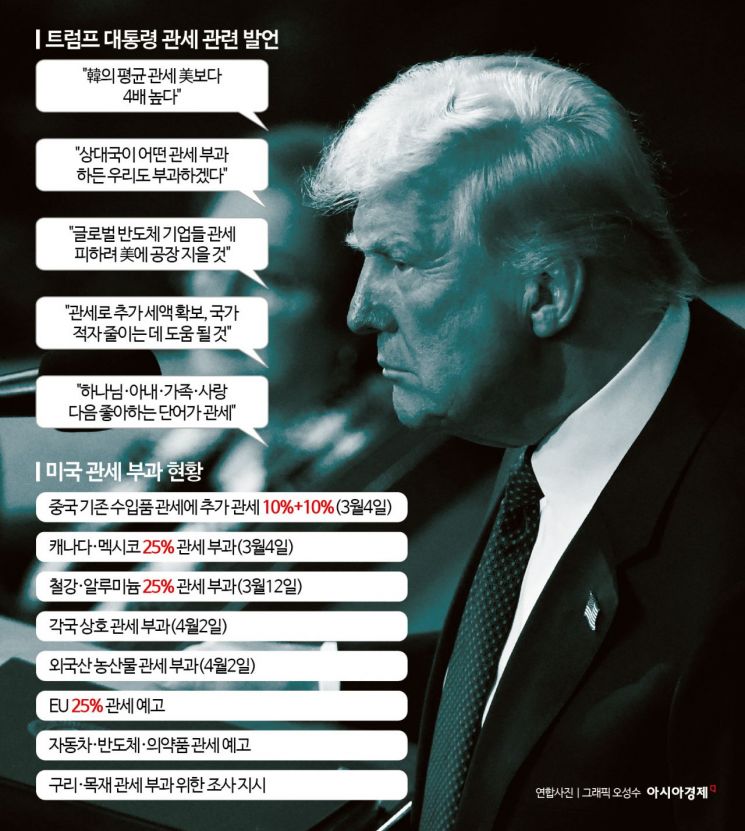
According to diplomatic sources on the 6th, President Trump has often used 'exaggerated rhetoric' to gain an upper hand over other countries in diplomatic and trade matters. His remarks during the joint session of the U.S. Congress the previous day are a typical example. President Trump claimed, "South Korea's average tariff rate is four times higher than (that of the United States)," and added, "Yet we provide South Korea with a lot of support militarily and in many other ways."
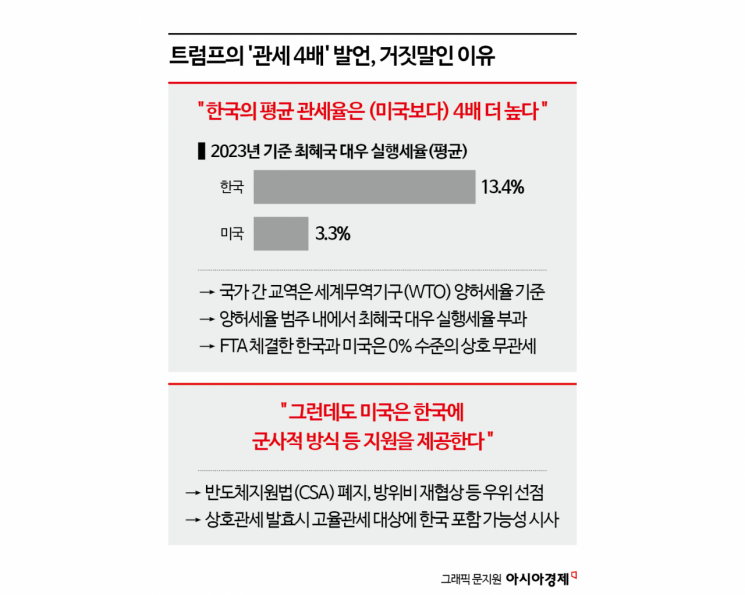
However, no concrete evidence was provided to support the claim that Korea's tariffs are four times those of the U.S. The blind spot lies in the term 'average' he used. Korea and the U.S. have applied 'mutual zero tariffs' to most traded items since the FTA was signed in 2012. According to data released by the Korea Institute for International Economic Policy (KIEP) in March 2022, both countries had completed tariff elimination on over 98% of export and import items at that time.
Industry and academia estimate that the 'average four times' claim likely stems from the World Trade Organization (WTO) bound tariff rates. Bound tariff rates represent the legally binding maximum tariff rates, while the Most Favored Nation (MFN) applied rates are the tariffs actually applied to WTO member countries.
In other words, tariffs are imposed on trading partners according to the MFN applied rates within the bound tariff rate limits. When the overall export and import items are averaged simply based on this standard, Korea's tariff rate in 2023 is 13.4%, and the U.S. tariff rate is 3.3%, which precisely converges to the 'average four times' figure. Korea's relatively higher tariff rate reflects defensive tariffs on agricultural imports. However, since Korea and the U.S. have an FTA, tariffs close to 0% are applied mutually, so such figures do not actually apply.
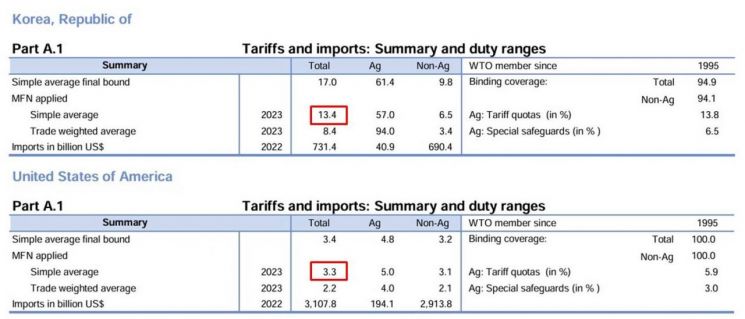 Final bound tariff rates and Most Favored Nation (MFN) applied tariff rates for South Korea and the United States as applied by the World Trade Organization (WTO) in 2023. Excerpted from WTO data.
President Trump has occasionally argued on economic issues that 'allies can be more harmful to the U.S. than adversaries.' This is why analysts believe the 'four times tariff' claim is a strategic move to gain leverage in the future repeal of the CHIPS Act (CSA) or renegotiation of defense cost-sharing. Above all, it is interpreted as a hint that South Korea might be included in the high tariff imposition list when the 'reciprocal tariffs' are scheduled to take effect on the 2nd of next month.
Since it is difficult for individual companies to counter the U.S. administration's policies, there are calls for the government to respond effectively. It is necessary to engage in multifaceted communication to prevent export companies from suffering damage.
Han Areum, a senior researcher at the Korea International Trade Association, advised, "South Korea has lowered tariff barriers against the U.S. through the FTA and has significantly reduced non-tariff barriers in services and regulatory easing according to U.S. demands. The high figures of Korea's exports to the U.S. also reflect the substantial investments Korean companies have made in the U.S. and the inclusion of intermediate goods, which should be efficiently communicated."
An official from the Ministry of Trade, Industry and Energy stated, "The MFN applied rates apply to WTO member countries without bilateral agreements and are irrelevant to Korea and the U.S., where FTA agreement rates apply," adding, "The government plans to actively explain these facts through various consultation channels with the U.S. in the future."
© The Asia Business Daily(www.asiae.co.kr). All rights reserved.
![Clutching a Stolen Dior Bag, Saying "I Hate Being Poor but Real"... The Grotesque Con of a "Human Knockoff" [Slate]](https://cwcontent.asiae.co.kr/asiaresize/183/2026021902243444107_1771435474.jpg)

















