National Assembly Culture, Sports and Tourism Committee Full Meeting
Minister Yoo: "If There Is Strong Opposition, We Will Not Proceed"
"Who exactly is the 'Cultural Vision 2035' for? We cannot understand why there is such a rush. We strongly urge an immediate halt to the policy announcement, followed by thorough consultations with the National Assembly and cultural and artistic organizations to revise the policy before re-announcing it." (Kim Jaewon, member of the Joguk Innovation Party)
"It is not hasty or unconsulted. Over the past year, we have held multiple meetings with many experts and gone through extensive processes." (Yoo Inchon, Minister of Culture, Sports and Tourism)
At the full meeting of the National Assembly’s Culture, Sports and Tourism Committee (CSTC) held on the 5th, a heated debate took place over the Ministry of Culture, Sports and Tourism’s (MCST) plan to integrate the boards of directors of five national arts organizations and establish a unified secretariat. Opposition party lawmakers criticized the integration plan as hasty and pushed forward without sufficient discussion, while Minister Yoo Inchon rebutted that ample discussions had taken place. However, Minister Yoo also stated that he would gather lawmakers’ opinions and conduct further discussions in the future, and if there is strong opposition, the integration plan would not be pursued.
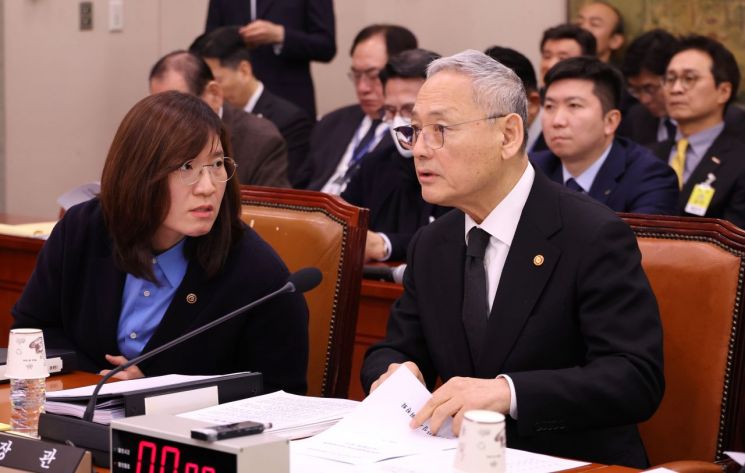 Yoo In-chon, Minister of Culture, Sports and Tourism, is conversing with Vice Minister Jang Mi-ran at the Culture, Sports and Tourism Committee plenary meeting held at the National Assembly in Yeouido, Seoul on the 5th.
 Photo by Yonhap News
The five national arts organizations targeted by the MCST for board and secretariat integration are the National Ballet Company, National Opera Company, National Symphony Orchestra, National Chorus, and National Contemporary Dance Company, all resident at the Seoul Arts Center. After the MCST’s integration plan became concrete, these five arts organizations publicly expressed opposition to the integration.
Kang Yoojung, a member of the Democratic Party of Korea, pointed out that the current integration plan runs counter to the MCST’s policy from 2000. She highlighted that in 2000, the National Opera Company, National Ballet Company, and National Chorus, which were under the National Theater of Korea, were made independent corporations, and said, "After 25 years, the current policy is going backward."
In response, Minister Yoo Inchon argued, "Only the secretariats are being integrated for joint operation; the organizations themselves are not being merged." He emphasized, "The only reason for pursuing integration is to enable the arts organizations to carry out their artistic activities more effectively and to reduce other administrative burdens."
Then, Kang Yoojung cited a 2011 research report by the Korea Culture & Tourism Institute on efficient integrated operation of national arts organizations to counterargue. Referring to the report’s findings, Kang said, "There is potential for conflicts among each organization, a high risk of reduced artistic autonomy, limited artistic synergy, administrative costs only increase, and it does not greatly help in creating an integrated organizational culture."
Even within the ruling party, calls for slowing down the process emerged.
Jo Seungsoo, a member of the People Power Party, advised, "I think there is no need to push forward with the integration plan if it will cause political misunderstandings."
Minister Yoo Inchon agreed with Jo’s comment, saying, "Actually, it’s okay not to do it."
When Im Okyung, a member of the Democratic Party of Korea, requested a complete re-examination of the integration plan from the starting point, Minister Yoo responded, "If you strongly oppose it, we will not proceed."
He also stressed that they would continue to gather opinions going forward. Minister Yoo said, "We are not deciding anything immediately or changing anything overnight. We will keep discussing so that the issue of national arts organizations will be settled around next year." However, he emphasized, "By April or May, we need to finalize next year’s budget, so we must set a certain direction for the national arts organizations now to prepare for the budget next year," and added, "We will continue to discuss and coordinate sufficiently."
The MCST is also promoting the relocation of national arts organizations to regional areas along with the integration of their boards and secretariats. The MCST plans to announce this mid- to long-term project in the fields of culture, sports, and tourism at the Government Seoul Office on the 6th.
Yong Hoseong, the first vice minister of the MCST, explained that the policy previously discussed under the title "Cultural Vision 2035" will be announced as "Cultural Korea 2035." He added that one of the main tasks is the balanced development of regional culture, and to achieve this, the MCST plans to relocate national arts organizations and institutions entirely to regional areas. Vice Minister Yong said, "The Seoul arts organizations will likely be expanded and reorganized into a National Asia Arts Organization and relocated to Gwangju as a leading initiative, and afterward, other arts organizations will find suitable regions and relocate accordingly."
© The Asia Business Daily(www.asiae.co.kr). All rights reserved.

















