TSMC's Employee Turnover Rate Soared to 17.6% in 2021
Annual Salary for Third-Year Engineers Reaches 140 Million KRW Including Bonuses
Many Leave for Vendor Companies Due to High Work Intensity
<1> TSMC, the God... Visiting the '2nm' Holy Land
<2> The '6 Challenges' Holding Back TSMC and Technology Security
<3> The Opening of Obscure Taiwan
<4> Korea-Taiwan, Between Deterrence and Cooperation
"Please refrain from hiring TSMC employees as much as possible."
Several years ago, TSMC, the world's No. 1 global semiconductor foundry, sent a letter to ASML, a Dutch supplier of extreme ultraviolet (EUV) lithography equipment. The letter requested that ASML refrain from hiring TSMC employees as much as possible. Although ASML is known as the 'super junior' in the semiconductor market, it could not ignore the requests of its major clients. Industry insiders say that even now, ASML tries to avoid hiring engineers from TSMC.
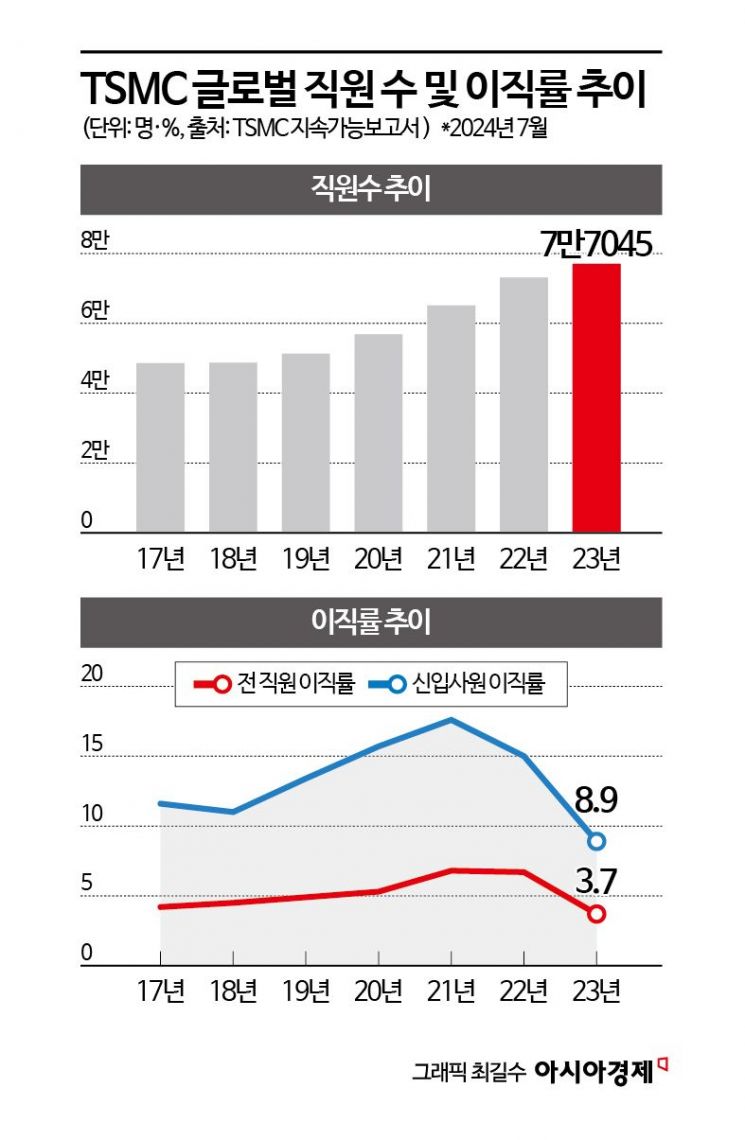
According to sources familiar with Taiwan's semiconductor industry on the 6th, when TSMC's new employee turnover rate soared to 17.6% in 2021, the company sent official letters to key partners asking them to refrain from hiring its employees. Since then, due to increased bonuses from improved performance and expanded dividends from rising stock prices, the turnover rate dropped to 15.0% in 2022 and 8.9% in 2023. The average turnover rate for all employees also decreased from 6.8% in 2021 and 6.7% in 2022 to 3.7% in 2023.
TSMC pays high annual bonuses to its approximately 70,000 employees in Taiwan. However, internally, there are still complaints that turnover remains significant due to the high work intensity, and that the company is neglecting fundamental improvement measures.
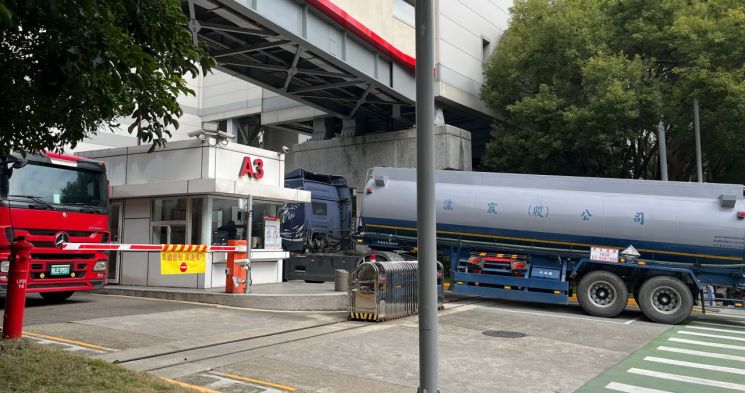 On the 20th of last month, trucks were entering and exiting the TSMC factory located in the Hsinchu Science Park, Taiwan. (Photo by Kim Hyunjung)
According to TSMC's Sustainability Report, the official median salary of TSMC employees (excluding pension and welfare benefits) was 2.5 million Taiwan dollars (approximately 110.95 million KRW) in 2023. Although it varies depending on specific work conditions and performance, a third-year TSMC engineer's annual salary, including bonuses, is known to be around 140 million KRW. This is among the highest levels in Taiwan, including the same industry, but it is insufficient to retain young engineers in their 20s and 30s who prioritize work-life balance.
Semiconductor production lines operate 24 hours a day, and employees work 10 to 12 hours daily. They are the so-called "Night Hawk Unit," guarding the factory in three shifts. Moreover, if a problem arises on the production line, the company culture still requires employees to come to work "regardless of circumstances," even in the middle of the night. In 2021, a local engineer working at TSMC's U.S. plant posted a critical review on Glassdoor, the world's largest workplace evaluation site, complaining about excessively long working hours and lack of respect for personal life, sparking controversy.
An industry insider who requested anonymity said, "One of the most common personal questions managers at TSMC ask employees is 'Have you bought a house?'" He explained, "Because real estate prices in Taiwan are relatively high, it is assumed that employees cannot easily quit for about 7 to 8 years due to mortgage loans." He added, "In other words, engineers who have been with the company for more than 7 years often repay more than 30% of their loans and prepare to leave, with many moving to vendor companies where the salary is lower but work intensity is less."
The insider emphasized, "Manufacturing should have a pyramid structure where the number of workers increases steadily at lower ranks, but TSMC is at great risk of this structure collapsing. There are dips in the middle, and many employees leave en masse at certain years of service, posing a significant risk to TSMC."
© The Asia Business Daily(www.asiae.co.kr). All rights reserved.


















