Specific Projects to Be Announced Later
Hong Youngjun, Head of Technology Research Institute, Held Q&A Sessions
LMR Mass Production Decision Expected This Year; Scale Undecided
Um Ki-cheon, CEO of POSCO Future M, expressed a positive outlook on this year's performance, stating that love calls are pouring in from automakers due to the de-China crisis.
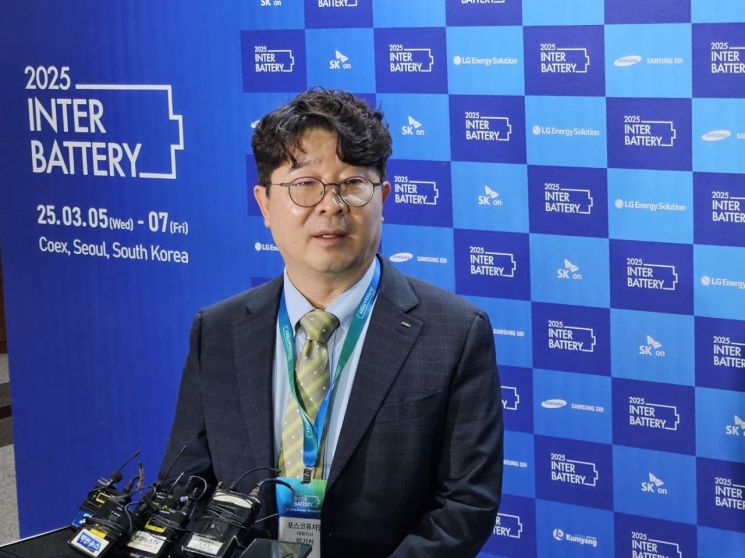 Eom Gi-cheon, President of POSCO Future M, is answering questions from the press. Joint coverage team of InterBattery 2025
On the 5th, at the 'InterBattery 2025' event held at COEX in Seoul, CEO Um told reporters, "The recent de-China crisis is extremely strong, and because of this, we are receiving many love calls from automakers," adding, "POSCO Future M has value chains for both anode and cathode materials, so automakers are coming down to the material level and seeking out our company."
He continued, "Specific projects have not yet been decided and are under review," adding, "We will disclose them once some decisions are made."
In response to criticism that POSCO Future M seems to be shrinking under the leadership of POSCO Group Chairman Jang In-hwa, CEO Um rebutted, saying, "That is a misconception." He emphasized, "Our group fundamentally operates on two pillars: steel and secondary batteries, so we have only extended projects and have not reduced the planned secondary battery business."
POSCO Future M decided to sell its Gumi cathode material plant last month. Regarding the proceeds from the sale, CEO Um said, "We have first solidified our financial structure," adding, "We have ongoing projects that have started construction, and the funds will be used for these." He further stated, "We have liquidated unprofitable businesses and plan to also liquidate P&OK Chemical."
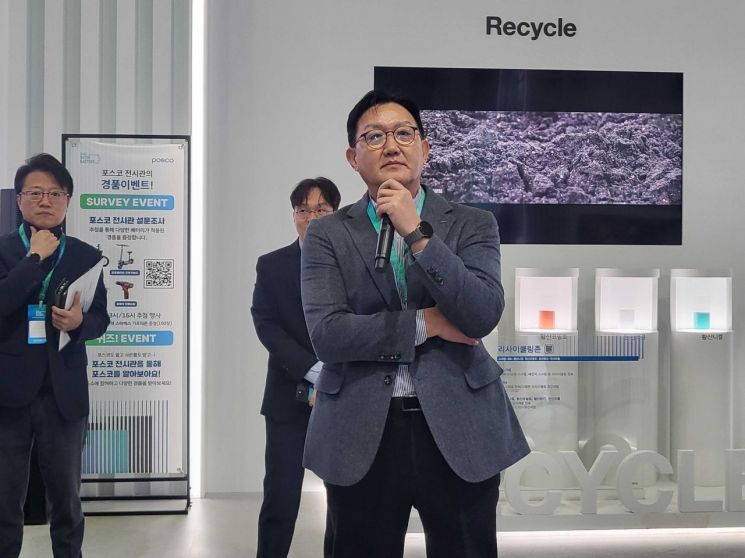 On the 5th, Hong Young-jun, head of the POSCO Future M Technology Research Institute, is answering questions from the press at the POSCO Future M booth at 'InterBattery 2025'. Photo by Shim Sung-ah
At the POSCO Future M booth that day, Hong Young-jun, head of POSCO Future M’s Technology Research Institute, conducted about 10 Q&A sessions.
Director Hong said, "Competition with China over lithium iron phosphate (LFP) is not a technological battle but a battle of investment amounts," adding, "Therefore, we judged it would be difficult to beat the Chinese government and developed a new manganese-rich (LMR) material."
LMR is a material that lowers the proportion of nickel and cobalt while increasing manganese content to enhance price competitiveness and stability. LMR batteries, when recycled, can achieve a price similar to LFP while providing 30% higher energy density. Director Hong explained, "The biggest problem with LFP is disposal, but considering recycling, LMR can produce prices equal to or cheaper than LFP."
Regarding mass production of LMR, he said, "The decision on mass production will be made this year," adding, "We need to discuss the scale of mass production with customers. It will take about 2 to 3 years to expand."
On the anode material business, Director Hong stated, "We have reduced the manufacturing cost of anode materials by 44%, but there is still a price gap with China," adding, "We plan to reduce it by about 30% more by 2027." He continued, "We are considering raw material diversification technology using inexpensive and widely available raw materials, which is expected to take about two years."
Regarding the solid-state battery development plan, Director Hong said, "Originally, we expected around 2028, but with China entering the competition, we are preparing for mass production by 2027," adding, "We see a jump when the new product’s market share reaches about 2%, and we expect it will take about 5 to 7 years to reach that point."
© The Asia Business Daily(www.asiae.co.kr). All rights reserved.


















