People Power Party Holds Grand Debate on Spy Crime Amendment
Emphasis on Expanding Spy Crime Targets to Foreign Entities
Na Kyungwon: "If You Don't Cooperate, You're No Different from a Spy"
Following Semiconductor and Inheritance Tax Laws, Now Spy Crime
Highlighting Economic and Security Bills to Appeal to Centrist Voters
On the 5th, Na Kyung-won, a member of the People Power Party, attacked Lee Jae-myung, leader of the Democratic Party of Korea, who proposed a Korean-style Nvidia equity sharing plan in which a national wealth fund jointly invests to secure shares in AI-related companies requiring large-scale investment, saying, "Looking at the behavior of Lee and the Democratic Party related to spy investigations, I question whether the society they dream of is possible."
This statement directly targeted the Democratic Party, which is considering expanding the definition of spies under the criminal law, currently limited to North Korea, to include foreign countries and equivalent organizations. Following recent pressures through the Semiconductor Special Act containing exceptions to the 52-hour workweek and amendments to the inheritance tax law, the introduction of the spy crime amendment is interpreted as an attack on the opposition party regarding systems directly related to people's livelihoods and a strategy to court the centrist voters sensitive to economic and livelihood policies.
In his opening remarks at the "Is Spy Investigation Properly Conducted? Grand Debate on the Spy Crime Amendment" co-hosted by 16 People Power Party lawmakers at the National Assembly Members' Office Building that morning, Na said, "Lee's K-Nvidia remarks are heating things up. He says, 'Let's divide it by 70:30,' 'Let's distribute it to the people.' How can something be divided before it even exists? This is not a shift in thinking but a delusional illness." He continued, "The Democratic Party transferred the investigative authority for spy crimes from the National Intelligence Service to the police in 2020," adding, "Hundreds of cases were transferred, but none were properly prosecuted, and I understand only two spies were caught."
According to the National Police Agency, technology leaks from Korean companies have sharply increased each year, from 9 cases in 2021 to 12 in 2022, and 22 in 2023. Additionally, the National Intelligence Service's Industrial Secrets Protection Center estimates that technology leakage crimes cause economic losses of about 60 trillion won annually. In response, the National Assembly's Legislation and Judiciary Committee's Subcommittee on Bill Examination passed the spy crime amendment last November through bipartisan agreement, but discussions have effectively stalled since the December 3 emergency martial law incident.
Na also said, "I remember Democratic Party lawmakers saying, 'When was the enemy ever a spy? Are all military secrets state secrets?'" He added, "I find that chilling. If Lee's Democratic Party does not promptly cooperate on the spy crime amendment, I want to say there is no difference from being a spy."
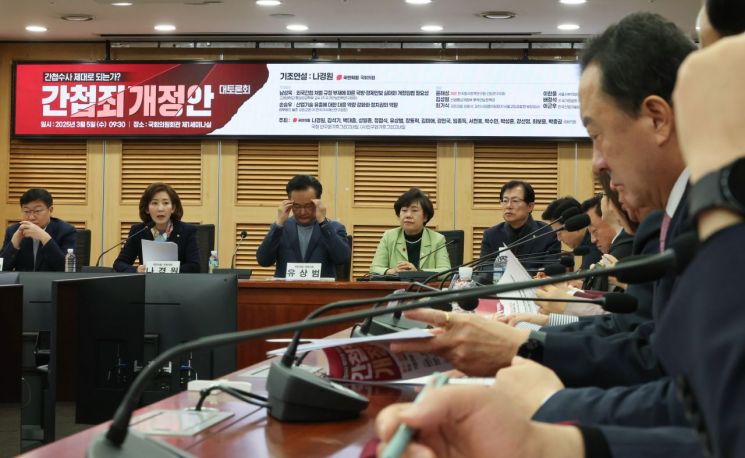
Jeong Jeom-sik also mentioned that opinions on amending Article 98 of the Criminal Act, which stipulates the spy crime to punish foreign espionage activities, have been continuously raised, saying, "Even in the 22nd National Assembly, discussions progressed considerably but failed to be approved in the plenary session due to opposition from the Democratic Party, leading to the current situation." He urged, "There is a saying, 'Fix the barn after losing the cow,' but even now, shouldn't we amend Article 98 to protect the remaining cows?" Yoo Sang-beom, the floor leader of the National Assembly's Legislation and Judiciary Committee, criticized, "The spy law is a typical national security law and has nothing to do with presidential impeachment," adding, "The Democratic Party shows no will to pass the spy law, so the passage of the amendment continues to be delayed."
© The Asia Business Daily(www.asiae.co.kr). All rights reserved.

















