Fiscal Deficit Ratio Expanded to 4% of GDP
Emphasis on Domestic Demand
The Chinese government has set this year's economic growth target at around 5%, the same as last year. Amid prolonged economic recession and the intensifying trade war with the Donald Trump administration in the United States, it is expected to actively pursue economic stimulus measures to achieve the 5% target.
On the 5th, Li Chang, Premier of the State Council of China, announced this economic growth target during the government work report at the opening ceremony of the National People's Congress (NPC) held at the Great Hall of the People in Beijing.
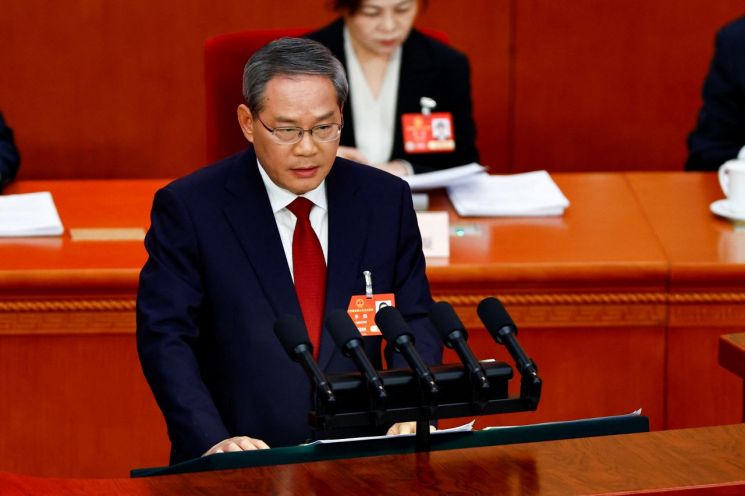 Premier Li Qiang of China is delivering the government work report at the opening ceremony of the National People's Congress (NPC) held at the Great Hall of the People in Beijing on the 5th. Photo by Reuters Yonhap News
This marks the third consecutive year at the same level and is an aggressive figure compared to overseas forecasts such as the World Bank (WB, 4.5%), the Organisation for Economic Co-operation and Development (OECD, 4.5%), the International Monetary Fund (IMF, 4.6%), and the Bank of Korea (mid-4%). Given the ongoing economic recession and the escalating US-China trade war, this target is considered challenging. Exports accounted for about one-third of China's economic growth last year. Premier Li explained the need for "employment stability, risk prevention, and improvement of people's livelihoods."
This year's consumer price index (CPI) target was lowered to 2%, below 3% for the first time since 2004. This is the lowest in 20 years, and Bloomberg interpreted it as a sign that China is finally acknowledging deflationary pressures (economic recession with falling prices). China's January CPI rose only 0.5% year-on-year, maintaining concerns about deflation.
Premier Li emphasized domestic demand, stating, "The goal is to improve the supply-demand relationship and keep the overall price level within a reasonable range." He also identified promoting consumption and improving investment efficiency to make domestic demand the main driver of the economy as key tasks for this year.
The fiscal deficit ratio was expanded to 4% of gross domestic product (GDP), the highest level since 1994. This indicates an intention to expand government spending through active fiscal policy. In December last year, the Chinese government announced a "more proactive fiscal policy" at the Central Economic Work Conference and set "appropriately accommodative monetary policy" as the direction of economic policy for the first time in 14 years.
Bloomberg explained, "China has tried to keep the official deficit below 3% of GDP for decades, and exceeding this indicates that President Xi Jinping is willing to take unconventional measures to stimulate domestic demand as the trade war with President Trump threatens exports."
The Chinese government plans to issue new special local government bonds worth 4.4 trillion yuan (approximately 882 trillion won) this year. This is the largest ever, an increase of 500 billion yuan compared to last year. Additionally, ultra-long-term special national bonds will be issued worth 1.3 trillion yuan (approximately 261 trillion won).
With domestic demand stimulation as a major task, subsidies for replacement purchases of consumer goods have been more than doubled to 300 billion yuan (approximately 60 trillion won) compared to last year.
Eswar Prasad, a Cornell University professor and former head of the IMF China division, evaluated, "Amid unfavorable external conditions and entrenched deflationary pressures, stimulating household consumption demand has become a key task. While one-off policies may provide some support, fundamental measures to provide sustained income support and strengthen social safety nets are essential."
As China's artificial intelligence (AI) DeepSeek has caused a global sensation, this year's science and technology research and development (R&D) budget was increased by 10% compared to the previous year. Premier Li stated in the report that advanced industries will continue to be supported and investment efficiency improved.
This year's defense budget increase was set at 7.2% compared to the previous year, the same growth rate as the past two years.
The urban unemployment rate target remains at 5.5%, the same figure maintained annually since 2020. New employment is targeted at 12 million, unchanged from last year.
© The Asia Business Daily(www.asiae.co.kr). All rights reserved.

















