Interview with Gangnam District Mayor Jo Seong-myeong
Gangnam Drives Seoul's Medical Tourism Industry Worth at Least 1 Trillion Won
"Korea's Key Growth Engine, Major Impact on Local Economy"
Introducing 'Emergency Treatment Clinic' for Weekend and Nighttime Care
New 'Integrated Support Center' for Addiction Issues Including Drugs
Gangnam-gu, Seoul is the mecca of the medical tourism industry. Gangnam is home to dermatology and plastic surgery clinics that are mainly visited by foreign medical tourists, and the infrastructure for related industries such as hotels, shopping, and beauty is well established.
On the 28th of last month, meeting in the district office, Jo Seong-myeong, the mayor of Gangnam-gu, emphasized that “the development of the medical tourism industry is more important than ever.” In a crisis situation marked by economic recession and weakening manufacturing competitiveness, the expansion of the foreign medical tourism industry, which has a significant ripple effect on related industries, is essential not only for the local economy and job creation but also for our national economy.
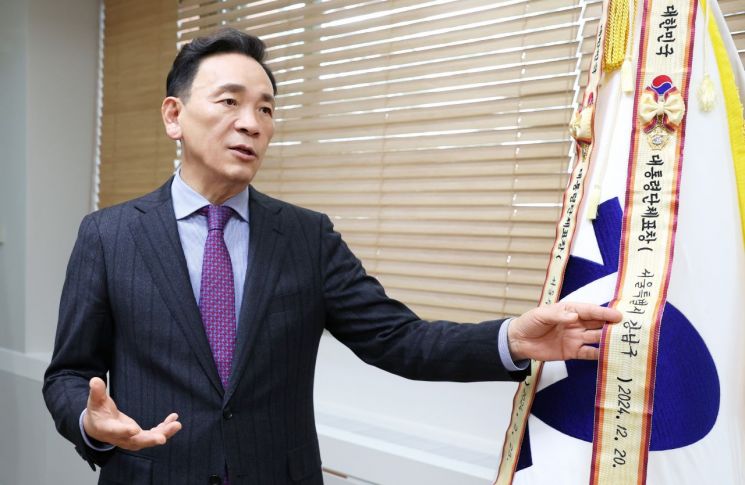 Gangnam-gu Mayor Jo Seong-myeong showed reporters the presidential citation streamer (a ribboned flag awarded to meritorious organizations) hanging on the Gangnam-gu flag and smiled, saying, "At first, I thought it was something we received routinely because the staff won many awards, but after becoming mayor, I realized they really work hard." Over the past two and a half years, Gangnam-gu has received 130 awards from government and external organizations and secured more than 1 billion won in performance bonuses. Provided by Gangnam-gu.
Mayor Jo said, “Medical tourists spend much more than general tourists,” and estimated that the number of foreigners who visited Gangnam for medical tourism surpassed 200,000 last year. He explained, “The spread of Hallyu culture such as K-pop, K-drama, and K-beauty, combined with the competitiveness of domestic medical technology and Gangnam-gu’s medical tourism support policies, is creating a strong synergy effect.”
According to statistics from the Ministry of Health and Welfare, 78% of medical tourists visiting Korea receive medical services in Seoul annually. In particular, 4 out of 10 foreign medical tourists visiting Seoul receive procedures, treatments, or surgeries at hospitals and clinics in Gangnam-gu. Official statistics show that the number of foreign patients visiting Gangnam-gu in the year before last was 185,559, a 210% increase from the previous year. This figure is also 1.4 times higher than the pre-COVID-19 peak of 131,808 in 2019.
Jo, who took office in July 2022, set a plan to increase the number of foreign medical tourists in Gangnam-gu from 23,734 (based on 2021) to 150,000 by 2026 and formulated a medical tourism industry development plan. This plan showed results exceeding 180,000 within two years of his term, and now the target has been raised to the 200,000 range.
The surge in medical tourists was largely due to the end of the COVID-19 pandemic and the influence of Hallyu, but various support policies promoted by Gangnam-gu also played a role. Mayor Jo said, “The good results in a short time were because we actively supported the services that medical tourists, who visit unfamiliar foreign countries for treatment, want.”
Two years ago, Gangnam-gu renovated the Gangnam Medical Tour Center in Apgujeong-dong and reopened it as a comprehensive community center for foreign medical tourists. Last year, more than 12,500 people visited this center. It is staffed by professionals who provide consultation, medical appointment services, and interpretation in four languages, as well as operate K-culture programs. The online platform “Medical Gangnam” had nearly 200,000 users last year.
Mayor Jo said, “The customized concierge service, which picks up visitors by limousine immediately upon arrival at the airport, guides them to hospitals or hotels, and provides free interpretation in nine languages to facilitate communication with medical staff during consultations or treatments, is also a highly satisfactory policy.”
Mayor Jo is also passionate about the sharing medical project that annually invites foreign children who cannot receive treatment due to economic difficulties to Korea for treatment. He recalled the memorable case of collaborating with local hospitals to create ears for a Mongolian girl suffering from microtia (a congenital deformity where the ear is not properly formed). This case became an issue even in Mongolia and helped establish the image of “kind and safe Gangnam medical care.”
Data supports Mayor Jo’s claims. According to the Korea Tourism Organization’s Data Lab, based on credit card usage, last year’s foreign medical tourism expenditure exceeded 1 trillion won nationwide and in Seoul for the first time. Of the nationwide 1.244 trillion won, 1.099 trillion won was spent by foreigners using credit cards at hospitals and clinics in Seoul. The expenditure in Seoul was 471.8 billion won last year and 207.1 billion won in 2023.
Considering that Gangnam-gu accounts for about 40% of Seoul’s medical tourism, sales of approximately 440 billion won were generated in Gangnam alone. Mayor Jo said, “Although it is difficult to quantify the effects on related industries such as accommodation, shopping, and beauty, the share in terms of jobs and the local economy is enormous.”
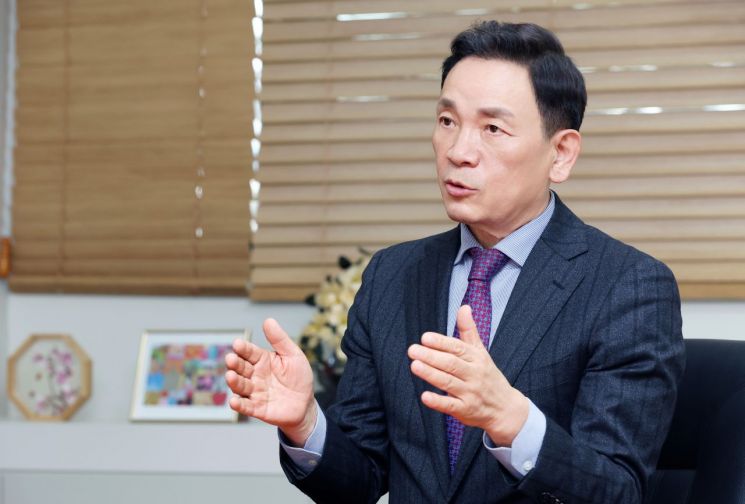 Gangnam-gu plans to establish an 'Emergency Medical Clinic' and an 'Integrated Support Center' for addiction such as drugs at the public health center this year. District Mayor Jo Seong-myeong is explaining the medical support policy for Gangnam residents. Provided by Gangnam-gu.
While medical tourism revitalizes the local economy, initiatives such as the introduction of an “Emergency Treatment Clinic,” the establishment of an “Integrated Support Center” for addiction issues including drugs, a senior-exclusive health club called “Smart Fitness Center,” and “Health Check-up” services are health protection projects targeting Gangnam residents.
Regarding the Emergency Treatment Clinic that Gangnam-gu plans to introduce this year, Mayor Jo said, “This project was conceived after seeing media reports that general hospital emergency rooms have no capacity to care for critically ill patients because they are treating mild cases.” He added, “If light illnesses or injuries are treated at public health centers during evenings or weekends when hospitals are closed, residents can receive necessary treatment quickly, and hospital emergency rooms can focus their capacity on critical patients, creating a win-win situation for all.”
Additionally, Mayor Jo said, “We plan to establish the first Integrated Support Center in the Gangnam area this year to treat addiction to drugs, substances, gambling, and the internet.” Such facilities do not exist anywhere in Seoul, including Gangnam-gu and the Gangnam area.
© The Asia Business Daily(www.asiae.co.kr). All rights reserved.
![Clutching a Stolen Dior Bag, Saying "I Hate Being Poor but Real"... The Grotesque Con of a "Human Knockoff" [Slate]](https://cwcontent.asiae.co.kr/asiaresize/183/2026021902243444107_1771435474.jpg)
















