Zelensky: "Immediate Ceasefire Possible in the Air and at Sea"
"Most U.S.-Supplied Weapons Are Missiles, Irreplaceable"
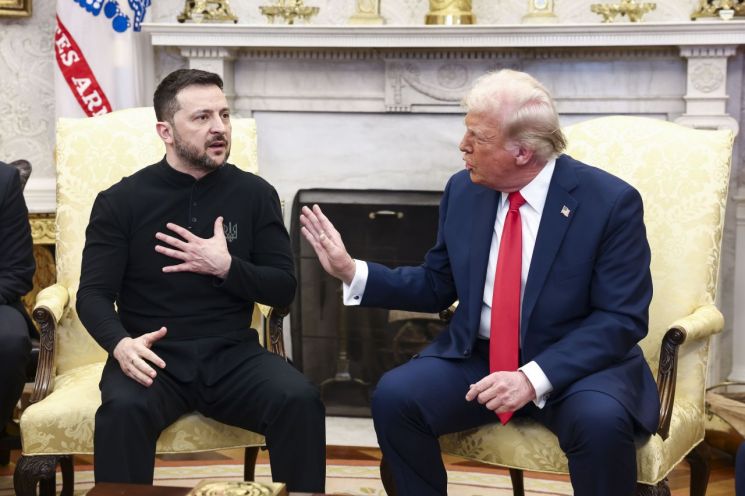 On the 28th of last month (local time), U.S. President Donald Trump (right) and Ukrainian President Volodymyr Zelensky (left) held a summit meeting. The negotiations ended in failure as differences over the ceasefire talks and mineral agreements could not be resolved. Photo by UPI and Yonhap News.
As U.S. President Donald Trump halts military aid to Ukraine, the Ukrainian forces are immediately facing a shortage of weapons. Although the proportion of U.S. military support to Ukraine is lower than that of European countries, most of it consists of essential missiles and shells on the battlefield, which is expected to have a significant impact. Both inside and outside the Ukrainian military, pessimistic forecasts suggest that if U.S. support is not resumed, the front lines may only be maintainable for about six more months.
Trump’s Order to "Cut Off Weapon Support" Prompts Zelensky’s Rapid Shift in Stance
 In June last year, Ukrainian President Volodymyr Zelensky visited Germany to inspect the Patriot missiles supplied by the United States. Photo by Reuters and Yonhap News
According to CNN on the 4th (local time), Ukrainian President Volodymyr Zelensky posted on the social media platform X (formerly Twitter), stating, "We are ready to strive for lasting peace under President Trump’s strong leadership," and proposed, "As the first step toward ending the war, we can immediately implement prisoner releases, a ceasefire in the air?meaning a ban on missile, long-range drone, energy, and civilian infrastructure attacks?and an immediate ceasefire at sea."
This marked a dramatic shift from Zelensky’s previous stance, which had fiercely criticized the U.S. after peace talks with President Trump broke down on the 28th of last month, to actively accepting Trump’s peace proposal. Zelensky’s change in position came immediately after the Trump administration announced it would halt all military aid to Ukraine.
According to the Associated Press, the U.S. government stopped all shipments of aid to Ukraine at 3:03 a.m. on the 4th. This was in accordance with President Trump’s order to suspend support following the breakdown of negotiations with President Zelensky. The U.S. Department of Defense also stated, "All military assistance currently provided will be suspended until President Donald Trump determines that Ukrainian leaders have demonstrated 'a good-faith commitment to peace.'"
U.S. Support Accounts for 20% of Weapons but Is Essential for Maintaining the Front
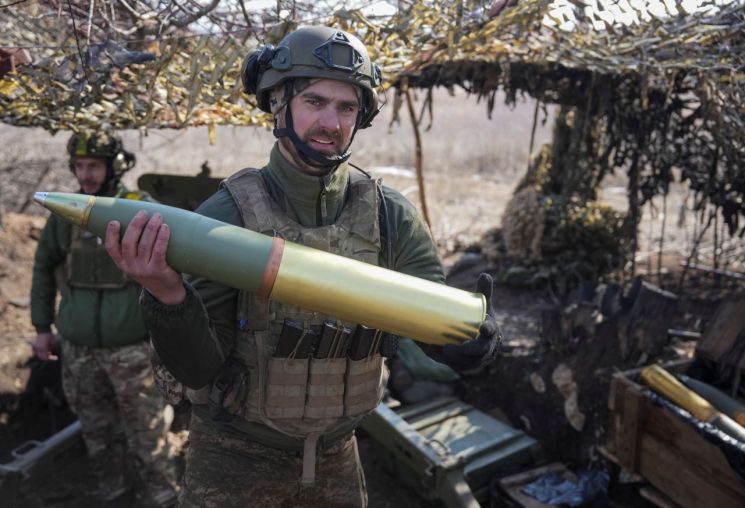 On the 3rd (local time), Ukrainian artillery soldiers engaged in combat on the eastern Donetsk front in Ukraine are moving howitzer shells. Photo by Reuters and Yonhap News Agency
The main reason President Zelensky quickly changed his stance after the U.S. halted weapon support is believed to be Ukraine’s heavy dependence on the weapons supplied by the U.S. According to CNBC, the Ukrainian military currently sources about 55% of its weapons domestically, 25% from European countries including the European Union (EU), and approximately 20% from the U.S. However, the weapons sent by the U.S. are known to be crucial for maintaining the front lines, making the dependence very high.
According to The Wall Street Journal (WSJ), since the outbreak of the Ukraine war, the U.S. government has provided over $120 billion (approximately 174.7 trillion KRW) worth of weapons to Ukraine, including essential arms such as anti-aircraft missiles, anti-tank missiles, and 155mm shells necessary for sustaining the front lines. If the U.S. weapon support suspension continues for a long period, the Ukrainian forces may suffer from shell shortages, potentially leading to a contraction of the front lines.
WSJ pointed out, "If U.S. support is completely cut off, Ukraine will lose supplies of some sophisticated weapons, including advanced air defense systems, surface-to-surface ballistic missiles, navigation systems, and long-range rocket artillery," adding, "Surface-to-surface tactical missiles like ATACMS and the highly mobile artillery rocket system HIMARS, which have become key weapons for Ukraine, are produced only by the U.S."
If U.S. weapon support is fully blocked, it is forecasted that Ukraine will find it difficult to maintain the front lines for more than six months. The British BBC quoted a soldier from the Ukrainian frontline area saying, "Since the U.S. support was cut off, we might be able to hold out for about six months," and added, "The cost of this decision will be measured in the lives lost."
© The Asia Business Daily(www.asiae.co.kr). All rights reserved.



















