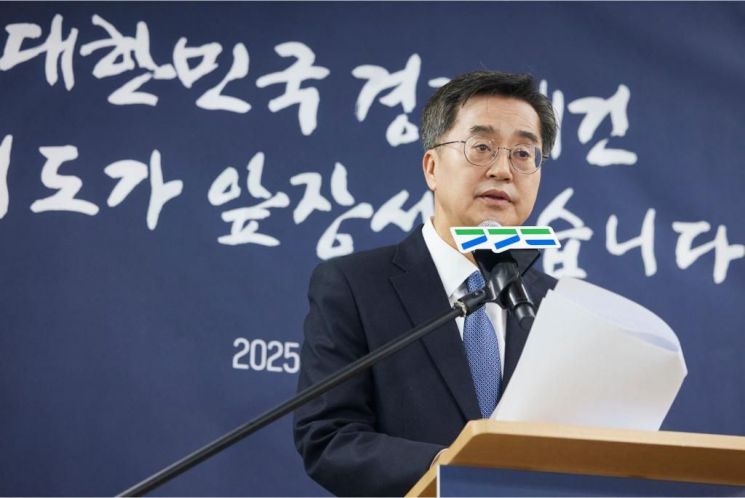
Gyeonggi Province Governor Kim Dong-yeon stated on the 4th that he cannot agree with the announcement of the constitutional amendment proposed by Incheon Mayor Yoo Jeong-bok, which centers on a four-year presidential term with one re-election and the introduction of a bicameral legislature, as the content was not coordinated.
The Gyeonggi Province spokesperson's office said on the same day, "Governor Kim Dong-yeon has not had any discussions regarding the constitutional amendment announced under the name of the Council of Governors of Provinces and Metropolitan Cities by Incheon Mayor Yoo Jeong-bok," and added, "He does not agree with the uncoordinated content."
Earlier, Yoo Jeong-bok, the chairman of the Council of Governors of Provinces and Metropolitan Cities of the Republic of Korea, composed of heads of metropolitan local governments nationwide, held a press conference at the National Assembly and announced a constitutional amendment focusing on a four-year presidential term with one re-election and the introduction of a bicameral legislature.
The amendment divides the National Assembly into an upper house and a lower house to improve the 'winner-takes-all' electoral system.
The upper house would consist of representatives from metropolitan local governments, while the lower house members would be elected by the current electoral method, with the introduction of medium and large electoral districts.
Additionally, a president and vice president system would be introduced so that in the event of a presidential vacancy, the vice president elected by election would succeed the presidency to minimize political confusion, and the president, serving a four-year term, could be re-elected once.
To enable local governments to realize substantial autonomy, 'autonomous legislative power' was codified, and local governments were granted the 'right to establish new local taxes,' allowing them to add local tax items and rates according to their circumstances.
Along with this, a 'right to autonomous planning' was newly established to allow local governments to formulate autonomous plans differing from uniformly regulated laws in areas such as housing, education, environment, and regional planning when necessary.
The constitution also included provisions for the Central-Local Cooperation Council alongside the State Council to allow the central and local governments to consult on major national policies as equals.
© The Asia Business Daily(www.asiae.co.kr). All rights reserved.
![Clutching a Stolen Dior Bag, Saying "I Hate Being Poor but Real"... The Grotesque Con of a "Human Knockoff" [Slate]](https://cwcontent.asiae.co.kr/asiaresize/183/2026021902243444107_1771435474.jpg)















