Three Months After the Passage of the AI Basic Act, Companies Criticize It as a Regulatory Rather Than Promotional Law
65 AI Experts Join Forces to Establish the 'AI Basic Act Amendment Research Committee'
Studying Amendments to the AI Basic Act: Scope of Application, Obligations, and Rationalization of Sanctions
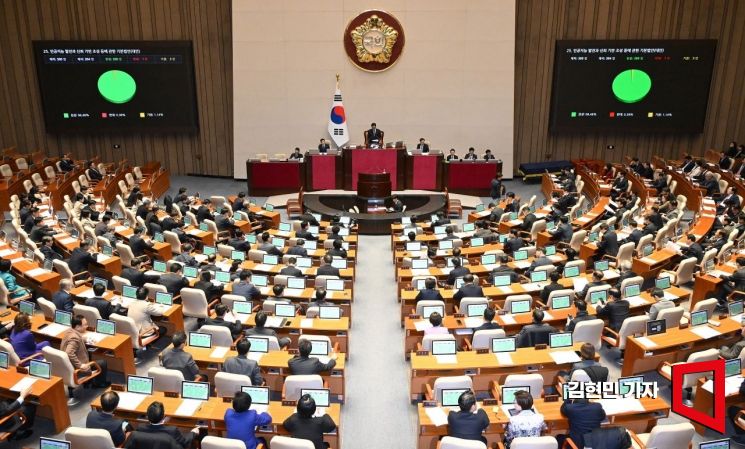 On the 26th, the 'Basic Act on the Development of Artificial Intelligence and the Establishment of a Trust-Based System (AI Basic Act)' was passed in the National Assembly plenary session. Photo by Kim Hyun-min
Amid criticism that the 'AI Basic Act (Basic Act on the Development of Artificial Intelligence and the Establishment of a Trust-Based System)' passed by the National Assembly last December was hastily legislated, AI experts have begun research on amendments. According to a compilation of Asia Economy's coverage on the 7th, the Korean Artificial Intelligence (AI) Law Society, an expert group exploring laws, systems, and policies related to AI technology, formed the 'AI Basic Act Amendment Research Committee' on the 25th of last month.
The Amendment Research Committee includes 65 AI experts. Divided into five subcommittees, they are tasked with studying the scope of application and obligations of the AI Basic Act, rationalizing investigation and sanctions, and establishing special provisions to support innovation. The chair of the general subcommittee is Professor Choi Kyung-jin of Gachon University’s Law Department, who is also the president of the Korean AI Law Society.
Particularly controversial among the AI Basic Act provisions are the requirements to be cultivated when developing AI, specified as ‘safety, reliability, and accessibility.’ Ambiguous terms like ‘high-impact AI,’ which impose various responsibilities, are also problematic. As companies lament the difficulty of developing AI while meeting such vague standards, experts have moved to propose and recommend amendment directions to the government.
South Korea’s AI Basic Act Modeled After the EU AI Act, Which Faces Criticism
The AI Basic Act passed the plenary session of the National Assembly on December 26 last year and is set to be enforced in January next year. The AI Basic Act was modeled after the European Union’s (EU) ‘AI Act (ACT),’ which was the world’s first AI law enacted last year, particularly its sanctions on high-risk AI creations. French President Emmanuel Macron sharply criticized the EU AI Act in an interview with CNN last month, stating, "Europe is falling behind in competition due to the (regulation-heavy) AI law," and warned that "Europe risks losing control over the direction of technological development and becoming merely a consumer of AI." Thus, the EU AI Act has been a target of criticism.
For these reasons, South Korea’s AI Basic Act has also been criticized by academia and industry as unrealistic and focused more on regulation than promotion. The regulatory content is vague and broad, raising concerns that all companies developing AI-related technologies could be subject to this law.
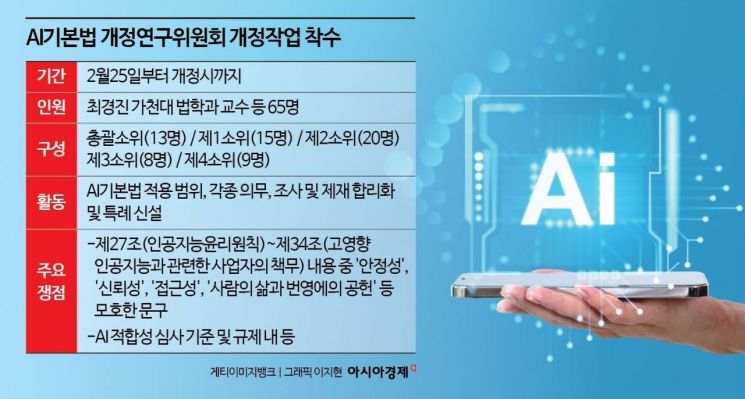
Focus on Promotion and Refinement of Ambiguous Terms Like ‘High-Impact’
The AI industry hopes that this amendment research will remove regulations from the AI Basic Act and include numerous promotion measures. The government is expected to accelerate the revision of subordinate statutes. The Ministry of Science and ICT plans to hold a full meeting of the AI Basic Act subordinate statute revision team this month to finalize the draft of the subordinate statutes. Afterwards, a session will be arranged to gather opinions from the National AI Committee’s legal and institutional subcommittee and stakeholders.
A senior official from the Ministry of Science and ICT said, "Considering the urgency of the Basic Act as AI technology rapidly grows, we decided to enact the law first and supplement it later with amendments or enforcement decrees," adding, "The AI Law Society is trying to clearly define ambiguous parts such as ‘high-impact’ in the ‘high-impact AI’ clause of the Basic Act, and we will also listen to opinions from the industry and civic groups."
© The Asia Business Daily(www.asiae.co.kr). All rights reserved.


















