Garak Market Opened in 1985... No Cases of Wholesale Corporation Designation Canceled Due to Poor Evaluation
Regulation for Canceling Poor-Performing Wholesale Corporations to Shift from "Discretionary" to "Mandatory"
Non-Quantitative Indicators Favoring Large Corporations to Be Removed... Public Interest Score to Be Increased
The government is pushing for a plan to mandate the cancellation of designation for wholesale corporations with poor evaluations in agricultural product wholesale markets to promote competition. Additionally, to ensure the effectiveness of mandatory cancellation, the weight for poor grades will be increased, and new indicators to strengthen public interest, such as support for shippers, will be introduced.
The Ministry of Agriculture, Food and Rural Affairs announced on the 5th that it will mandate the cancellation of designation for wholesale corporations with poor evaluations and will reform the evaluation system that serves as the basis for cancellation.
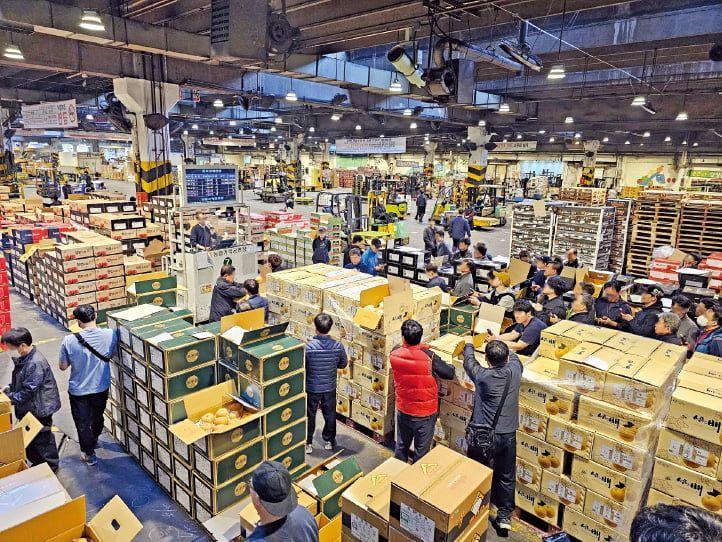 Agricultural products shipped by producers from all over the country are being auctioned at the Garak Market in Seoul. (Photo by Ministry of Agriculture, Food and Rural Affairs)
Wholesale markets are opened by local governments through public investment from central and local governments, with 32 currently operating nationwide. More than half of the horticultural products collected from production areas pass through wholesale markets before being sold to consumers. When farmers or corporations ship agricultural products to wholesale markets, wholesale corporations consign these products and sell them to intermediate wholesalers through auctions, bids, fixed prices, or negotiated sales. There are 82 wholesale corporations and 6,212 intermediate wholesalers. Sixty market wholesalers perform the functions of both wholesale market corporations (collection) and intermediate wholesalers (distribution).
The wholesale market evaluation system assesses wholesale market operators, wholesale corporations, and market wholesalers based on the "Act on the Distribution and Price Stabilization of Agricultural and Fishery Products." Evaluations are conducted out of 100 points, assessing customer service, facility management, and major business operations. Based on the score ratio, entities are rated into five grades: "Excellent (90 points or above), Good (top 10%), Average (80%), Poor (bottom 10%), and Underperforming (below 60 points)."
The problem is that the evaluation lacks effectiveness. Under the current Agricultural Products Management Act and its enforcement regulations, it is possible to cancel the designation of poorly evaluated corporations. However, a Ministry of Agriculture, Food and Rural Affairs official stated, "The cancellation clause in the enforcement regulations of the Agricultural Products Management Act is discretionary, so the likelihood of actual cancellation is very low." The official added, "Since the establishment of Garak Market in 1985, there have been cases where re-designation was canceled due to financial difficulties, but no wholesale corporation has had its designation canceled due to receiving an underperforming grade in evaluations."
Accordingly, the Ministry of Agriculture, Food and Rural Affairs is promoting an amendment to the Agricultural Products Management Act to mandate the cancellation of designation for wholesale corporations. Currently, the Act stipulates that if a corporation receives an underperforming grade twice consecutively or three times in total during the designation period, the local government that opened the wholesale market "may cancel the corporation's designation." The Ministry is pushing to amend the Act to change this to "must cancel." The proposed amendment was submitted to the National Assembly's Agriculture, Food, Rural Affairs, Oceans and Fisheries Committee plenary session on the 18th of last month.
Improvements to the wholesale corporation evaluation system are also being pursued. This is because, under the current evaluation system, even if cancellation is mandated, it is difficult for a wholesale corporation to receive an underperforming grade twice consecutively. A Ministry official explained, "Due to the absolute evaluation system, there is an inflation of evaluation grades that continue to rise, making it difficult to identify wholesale market corporations subject to cancellation. Since the 2015 evaluation, only four corporations have received an underperforming grade."
The Ministry plans to revise its internal guidelines on evaluation details. The current five-grade system of "Excellent, Good, Average, Poor, Underperforming" will be maintained, but the score weight for Average will be adjusted from the existing 80% to 60%, Poor from 10% to 20%, and Underperforming will remain at 10%. In particular, if the absolute score is below 50 points, the underperforming grade will be assigned regardless of weight.
The evaluation criteria will also be changed. The non-quantitative indicators, which currently account for 25 points out of the total 100 points (composed of 75 points for quantitative indicators such as transaction scale expansion, production area support performance, and customer satisfaction survey results, and 25 points for non-quantitative indicators), will be removed. For non-quantitative indicators, corporations submit reports on their efforts to achieve quantitative indicators, but this tends to favor large corporations with sufficient capacity to prepare reports.
Additionally, the score for public interest will be increased for support performance for shippers and price stabilization, such as fixed-price negotiated sales where shippers present or negotiate sales prices and quantities in advance. The use of electronic delivery notes, which digitize the paper delivery notes that shippers manually filled out and sent with products to wholesale markets, will also be reflected in evaluations. A Ministry official said, "We will strengthen public interest evaluations such as support for shipping farmers and contributions to agricultural product price stabilization, and introduce indicators to enhance corporate competitiveness such as internal monitoring. The purpose of operating wholesale markets is to protect shippers, but considering that some wholesale markets have excessive operating profits, we have increased the score for shipper support to return more benefits to shippers."
© The Asia Business Daily(www.asiae.co.kr). All rights reserved.

















