KOSPI Opens Lower After Holiday but Turns Upward
Tariff and Other Uncertainties Remain in March, but Intensity Expected to Weaken
Market Expected to Stabilize Gradually and Resume Upward Trend
KOSPI Projected to Reach as High as 2,730 This Month
On the last day of February, the KOSPI plunged more than 3%, falling below the 2600 mark again, drawing attention to the stock market trend in March. After the holiday, the KOSPI opened higher despite the sharp decline in the New York stock market. Given the many variables affecting the market, an expansion in volatility is expected to be inevitable, but since the burden from the previous rise has been somewhat alleviated, it is forecasted that the market will resume its upward trend from mid-March onward.
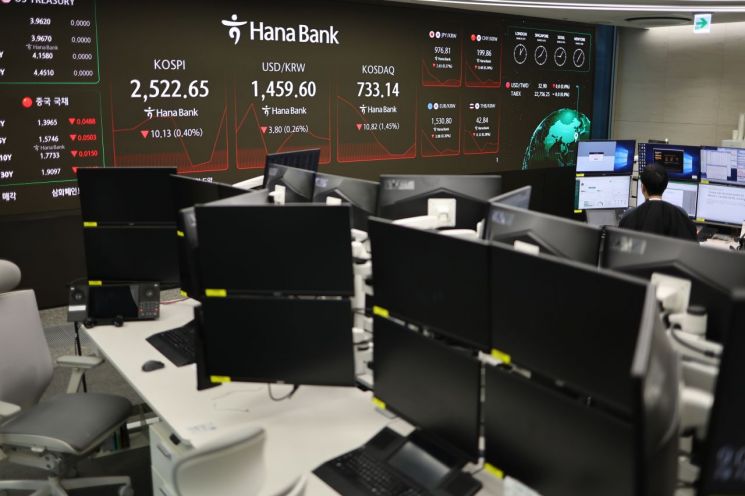
As of 9:20 a.m. on the 4th, the KOSPI was trading at 2,543.31, up 10.53 points (0.42%) from the previous close. The KOSDAQ was down 6.34 points (0.85%) at 737.62. The KOSPI started the day down 0.42% at 2,522.20 but later turned positive.
Previously, on the 28th of last month, the KOSPI fell 3.39%, marking the largest drop since the beginning of the year, retreating to the 2,530 level. The KOSDAQ also dropped 3.49%.
Joon-ki Cho, a researcher at SK Securities, said, "Most global stock markets showed weakness last week for various reasons, but mainly because economic indicators did not meet market expectations, raising stagflation concerns. Around the time of Nvidia's earnings announcement, there was selling at the peak, and President Donald Trump's imposition of an additional 10% tariff on China worsened investor sentiment." He added, "The domestic market also saw the KOSPI and KOSDAQ plunge more than 3% last Friday, with foreigners net selling nearly 5 trillion won in combined cash and futures in just one day. Since there was no entity to absorb the selling volume, the market failed to find a trigger for a rebound and closed by giving back most of the gains made over the past month in a single day."
Tariff risks are expected to continue affecting the stock market this month, but their intensity is anticipated to ease over time. Ji-young Han, a researcher at Kiwoom Securities, said, "Trump's tariff uncertainty frequently injects confusion into the market, but it is important to note that markets tend to develop immunity as they repeatedly experience the same negative factors. Since the market has undergone adjustments several times in February due to tariff risks, Trump's tariff actions are unlikely to cause a chain of sharp declines lasting more than 2-3 trading days or disrupt the market trend. Instead, they will be limited to volatility-inducing factors that cause repeated declines and rebounds, with the amplitude of volatility weakening over time."
After a short-term overheating correction in early March, the market is expected to resume its upward trend from mid-March. Some securities firms have forecasted the upper band of the KOSPI this month to be above 2,700. Kyung-min Lee, a researcher at Daishin Securities, said, "The February correction was a natural flow at a short-term inflection point encountered during the upward trend development, serving as a phase of short-term overheating relief and absorption of selling pressure." He added, "The March stock market will normalize as the uncertainties at the end of February stabilize, and fundamental momentum will flow in, resuming the upward trend." Daishin Securities projected the KOSPI range for March to be between 2,460 and 2,730, expecting a 'weak-then-strong' pattern."
Kiwoom Securities projected the KOSPI range for this month to be between 2,520 and 2,730. Researcher Ji-young Han said, "In March, the market will still face uncertainties such as concerns about a U.S. recession, the U.S. Federal Open Market Committee (FOMC) meeting, macroeconomic uncertainties, Trump's tariffs as political uncertainties, volatility in the Magnificent 7 (M7) stocks, profit skepticism, and the resumption of short selling." However, she added, "These uncertainties are more likely to cause volatility and limit the market's upside rather than materialize in a way that damages the market trend."
© The Asia Business Daily(www.asiae.co.kr). All rights reserved.
![Clutching a Stolen Dior Bag, Saying "I Hate Being Poor but Real"... The Grotesque Con of a "Human Knockoff" [Slate]](https://cwcontent.asiae.co.kr/asiaresize/183/2026021902243444107_1771435474.jpg)















