Korea National Institute of Health Emphasizes the Need for Healthy Eating Habits and Psychological Support
Obese children and adolescents have a higher likelihood of food addiction and face serious emotional and behavioral problems such as depression and anxiety, according to research findings.
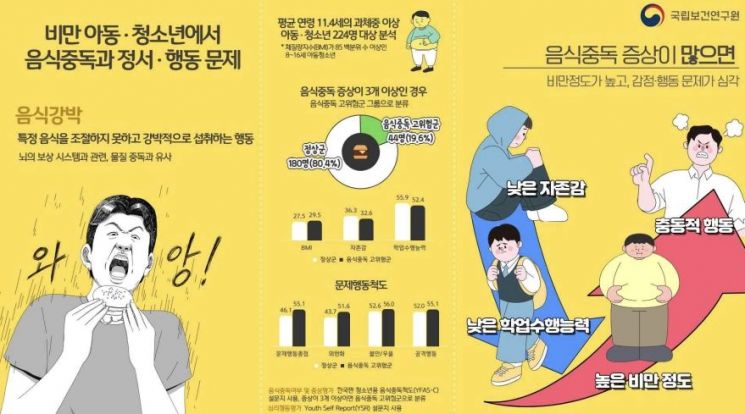
The Korea Disease Control and Prevention Agency's National Institute of Health announced on the 4th that it published research results in a professional academic journal confirming a significant association between food addiction and emotional and behavioral problems in obese children and adolescents.
First, the research team surveyed 224 overweight children and adolescents aged 8 to 16 with a body mass index (BMI) at or above the 85th percentile. Among the 224 obese children and adolescents, 44 (19.6%) were identified as high-risk groups for food addiction.
Food addiction refers to compulsive consumption of specific foods that cannot be controlled, related to the brain's reward system, and is known to exhibit characteristics similar to substance addiction. Children in the high-risk food addiction group had higher degrees of obesity, lower self-esteem, and poorer family functioning such as emotional exchange and support within the family. Emotional problems such as depression and anxiety, as well as impulsive behaviors, were also found to be higher.
The more symptoms of food addiction present, the more emotional and behavioral problems such as anxiety and depression tended to worsen. Even after adjusting for obesity levels and parental parenting attitudes, total problem behavior scores and aggression increased, while academic performance scores tended to decrease.
The research team also pointed out that the increasing obesity among children and adolescents, which persists into adulthood, can negatively affect not only physical problems such as cardiovascular disease, diabetes, and fatty liver but also mental health.
This study was conducted by the research team led by Professor Kyung-hee Park from the Department of Family Medicine at Hallym University, supported by the National Institute of Health. The research results were published in the international academic journal in the field of nutrition and health, 'Obesity Research & Clinical Practice.' The average age of the children and adolescents studied was 11.4 years. Food addiction status and symptoms were evaluated using the Korean version of the Yale Food Addiction Scale for Children (YFAS-C) questionnaire, and psychological and behavioral assessments were conducted using the Korean version of the Youth Self-Report (YSR) questionnaire to measure depression, anxiety, aggression, attention problems, and more.
Hyun-young Park, director of the National Institute of Health, stated, "Food addiction should be considered an important factor affecting obesity and mental health, not just a simple eating habit," adding, "In children and adolescents with obesity accompanied by emotional and behavioral problems, the tendency toward food addiction may increase, requiring careful understanding, evaluation, and intervention."
© The Asia Business Daily(www.asiae.co.kr). All rights reserved.
![Clutching a Stolen Dior Bag, Saying "I Hate Being Poor but Real"... The Grotesque Con of a "Human Knockoff" [Slate]](https://cwcontent.asiae.co.kr/asiaresize/183/2026021902243444107_1771435474.jpg)















