"Everything is Ready... Takes Effect Tomorrow"
Signs Executive Order for Additional 10% Tariff Increase on China
U.S. President Donald Trump is set to enforce a 25% tariff on Mexico and Canada starting on the 4th (local time). He also decided to raise additional tariffs on China by 10%, bringing the total to 20% following the existing 10%. By reaffirming that the previously announced reciprocal tariffs will be imposed as scheduled on April 2, concerns are growing that a 'Trump-led tariff war' will intensify.
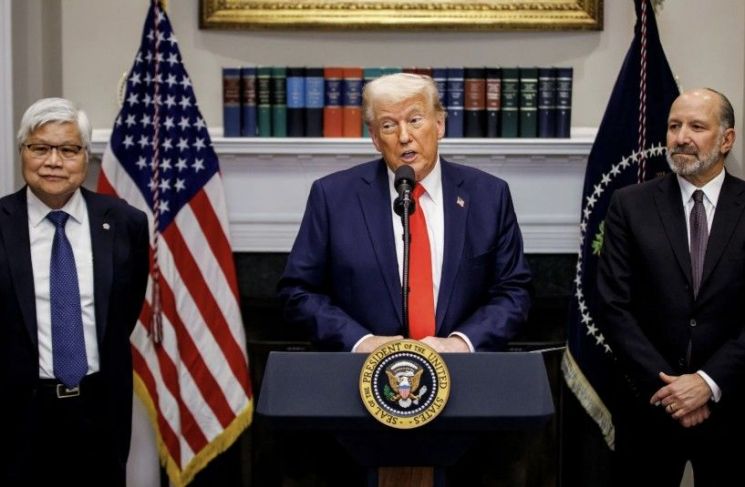
On the 3rd, at the White House during an announcement of the investment plans of Taiwan's TSMC, the world's largest foundry (semiconductor contract manufacturer), President Trump responded to reporters' questions about tariffs by saying, "There is no room for negotiation on Mexico and Canada," adding, "Everything is ready and it will take effect tomorrow."
President Trump reiterated that the reciprocal tariffs will be imposed as planned starting April 2. Reciprocal tariffs are essentially tariffs imposed by the U.S. on foreign imports, taking into account the tariff rates and non-tariff barriers that foreign countries impose on U.S. exports.
Earlier, President Trump announced on February 4 that 25% tariffs would be imposed on Mexico and Canada, and an additional 10% tariff on China due to issues related to fentanyl and illegal immigration. Subsequently, the tariff enforcement on Mexico and Canada was postponed for a month. The U.S. implemented the planned 10% additional tariff on China as scheduled and announced that starting from the 4th, an additional 10% would be added on top of the existing 10% increase. To this end, President Trump signed an executive order raising the total additional tariffs on China to 20% that day. The White House stated that China "has not taken appropriate measures" to stop the illegal influx of fentanyl. U.S. media such as The Wall Street Journal (WSJ) reported that the lack of a call between the U.S. and Chinese leaders since President Trump's inauguration is due to China’s reluctance to actively restrict the export of chemicals necessary for fentanyl production.
Recently, economic department officials in the Trump administration hinted at the possibility of tariff negotiations with Mexico and Canada, but President Trump dismissed any chance of negotiations on the day before the tariffs take effect. U.S. Commerce Secretary Wilbur Ross said in an interview with Fox News the previous day that there is "definitely a possibility" that tariff rates on Mexico and Canada could be lowered. U.S. Treasury Secretary Steven Mnuchin also mentioned in an interview with CBS News that Mexico is considering imposing tariffs on China in line with the U.S., and said such plans could help reduce the U.S. tariff rates on Mexico.
If the 25% tariffs on Mexico and Canada and the 20% additional tariffs on China, as announced by President Trump, take effect on the 4th, imports worth a total of $1.5 trillion annually will be affected by the tariff increases. The U.S., Mexico, and Canada have applied mostly tariff-free trade under the United States-Mexico-Canada Agreement (USMCA), a trilateral free trade agreement, and their supply chains are highly integrated, raising the likelihood of significant disruption. There are also growing concerns that if the three countries retaliate, it could escalate into a global trade war.
However, President Trump continues to raise the level of tariff threats worldwide, including hinting at tariffs on imported agricultural products on this day.
He posted on his social media platform Truth Social, which he created, starting with "To America's great farmers," urging them to "get ready to start producing many agricultural products to be sold domestically in the U.S." He added, "Tariffs will be applied to external goods starting April 2." He did not specify the detailed items subject to tariffs or whether any exceptions would apply. This could imply that imported agricultural products might be included in the reciprocal tariffs to be imposed in a month, or it could be a prelude to separate tariffs on specific items, according to analysts.
© The Asia Business Daily(www.asiae.co.kr). All rights reserved.
![Clutching a Stolen Dior Bag, Saying "I Hate Being Poor but Real"... The Grotesque Con of a "Human Knockoff" [Slate]](https://cwcontent.asiae.co.kr/asiaresize/183/2026021902243444107_1771435474.jpg)















