Preference for Ruling Power in Next Presidential Election by Realmeter
Support for "Regime Change" Rises by 6.1 Percentage Points from Last Week
A public opinion poll released on the 3rd showed that the 'regime change theory' regarding the Yoon Suk-yeol administration leads the 'regime extension theory' beyond the margin of error.
According to a survey conducted by Realmeter on behalf of Energy Economy Newspaper from the 26th to the 28th of last month, targeting 1,506 voters nationwide aged 18 and older (with a 95% confidence level and ±2.5 percentage points), 55.1% favored 'regime change by the opposition,' while 39.0% supported 'regime extension by the ruling party.' Those who responded 'don't know' accounted for 5.9%.
Compared to the survey conducted a week earlier, support for regime change rose by 6.1 percentage points, while support for regime extension fell by 6.3 percentage points. The gap between the two opinions, which was 3.7 percentage points last week, widened to 16.1 percentage points within one week, exceeding the margin of error.
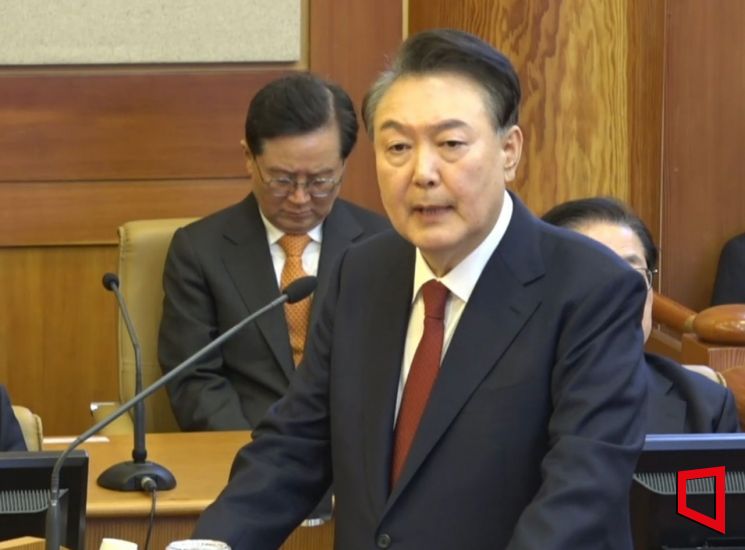 President Yoon Suk-yeol is delivering his final statement at the 11th hearing of his impeachment trial held at the Constitutional Court in Jongno-gu, Seoul on the 25th. 2025.2.25. Photo by the Constitutional Court
By region, regime change was most favored in Gwangju and Jeolla (72.7% regime change, 21.4% regime extension). This was followed by Seoul (56.8%, 37.8%), Daejeon, Sejong, and Chungcheong (54.8%, 41.0%), Incheon and Gyeonggi (54.7%, 39.0%), and Busan, Ulsan, and Gyeongnam (52.7%, 42.4%). Conversely, Daegu and Gyeongbuk (39.1%, 53.4%) showed a preference for regime extension.
By age group, regime change was dominant among those in their 40s (69.1%, 26.8%), 50s (63.0%, 33.8%), 20s (51.5%, 40.0%), and 30s (51.2%, 43.1%). Among those in their 60s (48.4%, 44.7%) and 70 and older (43.9%, 48.5%), opinions on regime change and extension were similar or regime extension slightly led.
Among supporters of the People Power Party, 90.8% favored regime extension, while 95.3% of Democratic Party supporters supported regime change. Among the politically unaffiliated, regime change (46.7%) was more favored than regime extension (25.3%).
By ideological inclination, 69.3% of conservatives expected regime extension, while 87.1% of progressives anticipated regime change. Among moderates, regime change (60.6%) was more favored than regime extension (33.6%). Compared to a week ago, support for regime change increased by 4.1 percentage points, and support for regime extension decreased by 4.7 percentage points.
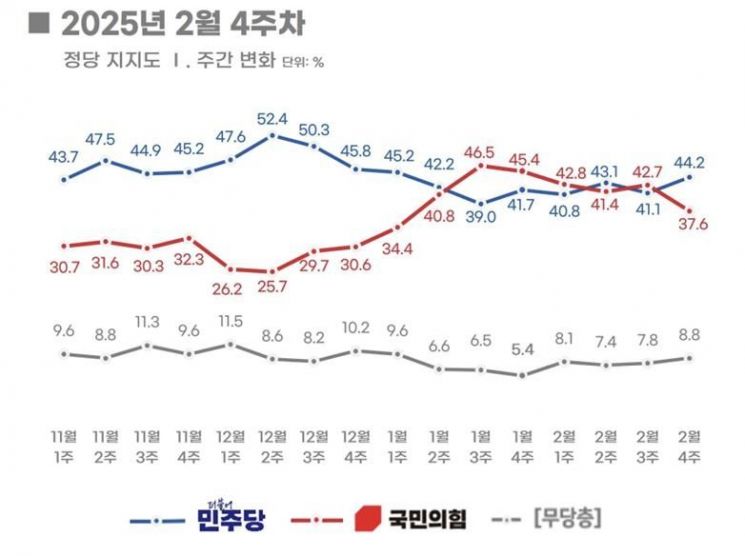
In the party support survey, the People Power Party received 37.6%, and the Democratic Party 44.2%. The gap between the two parties widened to 6.6 percentage points, exceeding the margin of error for the first time in five weeks. Compared to the previous week, Democratic Party support rose by 3.1 percentage points, while the People Power Party's support fell by 5.1 percentage points. Realmeter analyzed, "The People Power Party experienced significant support loss in Chungcheong, Honam, Yeongnam regions, among women, and those aged 70 and above and in their 20s," adding, "The 40% support threshold collapsed for the first time in six weeks since the second week of January."
Among respondents who identified their ideological stance as moderate, 45.8% supported the Democratic Party, and 30.1% supported the People Power Party. Compared to a week ago, Democratic Party support among moderates rose by 0.2 percentage points, while the People Power Party's support dropped by 5.2 percentage points. Other parties showed support as follows: the Party for National Innovation 4.0%, Reform Party 2.6%, Progressive Party 0.8%. The politically unaffiliated accounted for 8.8%. This survey was conducted via 100% wireless automated response, with a response rate of 6.0%. For detailed information, refer to the Central Election Survey Deliberation Commission website.
© The Asia Business Daily(www.asiae.co.kr). All rights reserved.


















