60 Days of Regulatory Elimination: More Than One Case Announced Daily
Easing Credit Guarantee and Lease Contract Restrictions
Removal of Extension Conditions for Massage Services for the Visually Impaired
The Seoul Metropolitan Government has decided to ease the guarantee restrictions that have been limited by region for small and medium-sized enterprises (SMEs) that relocate their workplaces or operate in multiple regions. In addition, it plans to support the business activities of small merchants by simplifying the contract documents of the Seoul Credit Guarantee Foundation and lifting restrictions on the production and installation of outdoor advertisements.
On the 3rd, Seoul announced that it will promote a total of 10 regulatory eliminations to help small merchants overcome the crisis, marking the 60th day since the start of the 100-day regulatory elimination project. Starting with the first regulatory elimination announced on January 3, including the 10 newly added cases this time, a total of 63 regulatory elimination plans have been announced so far, discovering more than one regulation per day on average.
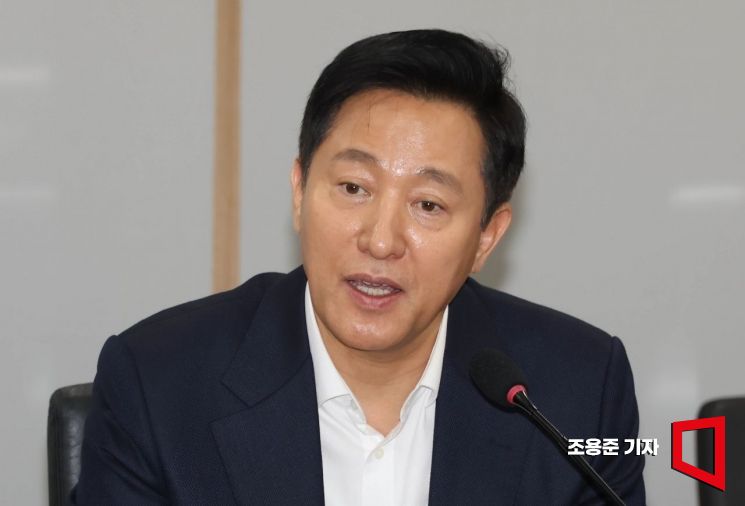 On February 13, 2025, Seoul Mayor Oh Se-hoon attended and spoke at the report meeting on the abolition of regulations for investment and affiliated institutions held at the Seoul City Hall in Jung-gu, Seoul. Photo by Jo Yong-jun
Among the newly announced regulatory elimination plans, numbers 54 to 58 were selected after review by an expert review committee during a regulatory elimination report meeting held on the 13th of last month, attended by 23 investment and contribution institutions under the Seoul Metropolitan Government. The report meeting presented 160 regulatory elimination tasks across four areas: livelihood and economy, housing and facilities, culture and tourism, and health and welfare, focusing on revitalizing livelihoods, reducing economic burdens, and improving citizen inconveniences.
Regulatory elimination plan No. 54 is 'Easing of guarantee restrictions for guarantee companies in other provinces.' The main point is that even if there is an outstanding guarantee balance with a credit guarantee foundation in another province, new additional guarantees can be received within the total support limit. For example, if the guarantee limit is 50 million KRW and the amount used in another province is 10 million KRW, the Seoul Credit Guarantee Foundation will provide a new guarantee support of 40 million KRW. Until now, to support more companies with limited guarantee resources, companies using other regional foundations were defined as overlapping guarantee restricted companies under the 'Credit Guarantee Regulations.' The foundation plans to revise the 'Credit Guarantee Regulations' after board approval in June.
No. 55 is 'Simplification of contract documents for the Seoul Credit Guarantee Foundation.' The main content is to reduce seven types of documents that were mandatory when contracting with private companies, such as the pledge to comply with integrity contracts and the pledge to protect workers' rights, into a single 'Integrated Contract Compliance Pledge.' Additionally, the non-face-to-face electronic submission method will be expanded to increase convenience for companies.
No. 56 is 'Improvement of deposit payment methods for small merchants renting at Garak Market and Gangseo Market.' Currently, when renting a store in the market, depending on the rental method?small amount private contract (100% cash), large amount private contract (at least 70% cash), or bidding contract (at least 20% cash)?20% to 100% of the deposit must be paid in cash, and only under certain conditions can part of it be replaced with guarantee insurance. The Seoul Agricultural and Marine Products Corporation will drastically abolish this regulation, allowing rental contracts to be made by paying only 10% or more of the deposit in cash regardless of the rental method, with the remaining amount replaced by guarantee insurance. Related regulations are expected to be revised by March this year.
No. 57 is 'Improvement of contract conditions for operating leased stores at Seoul Family Plaza.' Until now, to ensure transparency and objectivity when selecting operators of small stores such as food outlets within Seoul Family Plaza, operators were required to submit various documents in advance, including menu and sales price consultations, store operation plans, and operation performance, causing inconvenience to small merchants. Accordingly, the Seoul Foundation for Women and Family plans to grant autonomous operational authority within legal limits when selecting small store operators to alleviate business burdens in various ways.
The last regulatory elimination plan No. 58, proposed and adopted by a subordinate investment institution of the city, includes three items: lowering overdue interest rates, introducing a reporting system for changing business types in shopping districts, and allowing partial termination of integrated rental shopping malls, titled 'Regulatory Improvement for Seoul Subway Shopping Mall Operations.' Seoul Metro has prepared this plan through tenant meetings and will apply it from April.
Several regulatory elimination plans have also been introduced to grant autonomy and diversity by removing regulations that hinder small merchants' business activities. No. 59 is 'Abolition of restrictions on the use of red and black colors in outdoor advertisements.' Under the current ordinance, the background color of signs is limited to 50% use of red and black colors, but there were industry opinions that the unclear color standards of 'red' and 'black' restrict freedom of expression and criticisms that it blocks free promotion by self-employed business owners. Accordingly, Seoul plans to revise the 'Outdoor Advertisement Ordinance' in consultation with the Seoul Metropolitan Council. Through the ordinance revision, the unclear color restriction clause will be completely deleted to expand autonomy for the industry and small merchants in color selection.
No. 60 is 'Improvement of regulations on advertisements using public facilities.' Under the current ordinance, media poles, which are horizontal video cultural facilities, can only be installed during the 'Design Seoul Street Creation Project,' limiting their use to some autonomous districts. The city abolished this regulation by deleting the conditional clause limited to a specific project, allowing all autonomous districts to provide various information to citizens through media poles.
No. 61 is 'Relaxation of regulations on window advertisements,' which has proven effective through the Ministry of Trade, Industry and Energy's regulatory sandbox. The current ordinance stipulates that window electronic signs can only be installed on the first floor of commercial areas. This will be revised to relax regulations to allow installation on the second floor or below not only in commercial areas but also in exclusive and general residential areas.
In addition, regulatory elimination plans embracing vulnerable groups were also introduced. No. 62 is 'Extension of support period and expansion of eligible recipients for massage services for the visually impaired.' Within the first half of the year, the 'Seoul Metropolitan Government Community Service Investment Project Provider Operation Guidelines' will be revised to remove the condition limiting the extension of massage services to only 'patients with rare and intractable diseases.'
The massage service for the visually impaired is provided by massage therapists under the 'Medical Service Act' once a week (60 minutes per session) for up to 12 months, and only recipients with 'rare and intractable diseases' were eligible for a one-time 12-month extension. Due to this, citizens who need continuous massage services but are not included in the extension target faced difficulties, while few citizens met the extension criteria of 'rare and intractable diseases,' causing some service providers in certain autonomous districts to close due to a decrease in users.
No. 63 is 'Change in the selection method of participants for the Hope Double Youth Account,' an investment for future Seoul youth. Until now, participants were selected by allocating numbers by autonomous district, but from this year, the city will centrally select candidates to enhance fairness.
In addition to discovering and activating regulatory elimination plans, Seoul plans to actively propose institutional improvements to central government ministries to alleviate inconveniences that have a significant impact on the national economy or can be applied nationwide. First, five cases will be proposed to the relevant central ministries in March, and active consultations with the ministries will continue until improvements are made. Seoul plans to propose amendments to laws related to 'Improvement of regulations on activities within urban natural park zones,' allowing the city or provincial governor to directly install disaster prevention facilities such as retention ponds for flood prevention within urban natural park zones. It also plans to propose 'Relaxation of visa requirements for creators,' expanding the foreigner E-6 (art performance) visa, which currently focuses on entertainers, actors, and performers, to include one-person media creators (creators) such as YouTubers and SNS influencers.
© The Asia Business Daily(www.asiae.co.kr). All rights reserved.

















