Optical Detection of Kitaev Quantum Spin Liquid Properties in Cobalt-Based Oxide Thin Films
Joint Research by UNIST and Yonsei University
Advancing Quantum Computer Materials
Published in Nature Communications
Domestic researchers have succeeded in detecting traces of the Kitaev quantum spin liquid using light.
The Kitaev quantum spin liquid is a special quantum state that can enable the creation of error-free large-scale quantum computers. However, experimentally confirmed cases within materials are rare, and the search for candidate materials continues. An experimental methodology that can detect the characteristics of the Kitaev quantum spin liquid in materials using light has emerged, which is expected to aid in the discovery and characterization of quantum computer materials.
Professor Changhee Son's team from the Department of Physics at UNIST, in collaboration with Professor Jaehun Kim's team from Yonsei University and Professor Jungwoo Yoo's team from the Department of Materials Science and Engineering at UNIST, announced on the 3rd that they successfully optically detected spin fluctuations characteristic of the Kitaev quantum spin liquid state in cobalt-based oxide thin films.
 Research team. (From the bottom left, counterclockwise) Professor Son Changhee, Researcher Kang Baekjun (first author), Researcher Choi Wooksam (first author), Researcher Seo Euihyun, Researcher Park Miju, Researcher Kim Gyehyun. Provided by UNIST
The Kitaev quantum spin liquid is a special form of the quantum spin liquid state. In the quantum spin liquid state, even at low temperatures, spins inside the solid fail to align and instead exhibit fluctuations, maintaining a fluid and disordered state similar to liquid molecules.
The joint research team detected these spin fluctuations in cobalt-based oxide synthesized in the form of a 20-nanometer (nm) thick thin film. While conventional neutron-based analysis methods made it easy to detect spin fluctuations in bulk materials, signals were weak and observations difficult in thin films, which are reduced in volume for quantum computer device applications.
The research team detected these spin fluctuations by analyzing exciton particles generated when light was shone on the thin film. The measured spin fluctuations persisted even above a specific temperature called the N?el temperature (16K, approximately -257.15℃), providing evidence that these spin fluctuations arise not simply from heat but from the quantum spin liquid state.
They also confirmed strong Kitaev interactions through theoretical calculations. The Kitaev interaction is mainly found in the Kitaev quantum spin liquid rather than in general quantum spin liquids.
spin liquid.
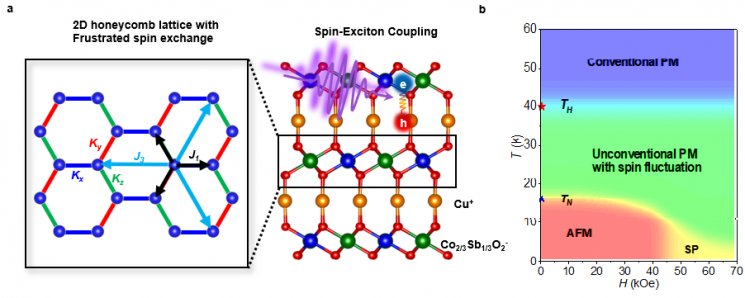 Schematic diagram showing the structure and spin states according to temperature of the cobalt oxide, a Kitaev quantum spin liquid candidate material.
Professor Changhee Son explained, “This study revealed that the characteristics of the Kitaev quantum spin liquid appear even in cobalt-based oxide thin films,” adding, “The analysis method used in the experiment will also be helpful for developing quantum computer materials.”
The study involved researchers Baekjun Kang, Wooksam Choi, and Seunghyun Noh from UNIST and Taekseon Jung from Yonsei University as co-first authors.
The research results were published online on February 3 in the international journal Nature Communications.
The research was conducted with support from the Ministry of Science and ICT and the National Research Foundation of Korea.
© The Asia Business Daily(www.asiae.co.kr). All rights reserved.
![Clutching a Stolen Dior Bag, Saying "I Hate Being Poor but Real"... The Grotesque Con of a "Human Knockoff" [Slate]](https://cwcontent.asiae.co.kr/asiaresize/183/2026021902243444107_1771435474.jpg)
















