Gyeonggi Province will become the first in the nation to introduce 'Climate Insurance' this month and will begin selecting private developers for the launch of a climate satellite. Additionally, it plans to introduce the 'Climate Fund,' a public-led renewable energy profit-sharing system, in the first half of this year.
On the 3rd, Gyeonggi Province announced that it will actively promote the 'Three Major Climate Gyeonggi Projects,' aiming for a sustainable 'climate economy' transition that simultaneously pursues climate crisis response and economic stability.
First, starting in March, Gyeonggi Province will implement 'Climate Insurance' for residents nationwide for the first time. Climate Insurance automatically enrolls all residents without a separate subscription process and provides fixed compensation for accident consolation in cases of heat-related illness, cold-related illness diagnosis fees, infectious disease diagnosis fees, and injuries lasting more than four weeks related to weather warnings.
In particular, about 160,000 climate-vulnerable groups (those targeted by city/county public health center health management projects) will receive additional benefits. Specific benefits include hospitalization costs for heat-related and cold-related illnesses, transportation costs to medical institutions during weather warnings, ambulance transport services during climate disasters, and support for mental damage caused by climate disasters.
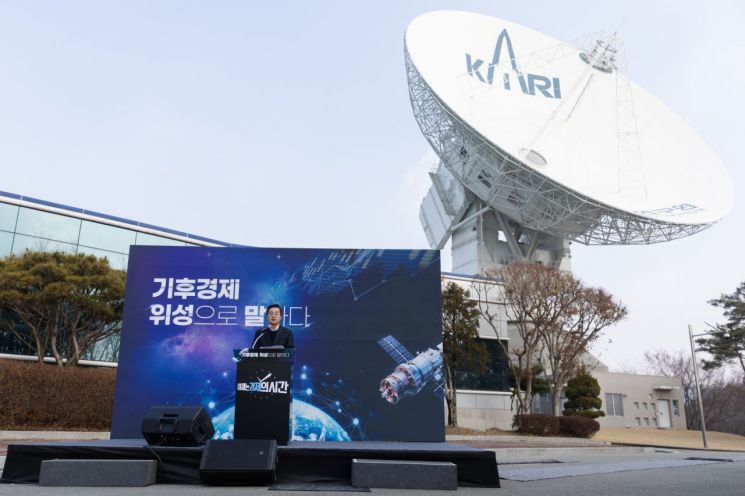 Gyeonggi Province Governor Kim Dong-yeon is presenting the climate economy vision at the Yeoju SKB Satellite Center on February 26. Photo by Gyeonggi Province
Climate Insurance is contracted on a one-year basis, and Gyeonggi Province has allocated a budget of 3.4 billion KRW for this purpose.
To strengthen climate crisis response capabilities and foster the new space industry, Gyeonggi Province will also actively promote the climate satellite development and launch project. The final operator will be selected this month, and the province plans to introduce Korea’s first ultra-small satellite for climate data collection.
Unlike the existing government-led research and development (R&D) approach, this climate satellite project is led by the private sector, which reduces costs and time while securing precise climate data. Through this, it is expected to enhance climate policy sophistication, respond to global carbon regulations, nurture climate tech startups, and strengthen international cooperation.
Furthermore, Gyeonggi Province will introduce the 'Climate Fund,' a public-led renewable energy profit-sharing system, in the second quarter of this year. Using unused national and public land within the province, Gyeonggi Stock Company will build renewable energy power plants and return part of the power generation profits to local residents.
This will not only expand renewable energy but also provide additional income to residents, thereby fostering social consensus for climate response and supporting companies’ RE100 commitments through the expanded renewable energy.
In addition to the 'Three Major Climate Gyeonggi Projects,' Gyeonggi Province will implement various policies to eliminate the 'climate gap,' which arises from differences in economic and social conditions affecting climate change response capabilities.
For the 'Gyeonggi Climate Bridge Project' announced last January, Gyeonggi Province will invest 364 billion KRW this year to implement a total of 121 tasks, including nurturing climate tech startups, distributing renewable energy in energy-vulnerable areas, and providing climate action opportunity income.
On the 26th of last month, Governor Kim Dong-yeon announced the 'Three Major Strategies for Climate Economy Transformation,' emphasizing, "The climate crisis is a crisis for South Korea’s economy. We can no longer fall behind. Now is the time to transform South Korea’s economy into a climate economy."
The three major strategies for climate economy transformation proposed by Governor Kim Dong-yeon focus on establishing climate economy governance, including ▲ investing at least 400 trillion KRW in the climate industry ▲ complete abolition of coal power plants ▲ and the establishment of a Climate Economy Department.
© The Asia Business Daily(www.asiae.co.kr). All rights reserved.
![Clutching a Stolen Dior Bag, Saying "I Hate Being Poor but Real"... The Grotesque Con of a "Human Knockoff" [Slate]](https://cwcontent.asiae.co.kr/asiaresize/183/2026021902243444107_1771435474.jpg)















