Average Apartment Price in Seoul Hits 1.38 Billion KRW in January
Yongsan District Records the Highest Growth Rate
In January, the average price of apartments across Seoul reached an all-time high. It is analyzed that the rise in housing prices in the Gangnam area drove up the average price.
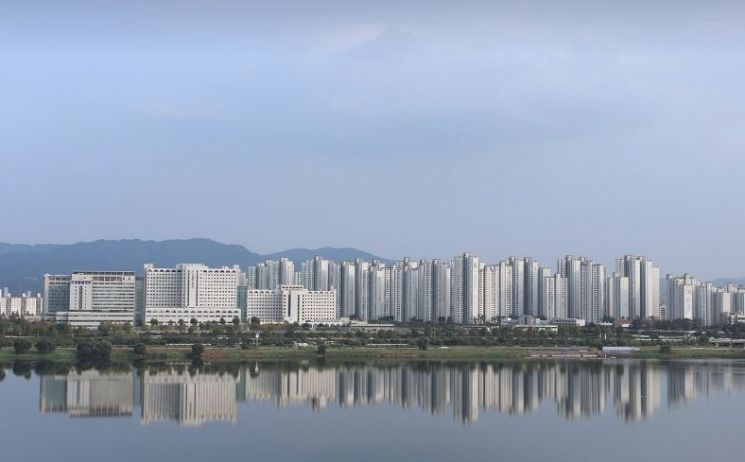
On the 2nd, Real Estate R114 surveyed the average price of 1.55 million apartments (excluding rentals) in 25 autonomous districts of Seoul, reflecting asking prices, market prices, and regional averages. As of January, the average price of apartments in Seoul was recorded at 1,382.89 million KRW. This surpassed the previous peak of 1,375.32 million KRW in May 2022, marking an all-time high.
The increase in apartment prices in certain areas such as the Gangnam district and the Han River belt is interpreted as having driven up the overall apartment prices.
By district, Yongsan-gu recorded the highest growth rate at 110.98%, with an average price of 2,198.80 million KRW, compared to its previous peak of 1,982.80 million KRW in August 2022.
Following were Seocho-gu at 2,995.16 million KRW (109.23% compared to the previous peak in August 2022), Gangnam-gu at 2,833.33 million KRW (108.86% in July 2022), Seongdong-gu at 1,546.67 million KRW (105.59% in August 2022), and Yeongdeungpo-gu at 1,357.90 million KRW (102.02% in July 2022), all exceeding their previous highs.
Areas with strong demand have already reached levels close to or beyond recovery, nearing their previous peak prices.
Additionally, Gwangjin-gu (1,498.26 million KRW, 99.13%), Songpa-gu (1,969.22 million KRW, 99.09%), Yangcheon-gu (1,361.56 million KRW, 98.58%), and Mapo-gu (1,396.78 million KRW, 98.09%) also showed housing prices close to their previous peaks.
Jongno-gu (97.14% compared to previous peak), Dongjak-gu (96.38%), Dongdaemun-gu (93.76%), Seodaemun-gu (94.61%), Gangdong-gu (90.81%), Eunpyeong-gu (90.24%), Gangseo-gu (90.08%), and others have also risen to around the 90% level.
However, Jungnang-gu (89.37%), Jung-gu (89.28%), Guro-gu (89.06%), Seongbuk-gu (88.34%), Geumcheon-gu (87.66%), Gwanak-gu (86.41%), Nowon-gu (85.06%), Gangbuk-gu (84.23%), Dobong-gu (82.49%), and others are relatively slower in their recovery.
© The Asia Business Daily(www.asiae.co.kr). All rights reserved.
![Clutching a Stolen Dior Bag, Saying "I Hate Being Poor but Real"... The Grotesque Con of a "Human Knockoff" [Slate]](https://cwcontent.asiae.co.kr/asiaresize/183/2026021902243444107_1771435474.jpg)















