Oh Junho, Head of Samsung Future Robot Promotion Team
"We must catch up with the US and China"
Few humanoid platforms in Korea
'Technology internalization' is essential for robot development
Oh Junho, head of Samsung Electronics' Future Robot Promotion Team, stated, "In 2 to 3 years, South Korea's humanoid robots will be able to join the ranks of the global top tier."
On the 28th, at the 'Current Status and Future of K-Humanoid Robots' conference held at the Korea Science and Technology Center in Gangnam-gu, Seoul, Oh delivered a keynote speech, saying, "Although South Korea started late, we possess considerable technology. The day will come when we play a role on par with or exceeding robots from the U.S. and China."
Oh is a leading authority who led the development of the country's first bipedal humanoid robot, 'Hubo,' in 2004. Previously, Samsung Electronics established the Future Robot Promotion Team directly under the CEO at the end of last year, officially advancing into future robot businesses including humanoids. Along with this, Professor Oh, a founding member of Rainbow Robotics, was appointed as the head.
Meeting with reporters that day, Oh said, "We think we need to catch up with (the U.S. and China) as soon as possible," adding, "Everyone probably shares the same thought." Regarding his activities since joining the Future Robot Promotion Team, he said, "Nothing has been concretized yet, and we are planning and conceptualizing future plans."
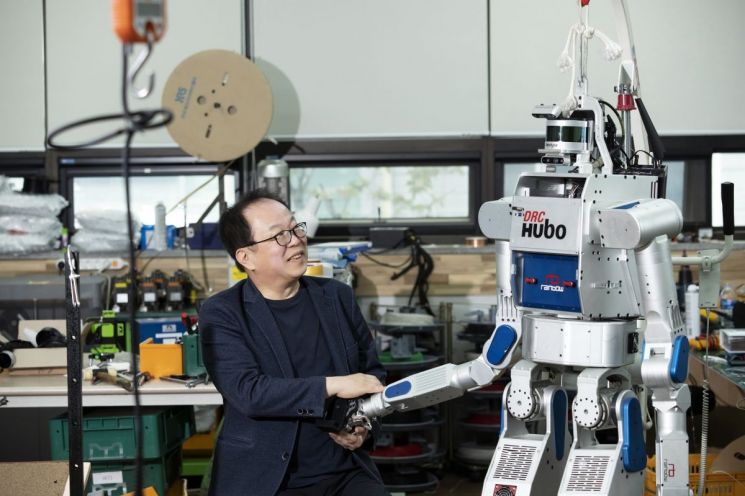
He attributed the recent growing interest in humanoid robots to the emergence of generative artificial intelligence (AI). Oh said, "In the past, research on humanoid robots was active, but the industry declined over the past 5 to 10 years. Until just 3 to 4 years ago, many people were skeptical about humanoid robots, but with the advent of generative AI, active interest has emerged."
Oh explained, "In China's case, the policy is to mass-produce low-cost robots to distribute worldwide and have an impact, whereas the U.S. produces more sophisticated robots based on rule-based and model-based systems. The global component ecosystem is currently bifurcated between advanced countries like the U.S. and Europe, and China."
In South Korea, humanoid research began in 2002 at the KAIST Hubo Lab, where Oh was involved, and Samsung Electronics conducted research from 2008 but later halted it. Additionally, active research has been conducted at the Korea Institute of Science and Technology (KIST) and Robotis. Oh said, "However, there are still very few places that possess humanoid platforms worthy of being called commercialized."
Oh cited technology internalization as an important factor for future humanoid development. He said, "Without internalizing technologies such as motors, reducers, and drivers, optimization is impossible. To develop humanoid robots, you absolutely must know how to make actuators, and technology internalization is essential."
He added, "There are also very complex challenges such as how to manage heat, how to implement AI, and how to prevent malfunctions."
© The Asia Business Daily(www.asiae.co.kr). All rights reserved.
![Clutching a Stolen Dior Bag, Saying "I Hate Being Poor but Real"... The Grotesque Con of a "Human Knockoff" [Slate]](https://cwcontent.asiae.co.kr/asiaresize/183/2026021902243444107_1771435474.jpg)















