Hyundai Pony Opens the 'My Car Era'
A Symbol of Korea's Economic Growth and Middle-Class Expansion
Developed in Just 2 Years and 3 Months
Korea Becomes the Ninth Country with an Indigenous Passenger Car
Successful Exports to North America... Laying the Foundation for an Export-Led Economy
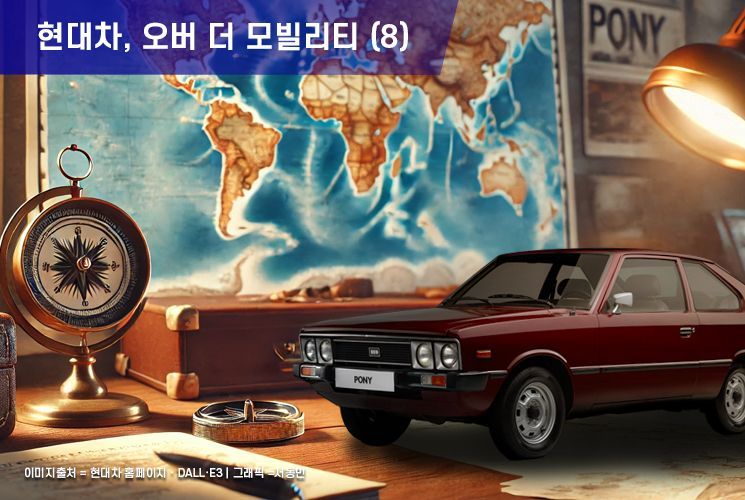
In 1974, Lee Chung-gu, former president of Hyundai Motor Company, was just an assistant manager. Driven by the single-minded determination to develop Korea’s indigenous passenger car model, the ‘Pony,’ he arrived in the small Italian city of Torino. At that time, the government prohibited ordinary citizens from traveling abroad to prevent foreign currency outflow and protect the national economy. Emphasizing the intention to learn advanced Italian automotive technology, he barely obtained permission to leave the country. The five members of the ‘Hyundai Motor Pony Project’ team who arrived in Torino via Gimpo Airport and Milan were amazed. The streets were filled with sleek coupes and sports cars they had only seen in magazines from secondhand bookstores in Cheonggyecheon. People were lively, and the economy was prosperous. Unlike Koreans who always wore black or white clothes, Italians’ fashion was a riot of colors. Conversely, five Korean men walking through Torino often attracted attention. People asked if they were Chinese or Japanese. When they said ‘Koreano (Korean),’ they were often asked, “Where is Korea located?”
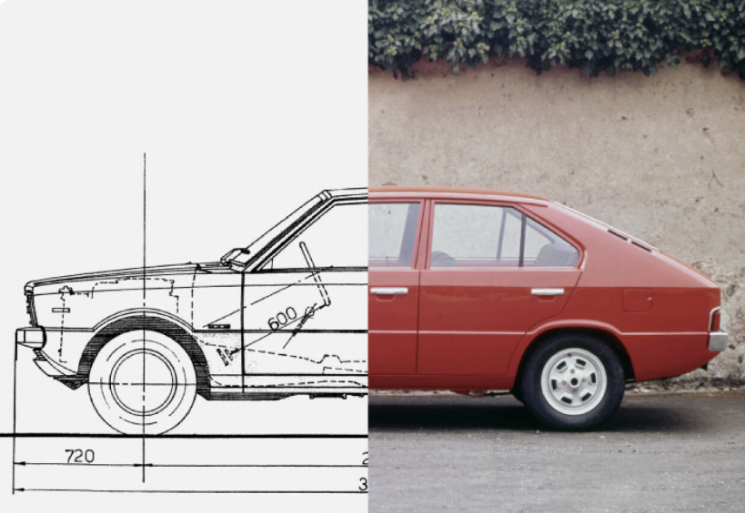
There, Lee first met Giorgetto Giugiaro. At 36, he was a promising automotive designer who had designed Volkswagen’s Passat and Golf, and Alfa Romeo’s Giulia. The Italian young man with gentle eyes had not only profound knowledge of cars but also great passion. Lee learned the entire development process of car design and production at Giugiaro’s carrozzeria (automobile workshop), Italdesign. He meticulously transcribed their work by hand. Most craftsmen did not speak English, so communication difficulties were resolved through intuition.
Lee recalled, “To ask questions, you need to know something about car design, but since I knew nothing, I just transcribed everything as it was. I recorded everything worth noting, from detailed brand names of parts to the progress in the design room and master model production room.” The notes he took then later became known as the ‘Assistant Manager Lee’s Notes’ and served as a development guide for juniors.
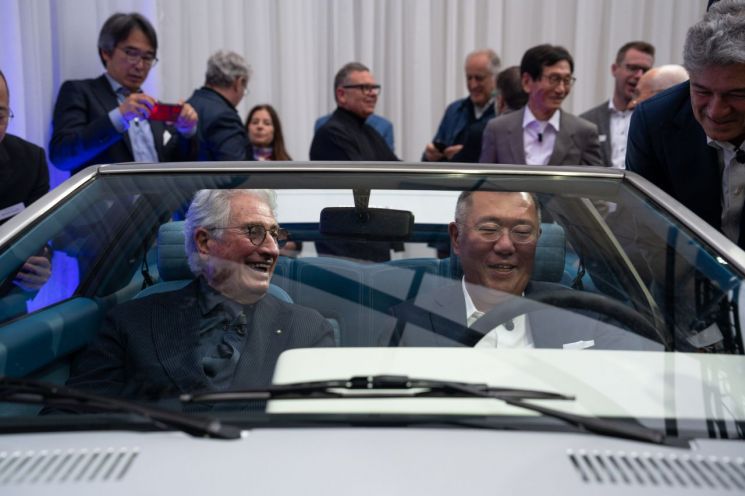 Hyundai Motor Group Chairman Chung Eui-sun (right in the photo) and Giorgetto Giugiaro, the designer of the Pony, seated in the restored Hyundai Pony Coupe concept model. Photo by Hyundai Motor Company
First Indigenous Korean Passenger Car Made in 2 Years and 3 Months
Hyundai Group’s founding chairman Chung Ju-yung gave Lee and his team just over a year. Dispatched to Italy in February 1974, they had to exhibit two prototypes, the ‘Pony Hatchback’ and ‘Pony Coupe,’ at the international motor show held in Torino at the end of October that year. Giugiaro proposed a fastback style, a car design where the roof slopes gently down to the rear end. It was the latest trend in Europe but was likened by Koreans to a ‘chicken with its tail cut off.’ However, Chairman Chung, who had export in mind from the start, made a bold choice. According to Lee, Chairman Chung always made sure to attend new car design evaluations no matter how busy his schedule was.
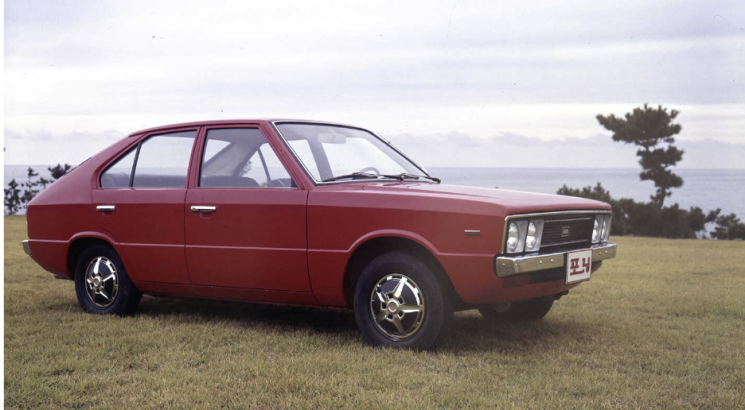
The Pony was a car created by combining Italian design, Japanese chassis and engine technology, and American mass production systems, with the sweat and tears of Korean engineers added. Hyundai sought overseas partners to help develop an indigenous passenger car model. In 1973, it signed a contract with Italy’s Italdesign for body design services and a technology agreement with Japan’s Mitsubishi for gasoline engines, transmissions, and rear axles. In 1974, it recruited George Henry Turnbull, former vice president of British Leyland, the UK’s largest car company, as a technical advisor. However, the advisory group only provided fragmented information such as which European company had the best conveyor belts or which Japanese company was competitive in mold manufacturing; the final decisions were entirely up to Hyundai engineers. Hyundai had to directly handle detailed tasks such as researching, comparing, and selecting companies.
After 2 years and 3 months of development, full-scale production of the Pony began in December 1975. The first test drive was held at Namsan. Then-president Chung Se-young often said, “If the Pony can’t climb Namsan, we are doomed.” When the Pony easily ascended the steep roads of Namsan, cheers erupted among government officials and journalists. The result was a great success. In its first year, the Pony sold over 10,000 units domestically, capturing 43.6% of the passenger car market share. Later, designer Giugiaro reflected, “Hyundai completely overturned the skeptical views doubting its success at the time. The people I met in Korea were full of strong will and hope.”
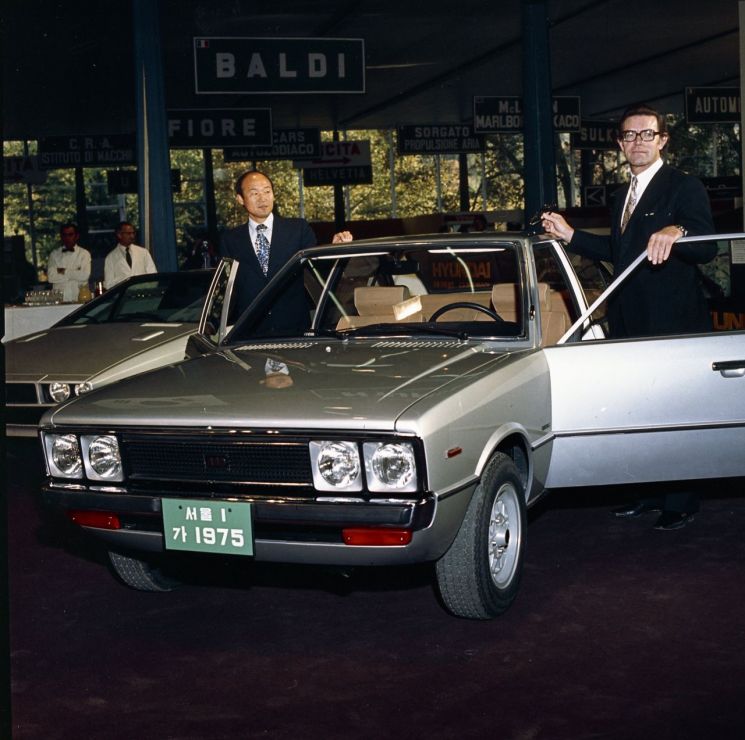 Jung Se-young, then President of Hyundai Motor Company, and George Turnbull, Vice President of Hyundai Motor Company, posing for a commemorative photo with the Pony. Photo by Hyundai Motor Company
Chairman Chung Ju-yung’s Love for Automobiles
“If a country is likened to a human body, the roads spread across the land are the blood vessels, and cars are the blood flowing through those vessels.”
This statement by Chairman Chung clearly shows his vision for the national economy. Just as we can have healthy vitality when blood flows smoothly in the body, a nation’s economy can be symbolized by the movement of cars as the lifeblood of the economy. In the 1960s, when he made this remark, Korea’s road paving rate was less than 10%. Chairman Chung believed that to revive the postwar Korean economy, the national transportation system had to be organized first. Therefore, Hyundai Construction, the foundation of Hyundai Motor Group, took charge of the Seoul-Suwon section, a key part of the Gyeongbu Expressway. Chairman Chung instructed that even if it meant reducing corporate profits, the construction deadline must be met for national economic development. The construction of the Gyeongbu Expressway made the ‘Seoul-Busan one-day living zone’ possible. Logistics, transportation, and distribution competitiveness improved, accelerating economic development and industrialization.
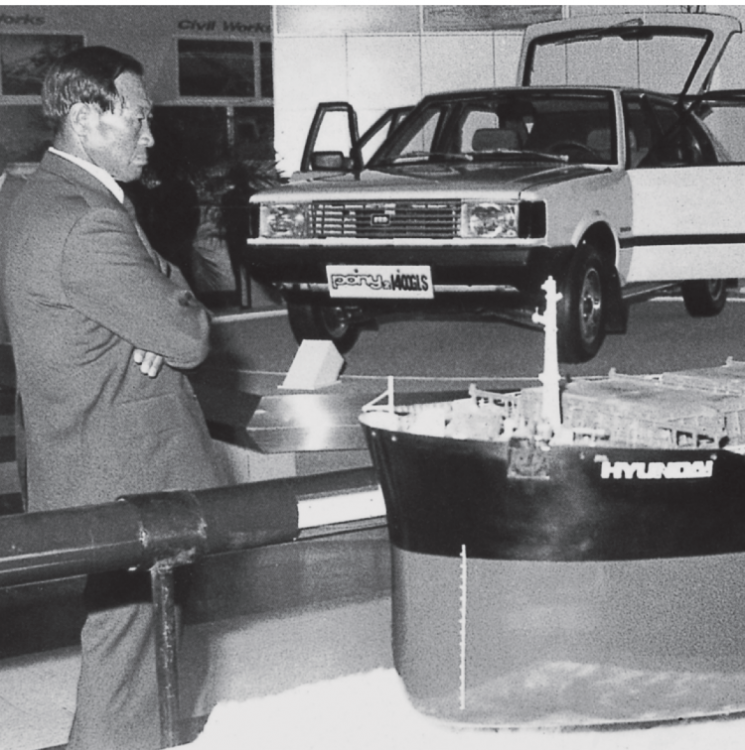
It was an inevitable choice for Hyundai Group, which contributed to laying the nation’s lifelines, to turn its eyes to the automotive industry, the blood of the body. Empowered by Chairman Chung’s drive, Hyundai Group signed a CKD (completely knocked down) assembly production cooperation contract with the American automaker Ford in 1968. The first car assembled in Korea was the small sedan ‘Cortina’ sold in the UK. Hyundai was the only CKD company worldwide that built a factory within six months of Ford’s founding and localized 21% of parts within three months of starting. Even Ford was impressed by Hyundai’s drive.
Having successfully demonstrated assembly production capability, Hyundai aimed to move into independent manufacturing. In the 1970s, the government announced a policy to permit only one company meeting optimal conditions to establish an engine casting plant. Ford, seeking to expand into East Asia, proposed a joint venture with Hyundai beyond just an engine plant. Lengthy negotiations ensued but ultimately failed. Ford regarded Hyundai as a mere parts supplier, but Hyundai’s dream was grander. Hyundai envisioned exporting domestically made cars from the joint venture using Ford’s sales network worldwide. Eventually, Chairman Chung declared, “We will develop an indigenous passenger car model,” severing ties with Ford and choosing an independent path.
Four years later, in 1974, Hyundai began the Pony development project and launched the first indigenous model, the Pony, in 1976. Korea thus became the ninth country to own an indigenous car model. For a model to be called indigenous, it must be designed, produced, and assembled domestically based on technology developed by a domestic company and be exportable under a domestic brand name.
The Pony that Opened the ‘My Car Era’
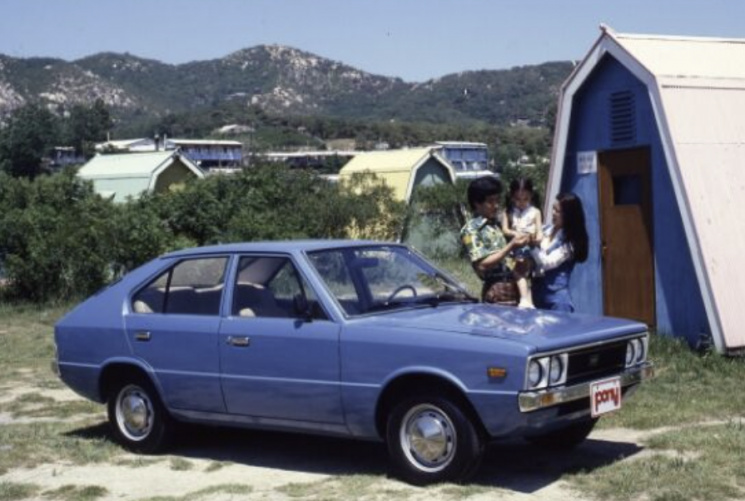
The Hyundai Pony symbolizes Korea’s economic development and industrialization. It was Korea’s first indigenous passenger car model and the first car affordable to the general public. When Hyundai was founded in 1967, Korea’s per capita income was only about $150. By the Pony’s launch in 1976, it had risen to $830, and by the release of Pony 2 in 1982, it reached $1,973, showing remarkable growth. As incomes rose, the middle class expanded, and the ‘My Car Era’ officially began. In the 1980s, owning a private car was the top priority for middle-class families, and the most common taxi on the streets was the Pony. Thanks to this, the Pony frequently appears as a motif in films and dramas set in the 1980s. Koreans who lived through that era can infer the period of a movie just by the appearance of the Pony.
The Pony was developed specifically for Korea’s terrain, which had many unpaved roads. Its durability made it popular as a taxi. It had higher domestic parts usage than competing cars assembled from imported parts, giving it price competitiveness. Above all, it was Korea’s first domestically made and exported car, enabling patriotic marketing. As a result, the Pony sold over 10,000 units in its first year and maintained over 50% market share in the domestic passenger car market for three consecutive years. In December 1978, it set a record as the first single model in Korea to surpass 100,000 units produced.
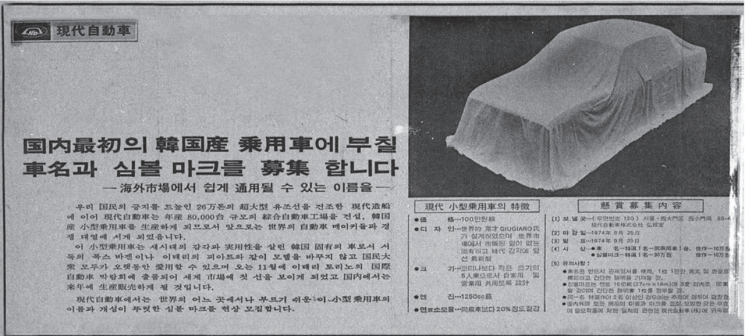 A newspaper article soliciting name suggestions for Hyundai Motor Company's unique passenger car model. Hyundai Motor Company website
‘Pony Excel’ Sets Export Records in the U.S.
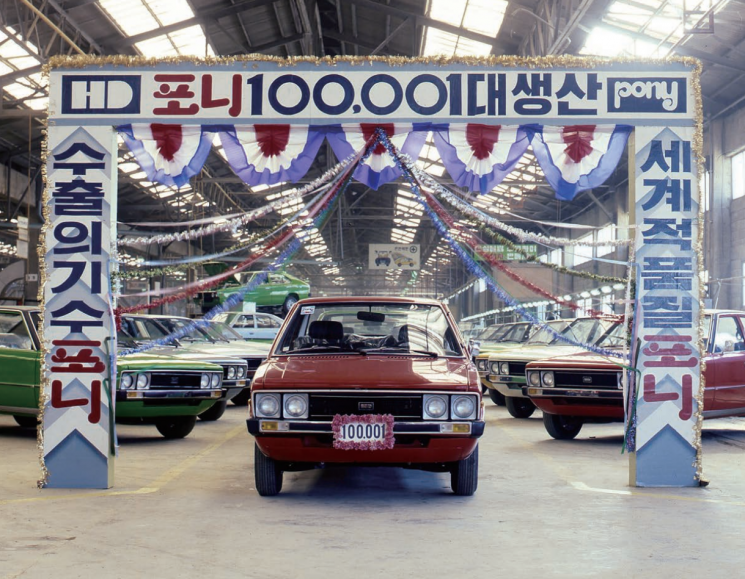
The Pony’s first export was a barter deal. In July 1976, Hyundai signed a contract to export five Ponies to Ecuador in exchange for bananas. When a refrigerated ship carrying Ecuadorian bananas arrived at Busan Port, five Ponies were loaded onto the ship. Bananas were quite rare in Korea at the time. The Ministry of Agriculture and Fisheries was reluctant to grant import permits for bananas but willingly allowed it to open the door for domestic car exports.
What started modestly blossomed in the 1980s in North America. The Pony’s successor, the Pony Excel, ranked first in annual imported compact car sales in the U.S. in 1987. The record of 263,610 units sold remains unbroken. It surpassed competitors like Toyota Corolla, Nissan Sentra, and Honda Civic. The Pony Excel was the result of the ‘X Car Project’ aimed at export markets and a litmus test for the sustainability of Hyundai’s export business. Of course, early success in the U.S. later backfired due to quality issues. However, news that a Korean car had overtaken Japanese cars in the Americas ahead of the Seoul Olympics was a hopeful message for the nation.
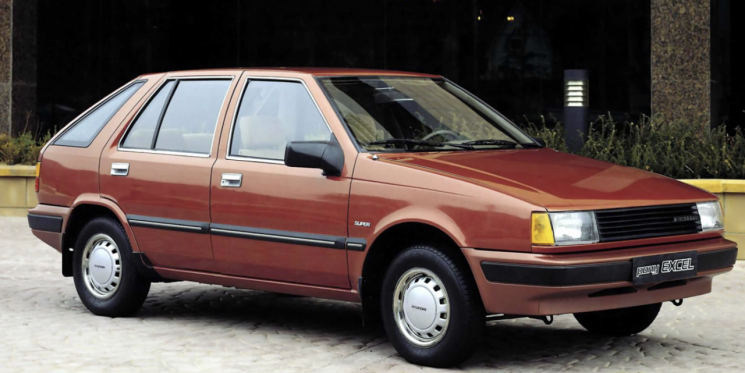
Success in the U.S. was possible because of prior success in Canada. The Pony 2, launched in Canada in 1984, broke the 10% import car market share record in its first year and sold like wildfire. This was during the aftermath of the second oil shock when all global manufacturers struggled. Hyundai was on the brink, even cutting large numbers of employees. The Pony 2 in Canada was a savior, earning foreign currency and enabling profitable management. It was cost-effective and rear-wheel drive, making the engine compartment simpler and maintenance easier.
Other import car dealers lobbied the Canadian government and media to block Hyundai’s duty-free exports. Korea was classified as a developing country, so there were no tariffs on car exports. If tariffs were imposed as they demanded, Pony 2’s biggest weapon, price competitiveness, would disappear. Upon hearing this, Chairman Chung immediately came up with an idea. He ordered the purchase of a 1,000?2,000-pyeong site on the outskirts of Toronto and instructed bulldozers to move back and forth there. He also directed contacts with high-ranking officials including the Canadian Minister of Industry and Commerce and held press conferences to widely announce the intention to build a parts factory in Toronto.
The over 40-year-old story of Hyundai overlaps with today’s story in 2025. Recently, the second Trump administration in the U.S. threatened to impose a 25% tariff on Korean cars. While the stated reason is to revive domestic manufacturing, it is also an unspoken pressure for global companies operating in the U.S. market to increase investment there. Facing the same dilemma as his grandfather did 40 years ago, what solution will Chung Eui-sun, chairman of Hyundai Motor Group in 2025, propose?
© The Asia Business Daily(www.asiae.co.kr). All rights reserved.



















