Forecast of a Sharp Decline in Household Capital Market Assets from 2034
Low Participation of Both Elderly and Younger Generations Fails to Offset Decrease
Role of Finance Must Evolve in Response to Super-Aged Society
Financial Institutions Urged to Support Asset and Income Smoothing Across Life Cycle
Green Finance Should Continue Despite Changes in U.S. Climate Policy
Experts Stress Need for Ongoing Development of Climate Finance in Korea
Call for Active Digital Innovation in the Financial Sector
Regulatory Flexibility and AI Talent Development Highlighted as Key Challenges
Adapting to Demographic Changes is Crucial for the Future of the Financial Industry
Proactive Responses Needed to Overcome Crises and Seize New Opportunities
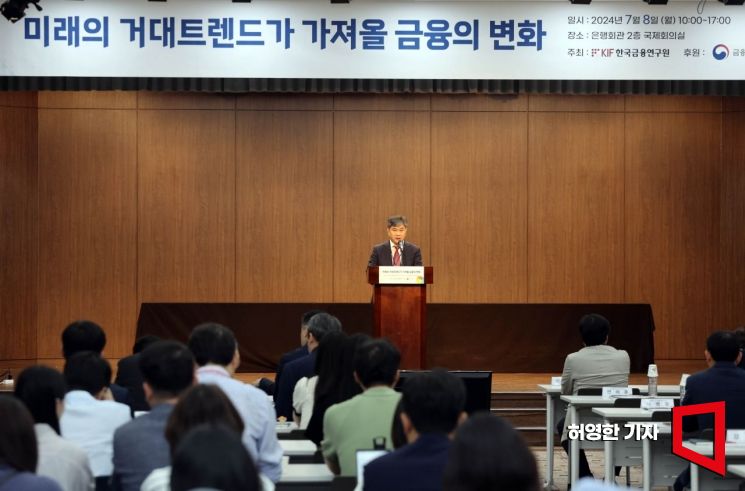 The seminar "Financial Changes Brought by Future Mega Trends," hosted by the Korea Institute of Finance and sponsored by the Financial Services Commission, was held on the 8th at the Bankers' Hall in Myeongdong, Seoul. Lee Hang-yong, President of the Korea Institute of Finance, is delivering the opening remarks. Photo by Heo Young-han younghan@
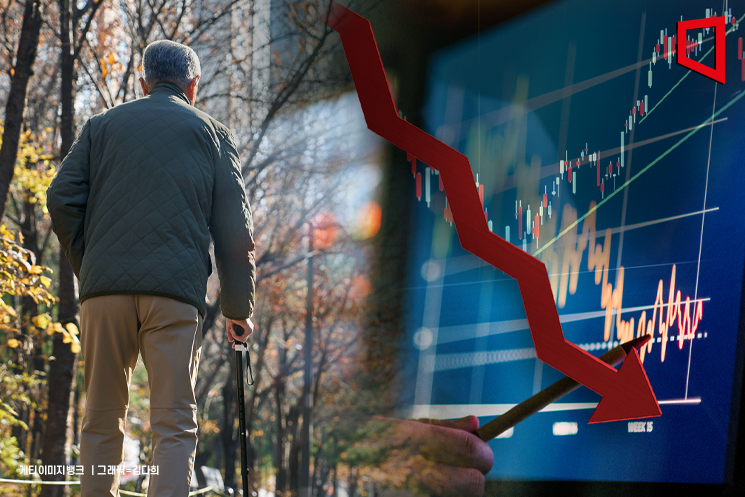
A forecast has emerged that from 2034, ten years from now, the scale of household capital market assets such as stocks and funds will sharply decline. It was analyzed that the low participation rate of the elderly aged 65 and over in the capital market, along with the declining participation rate of the younger generation, will not offset the decrease.
Jeong Hee-cheol, a research fellow at the Macroeconomic and Financial Research Division of the Korea Capital Market Institute, revealed this during a keynote presentation at the ‘Future Changes and Growth Strategies in Finance’ seminar held on the afternoon of the 27th at the Bankers’ Hall in Jung-gu, Seoul.
Researcher Jeong said, "Analyzing changes in age and generational structure to forecast future household asset sizes, it was found that unlike the total assets which increase, the scale of capital market holdings will sharply decline in ten years." He added, "Not only is the elderly participation rate in the capital market low, but the generation born after 1990 also shows a reduced participation rate compared to previous generations," and "This indirectly suggests that the recent generations may follow the elderly’s asset holding pattern centered on real estate and savings deposits."
There was also a point made that the role of finance must change to respond to the super-aged society. Jo Eun-ah, head of the Financial Stability Research Team at the Bank of Korea, said, "In a situation where population decline exerts downward pressure on housing prices, the proportion of elderly borrowers is increasing, which could negatively affect the soundness of financial institutions. While financial institutions have mainly helped expand household assets through leverage in the past, going forward, their role should be strengthened to help smooth assets and income over the life cycle, such as through the pensionization of real assets."
Regarding green finance amid future changes, opinions were expressed that green finance must continue even if climate change policies retreat after the administration of U.S. President Donald Trump.
Hyun Seok, a professor at Yonsei University Graduate School of Environmental Finance, said in his presentation on ‘Strategies to Revitalize Green Finance,’ "Even if the Trump administration is passive in responding to climate change, the direction we must take is clear. Temperatures are rising, and climate change negatively impacts the macroeconomy, so the role of finance to mitigate these effects is inevitably emphasized." Yoo In-sik, head of ESG Management at Industrial Bank of Korea, also stated, "It is true that the momentum for climate finance has weakened due to external environmental changes such as Trump’s administration, but since Korea is already lagging behind countries like the U.S., it is important to continue developing climate finance."
As digital transformation accelerates in the financial sector, there was also a suggestion that Korean financial companies should not attempt only limited innovation but pursue active innovation.
Park Young-ho, a partner at BCG, pointed out, "Although the Korean financial sector quickly adopted artificial intelligence (AI) and cloud technologies, the digital transformation has been superficial, merely making noise without substantial change," and added, "There are still many regulations, which inevitably reduce the global competitiveness of Korean finance." He emphasized, "Flexible regulations are needed, and regulations at the level of fast followers should be introduced." Lee Yong-jae, associate professor of Industrial Engineering at UNIST, said there is a severe shortage of AI talent in the financial sector, and "It is not enough to simply hire many people and develop; rather, there must be many people who have already been secured and can quickly apply AI to services," arguing that the research and development (R&D) environment must be improved.
Lee Hang-yong, president of the Korea Institute of Finance, emphasized, "Changes in population structure due to low birth rates and aging have posed various challenges to the financial industry," and "Active responses to the accompanying changes in financial demand will provide a foundation for the financial industry to overcome crises and discover new opportunities."
© The Asia Business Daily(www.asiae.co.kr). All rights reserved.
![Clutching a Stolen Dior Bag, Saying "I Hate Being Poor but Real"... The Grotesque Con of a "Human Knockoff" [Slate]](https://cwcontent.asiae.co.kr/asiaresize/183/2026021902243444107_1771435474.jpg)
















