Landing Attempt Scheduled for March 6 After 8-Day Flight
Intuitive Machines Makes Second Attempt After Last Year's 'Partial Success'
For the first time, NASA and the American space company Intuitive Machines have launched a lunar probe with the goal of finding ice in the Moon's south pole crater.
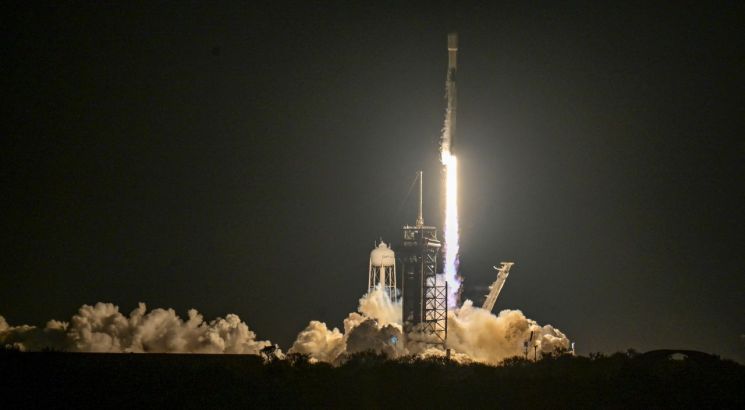 On the 26th (local time), the private lunar probe 'Athena' was launched aboard a rocket. Photo by Yonhap News
Intuitive Machines' unmanned lunar probe "Athena" (Nova-C), equipped with NASA's scientific instruments, was launched on the 26th at 7:17 PM (Eastern Time) from Kennedy Space Center in Florida aboard SpaceX's Falcon 9 rocket.
Subsequently, the first and second stages of the Falcon 9 rocket carrying the Athena spacecraft successfully separated, and the first stage booster descended and landed on a drone ship at sea about 8 minutes after launch. About 44 minutes after launch, Athena separated from the rocket's second stage as planned and began its flight toward the Moon.
Athena is expected to attempt landing in the highland area called "Mons Mouton" near the Moon's south pole crater around March 6, after approximately 8 days of flight. According to NASA, this landing target is the closest to the south pole in the history of lunar exploration missions.
The spacecraft carries the "Polar Resources Ice Mining Experiment" (PRIME-1) equipment, which combines a drill and a mass spectrometer. This equipment is designed to drill into the lunar surface up to 1 meter deep after landing, collect soil samples, analyze their composition, and transmit the data. The goal is to identify the potential presence of water, gases, and other mineral resources at the Moon's south pole.
Another device onboard the spacecraft, the exploration drone-robot "Micro-Nova Hopper" (nickname Grace), plans to enter the crater at the Moon's south pole to investigate whether there is water ice in the shadowed areas. NASA's small spacecraft "Luna Trailblazer," launched on the same rocket, will orbit the Moon and capture images of the lunar surface to explore the presence of water.
Intuitive Machines partially succeeded in landing the spacecraft "Odysseus" (Nova-C) near the Moon's south pole in February last year. This is the fourth lunar probe launch jointly conducted by NASA and private companies.
© The Asia Business Daily(www.asiae.co.kr). All rights reserved.

















