Applicable to bio-implantable sensors and long-term structural safety monitoring systems
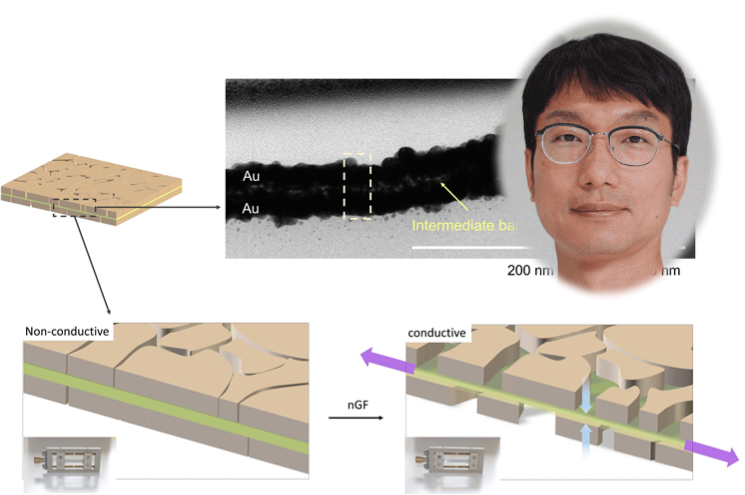
Korea Polytechnic University announced on the 27th that a research team led by Professor Chae Susang from the Department of Energy and New Materials Engineering, in collaboration with research institutes in Germany and the United States, has developed a strain sensor that reduces standby power by approximately one million times.
This research was published online on the 25th in the world-renowned nanotechnology journal 'Nano Letters'.
Strain sensors are devices that detect mechanical deformations such as pressure, stretching, or bending, and are used in various fields including building safety inspections, artificial joint monitoring, and robotics technology.
According to the paper, the research team created a new material by inserting a layer called a 'soft nano barrier', composed of polydimethylsiloxane (PDMS), between metallic nanofilms.
The new material demonstrated approximately 130% improved elasticity compared to conventional sensors, and the standby power level was reduced to about 0.00001mW, which is one million times lower than the previous 12.5mW.
Professor Chae Susang said, "Since almost no standby power is needed, it can be applied to bio-implantable sensors or long-term structural safety monitoring systems where power supply is difficult," and added, "With further research, it is expected to be utilized in various fields."
Meanwhile, the research team is in the process of signing a technology transfer agreement with Mimetic Co., Ltd. for commercialization.
© The Asia Business Daily(www.asiae.co.kr). All rights reserved.

















