Faster Than the Government's 2039 Projection
Expected to Fall Below 700,000 Excluding Foreigners
Nikkei Analyzes Link to Declining Marriages
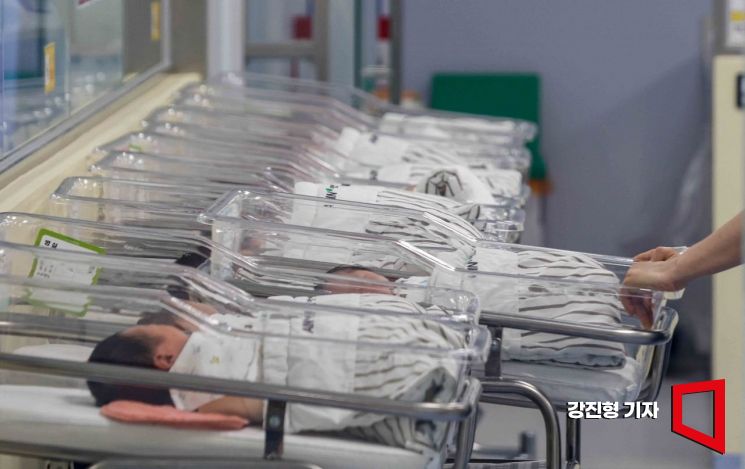
Japan's number of newborns last year fell to around 720,000, continuing a decline for the ninth consecutive year and setting a new record low. The Nihon Keizai Shimbun (Nikkei) reported that the decline in birth rates is progressing faster than the government initially expected, and pointed out that the recent decrease in marriages is related to the drop in fertility rates.
According to population statistics released by Japan's Ministry of Health, Labour and Welfare on the same day, the number of newborns last year, including foreigners, was 720,988, a 5.0% decrease from the previous year. This marks the lowest number for nine consecutive years and the lowest since records began in 1899. Compared to 1,003,000 in 2014, ten years ago, the number has decreased by 282,000 (about 30%) over the decade. If only Japanese newborns excluding foreigners are counted, the number may fall below 700,000.
Nikkei noted that the decline in birth rates is occurring faster than the government's initial expectations. According to future population projections released by Japan's National Institute of Population and Social Security Research in April 2011, the number of births including foreigners was expected to drop to the 720,000 range by 2039. In reality, this decline is happening 15 years earlier than the government predicted.
There is also analysis suggesting that the decreasing trend in marriages within Japan is linked to the decline in fertility rates. The number of marriages in 2024 rebounded to 499,999, a 2.2% increase from the previous year, marking a recovery after two years. However, since the number has remained below 500,000 for two consecutive years, and given that out-of-wedlock births are rare in Japan, Nikkei pointed out that the decrease in marriages is likely to have a significant impact on future fertility rates.
On the other hand, South Korea, which is in a similar situation to Japan, saw an increase in newborns last year. According to Statistics Korea, the number of births last year was 238,300, an increase of 8,300 (3.6%) compared to the previous year. This is the first time in nine years since 2015 that the annual decline in births has stopped. Park Hyun-jung, director of the Population Trends Division at Statistics Korea, cited three factors for the rebound in fertility rates: population structure, changing values regarding marriage, and an increase in the number of marriages.
Attention is also focused on the total fertility rate (the average number of children a woman is expected to have in her lifetime), which will be announced in the future. The total fertility rate is often cited in comparisons of fertility rates between countries. The total fertility rate for Japanese nationals excluding foreigners is announced every June. In 2023, South Korea's rate was 0.72, lower than Japan's 1.20. South Korea's total fertility rate increased by 0.03 to 0.75 last year, alongside the rise in newborns.
© The Asia Business Daily(www.asiae.co.kr). All rights reserved.

















